


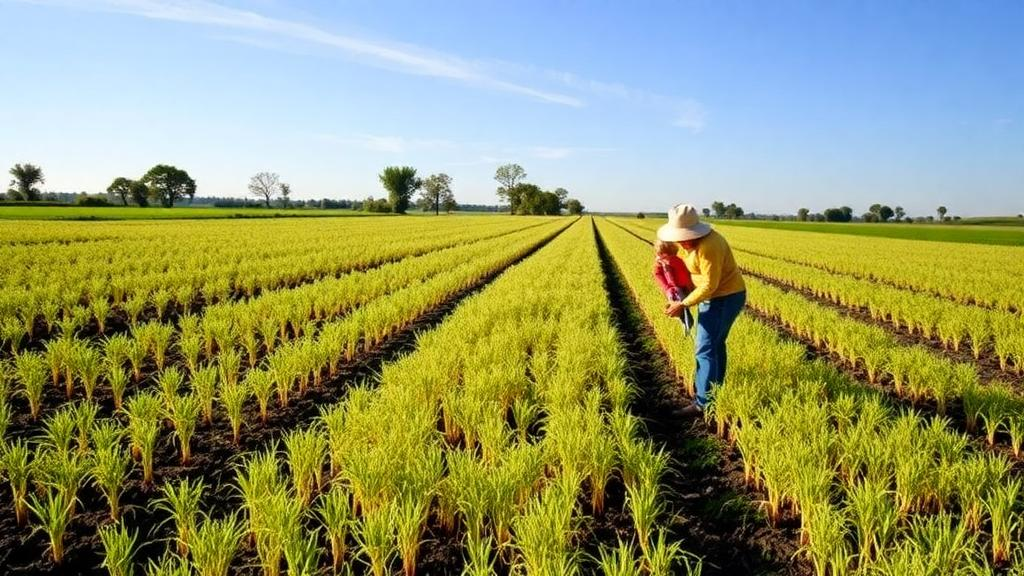
Public agricultural research funding has long followed a familiar script: finance the idea, equip the laboratory, reward the publication, and hope that somewhere downstream a farmer eventually benefits. A new Perspective published in Discover Sustainability argues that this script leaves out the riskiest link in the chain of innovation — the very first real-world user of a new technology. Ibrokhim Y. Abdurakhmonov, of the Ministry of Agriculture of the Republic of Uzbekistan and the Centre of Genomics and Bioinformatics at the Academy of Sciences of Uzbekistan, proposes a funding instrument he calls the proof-of-use grant, designed to make the first user an eligible, accountable and financed component of publicly funded agricultural research from project inception.
The core idea is deceptively simple. Between the proof-of-concept stage, where a technology is shown to work under controlled conditions, and full commercialisation, where it must survive in the market, there lies a translational gap. Technologies that perform brilliantly in laboratories and research stations routinely fail when they encounter the messy realities of working farms: variable soils, unpredictable weather, labour constraints, cash-flow cycles and the accumulated practical knowledge of the people who must operate them. Proof-of-use grants are proposed as a dedicated funding layer to bridge that gap, financing a named first-user platform that tests whether an innovation actually works for the people it is intended to serve.
What distinguishes the proposal from existing participatory approaches, the author argues, is not the involvement of farmers themselves — participatory research, farmer field schools, living labs and on-farm trials have engaged users for decades. The contribution is an integrated grant architecture in which the user platform becomes an eligible and accountable budget line from the very beginning of a project. Laboratory work, station trials and farmer-managed experiments can proceed in parallel rather than sequentially, so that the perspectives of intended users shape the technology while it is still being built, not merely after it has been fixed in its final form.
Technically, the proposed architecture specifies several components that must be written into the grant itself. These include a named first-user platform, explicit coverage of first-use risk, investment in local capability so that users can operate and maintain the innovation, mechanisms for retaining benefits within the community that hosts the trial, measurement of sustainability performance, and a predefined exit pathway describing what happens when public support ends. Each component makes a different failure mode addressable: without first-use risk coverage, users bear the costs of experimentation; without local capability, innovations collapse when researchers leave; without benefit retention, value drains away from the communities that generated it.
Evidence requirements form another pillar of the design. The author proposes that projects collect baseline data, establish comparators, track costs, analyse distributional effects and gather post-grant evidence to test technical, economic, environmental and social performance. This is a demanding evidentiary standard — far beyond the demonstration plots and subsidised field days that characterise much agricultural extension work. The point is not merely to show that a technology can work, but to generate credible evidence that it works for intended users under real conditions and can persist once the grant ends. In this respect, proof-of-use funding is positioned as a complement to controlled research and conventional commercialisation, not a replacement for either.
The author draws on a synthesis of literature spanning innovation systems theory, participatory research, learning networks, living labs and agricultural innovation funds, and uses an agricultural programme in Uzbekistan as a preliminary administrative illustration of how such grants might be organised in practice. He is careful to frame this as programme design rather than impact evaluation: the article does not establish causal effects, and the Uzbekistan case serves to show what the administrative architecture looks like on the ground, not to prove that it delivers results. The article was published as a Perspective, an open-access contribution accepted on 12 October 2026 and published on 17 October 2026, carrying the DOI 10.1007/s43621-026-05043-2.
If the architecture works as intended, the author argues, the benefits could ripple across several Sustainable Development Goals: SDG 2 on food security, SDG 6 on water and sanitation, SDG 8 on decent work and economic growth, SDG 9 on industry, innovation and infrastructure, and SDG 12 on responsible consumption and production. The logic is that linking first users to publicly funded innovation ties together food security, resource efficiency, rural livelihoods, innovation capacity and responsible production in a single funding instrument. Agricultural innovation that is tested by its first users is more likely to be adopted, more likely to be maintained, and more likely to deliver the resource-efficiency gains that sustainable agriculture demands.
But the author is equally explicit about the conditions and risks. Poor targeting could direct funds to the wrong users or the wrong technologies. Grant dependency could leave innovations unable to survive without public subsidy. Moral hazard could encourage recipients to overstate performance. Elite capture could concentrate benefits among well-connected farmers or institutions while marginal users are excluded. Crowding out could discourage private suppliers from entering the market, leaving the innovation dependent on a single public funder. These failure modes are not hypothetical; they are documented risks in agricultural subsidy and innovation programmes worldwide, and the author treats them as central design constraints rather than afterthoughts.
To mitigate these risks, the proposal specifies safeguards: time-bound or graduated support so that subsidies taper rather than persist indefinitely, transparent selection processes for grants and first users, independent verification of performance claims, and predefined post-grant pathways that describe how the innovation will be sustained after public funding ends. The author also acknowledges that the article received no specific funding for the Perspective itself, while noting European Union budget support for research grants to scientific institutions in Uzbekistan’s agricultural sector and thanking colleagues and partners in Uzbekistan’s agricultural research and innovation system for discussions on research commercialisation and rural innovation.
The broader significance of the proposal lies in its reframing of what public agricultural research funds are for. Traditional grant instruments finance ideas, laboratories and scientific outputs but do not always include first-user risk in the grant — meaning the costs and uncertainties of the first real deployment fall outside the funded project, often onto farmers or extension services least able to bear them. By making the first user an accountable component of the grant from inception, proof-of-use funding shifts that risk into the public innovation system where it can be managed, measured and learned from. Whether the architecture can deliver at scale remains an open question — the author himself stresses that the proposal illustrates programme design only — but the argument offers a concrete, technically specified template for funders seeking to close the persistent gap between agricultural research and the farmers it is meant to serve.
Subject of Research: Proof- of-use grants embed first users in sustainable agricultural innovation
Article Title: Proof- of-use grants embed first users in sustainable agricultural innovation
Article References: Abdurakhmonov, I. Y. (2026). Proof- of-use grants embed first users in sustainable agricultural innovation. Discover Sustainability. https://doi.org/10.1007/s43621-026-05043-2
Image Credits: AI Generated
DOI: 10.1007/s43621-026-05043-2
Keywords: Proof-, of-use, grants, embed, first, users, sustainable, agricultural, innovation, scientific research
Cite Scienmag News
Alan Morgan. (October 17, 2026). Proof-of-use grants put first users at the heart of sustainable farming innovation. Scienmag. https://scienmag.com/proof-of-use-grants-put-first-users-at-the-heart-of-sustainable-farming-innovation/
Alan Morgan. "Proof-of-use grants put first users at the heart of sustainable farming innovation." Scienmag, 17 October 2026, https://scienmag.com/proof-of-use-grants-put-first-users-at-the-heart-of-sustainable-farming-innovation/. Accessed 17 October 2026.
Alan Morgan. "Proof-of-use grants put first users at the heart of sustainable farming innovation." Scienmag. October 17, 2026. https://scienmag.com/proof-of-use-grants-put-first-users-at-the-heart-of-sustainable-farming-innovation/


