


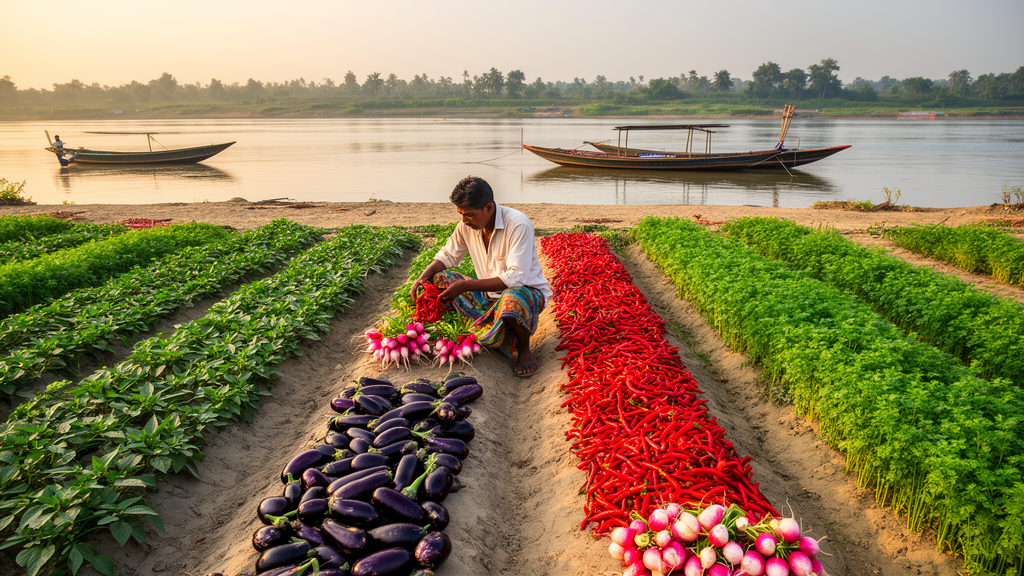
On the shifting sandbars of Bangladesh’s mightiest rivers, farmers have long gambled their livelihoods on a simple question: how much of each seed should go into the ground? A two-year field experiment conducted on a char — a riverine island formed by sediment deposition — in Chinirpotol, Saghata, Gaibandha (25°09’N, 89°57’E, 18 m above sea level) has now delivered a precise answer. Researchers evaluated five seeding combinations of chili with brinjal, radish and coriander in a mixed cropping system and found that sowing 100% chili seed together with 30% brinjal, 40% radish and 30% coriander produced the highest chili equivalent yield of 29.9 tonnes per hectare, a gross return of roughly 10,582 USD per hectare, and a gross margin of 9,233 USD per hectare. The study, published in Innovations in Agriculture, was carried out during the rabi seasons of 2019–20 and 2020–21 under the Active Brahmaputra-Jamuna Floodplain agro-ecological zone.
The char ecosystem is one of the most challenging agricultural environments in the subtropics. These islands are home to marginalized communities with limited rights to land and livelihood resources, and their fields are exposed to floods, erosion, droughts, hailstorms and cold waves. Mixed cropping — the simultaneous cultivation of two or more crops on the same piece of land — is one of the principal adaptation measures char dwellers use to cope with these hazards. A dense plant stand covers more foliage and root area, increasing capture of radiation, water and nutrients, suppressing weeds and insect pests, and buffering the crop against climate extremes. Yet when farmers sow their mixed stands of chili, brinjal, radish and coriander, they rely on personal assumptions about seed-to-soil ratios, and each farmer uses a different one. The result is highly variable returns from similar land.
To replace guesswork with evidence, the team designed a randomized complete block experiment with three replications and unit plots of 6 m × 6 m. Chili (Capsicum frutescens L., variety BARI Morich-3) served as the main crop because it is a significant source of revenue for char dwellers. Brinjal (Solanum melongena L., BARI Hybrid Begun-4), radish (Raphanus sativus L., BARI Mula-1) and coriander leaf (Coriandrum sativum L., BARI Dhania-1) were used as subsidiary crops. Four seeding combinations were evaluated alongside sole chili: 100% chili + 70% brinjal + 20% radish + 10% coriander; 100% chili + 50% brinjal + 30% radish + 20% coriander; 100% chili + 30% brinjal + 40% radish + 30% coriander; and 100% chili + 80% brinjal + 70% radish + 50% coriander. The percentages were anchored to the conventional seeding rates used by char farmers — 7 kg ha⁻¹ chili, 1 kg ha⁻¹ brinjal, 2 kg ha⁻¹ radish and 4 kg ha⁻¹ coriander — so, for example, the 100% chili + 30% brinjal + 40% radish + 30% coriander treatment meant 7 kg chili, 300 g brinjal, 800 g radish and 1.2 kg coriander seed sown together.
All seeds were mixed and sown on November 15–20 of each year, and every treatment received the same fertilizer dose of N-P-K-S-Zn-B at 142-58-61-18-3-2 kg ha⁻¹. A full dose of P, S, Zn and one quarter of the K was applied during final land preparation, while the remaining K and the full N were split into three equal applications at 25, 50 and 75 days after sowing. Weeding and thinning followed two to three weeks after seeding, and the crop was irrigated five to six times per year. Pests were managed with targeted insecticides: brinjal shoot and fruit borer was controlled with Spinosad at 0.4 ml L⁻¹ of water, and chili thrips with Imidacloprid at 0.5 ml L⁻¹. The staggered harvest schedule is central to the system’s logic — radish was first harvested as a leafy vegetable one month after sowing in mid-December, coriander leaf followed within two months in mid-January, chili picking began on 1 March and continued through 31 March, and brinjal, which gained space as chili plants thinned, fruited from 15 March and remained in the field two months longer, up to 31 May.
The yield data revealed a clear pattern. Sole chili produced the highest chili yield itself — 11.5 t ha⁻¹ in 2019–20 and 11.9 t ha⁻¹ in 2020–21 — but the lowest total system output. The winning combination of 100% chili + 30% brinjal + 40% radish + 30% coriander delivered 10.0 and 10.5 t ha⁻¹ of chili, 16.5 and 16.8 t ha⁻¹ of brinjal, 10.0 and 10.3 t ha⁻¹ of radish, and 2.47 and 2.50 t ha⁻¹ of coriander in the two consecutive years. The densest mixture, 100% chili + 80% brinjal + 70% radish + 50% coriander, performed well but fell short of the optimum, while the sparsest, 100% chili + 70% brinjal + 20% radish + 10% coriander, yielded the least among the mixtures. All differences were statistically significant at the 5% level, with means separated by least significant difference.
To compare mixtures on a common scale, the researchers converted the yield of each subsidiary crop into chili equivalent yield (CEY) using the formula CEY(crop x) = Yx(Px/Pc), where Yx is the yield of crop x, Px its farmgate price and Pc the price of chili. Prices used were 354 USD t⁻¹ for chili, 236 USD t⁻¹ for brinjal, 118 USD t⁻¹ for radish and 708 USD t⁻¹ for coriander leaf, converted from Bangladeshi Taka at an average exchange rate of 1 USD = 84.77 BDT from 2019 to 2021. The optimum combination averaged 29.9 t ha⁻¹ CEY (29.7 in 2019–20 and 30.1 in 2020–21), a 253–254% increase over sole chili, which averaged just 11.8 t ha⁻¹. The other mixtures ranged from 21.7 to 26.5 t ha⁻¹ CEY, corresponding to yield increases of 182–226% over the sole crop.
The economics were equally striking. Gross return was computed from harvested product and farmgate prices, while gross margin subtracted the total variable cost — tillage, seed, sowing, labor, fertilizers, pesticides, irrigation and harvesting — from gross return. The optimum mixture returned 10,582 USD ha⁻¹ gross return against a total variable cost of only 1,348 USD ha⁻¹, leaving a gross margin of 9,233 USD ha⁻¹. Sole chili returned 4,167 USD ha⁻¹ against 1,322 USD ha⁻¹ of costs, a margin of just 2,845 USD ha⁻¹. The marginal benefit cost ratio (MBCR), calculated as the change in gross return divided by the change in total variable cost relative to the sole crop, peaked at 241.7 for the optimum combination — meaning every additional dollar spent on the mixed system generated more than 240 dollars of additional return. Profitability in the mixed systems exceeded sole chili by 126–225%.
The agronomic explanation lies in complementary resource use. Different crops exploit different soil layers: radish has a shallow root system and absorbs nutrients from the upper soil level, while chili, brinjal and coriander have deeper roots that draw from lower layers and break up compacted soil, increasing water infiltration. Distinct rooting depths, leaf orientations and peak nutrient and water demands reduce competition between component crops, while a denser canopy suppresses weeds and the diversity of species limits the spread of pests and diseases, since pathogens and insects rarely affect all crops equally. Mixed cropping also spreads labor and cash returns across the season, provides food in manageable installments, and reduces the risk of complete crop failure, because even if one crop succumbs to weather, the others in the field may still yield.
For the char dwellers of Bangladesh, the practical message is unambiguous. Sowing 100% chili seed with 30% brinjal, 40% radish and 30% coriander seed maximizes both land use efficiency and household income in the subtropical char ecosystem, more than doubling system yield and more than tripling gross margin compared with growing chili alone. The researchers caution that the subsidiary crops must not hinder the main crop’s growth or mature at the wrong time relative to it — the staggered harvest sequence of radish, coriander, chili and brinjal is what allows the field to remain productive from December through May. After two consecutive years of trials, the combination of 100% chili + 30% brinjal + 40% radish + 30% coriander stands as the most productive and profitable seeding ratio for mixed cropping in this vulnerable riverine landscape.
Subject of Research: Revealing seeding combinations of chili with brinjal, radish and coriander in a mixed cropping system to increase the productivity and profitability in Char ecosystem of subtropical climate
Article Title: Revealing seeding combinations of chili with brinjal, radish and coriander in a mixed cropping system to increase the productivity and profitability in Char ecosystem of subtropical climate
Article References: Alam, M. J., Al-Mahmud, A., & Rana, M. S. (2024). Revealing seeding combinations of chili with brinjal, radish and coriander in a mixed cropping system to increase the productivity and profitability in Char ecosystem of subtropical climate. Innovations in Agriculture, 7, 1-6. https://doi.org/10.3897/ia.2024.124180
Image Credits: AI Generated
Keywords: Revealing, seeding, combinations, chili, brinjal, radish, coriander, mixed, cropping, system, increase, productivity
Cite Scienmag News
Alan Morgan. (October 17, 2026). Optimal chili-brinjal-radish-coriander mix boosts yields and profits on Bangladeshi river islands. Scienmag. https://scienmag.com/optimal-chili-brinjal-radish-coriander-mix-boosts-yields-and-profits-on-bangladeshi-river-islands/
Alan Morgan. "Optimal chili-brinjal-radish-coriander mix boosts yields and profits on Bangladeshi river islands." Scienmag, 17 October 2026, https://scienmag.com/optimal-chili-brinjal-radish-coriander-mix-boosts-yields-and-profits-on-bangladeshi-river-islands/. Accessed 17 October 2026.
Alan Morgan. "Optimal chili-brinjal-radish-coriander mix boosts yields and profits on Bangladeshi river islands." Scienmag. October 17, 2026. https://scienmag.com/optimal-chili-brinjal-radish-coriander-mix-boosts-yields-and-profits-on-bangladeshi-river-islands/


