


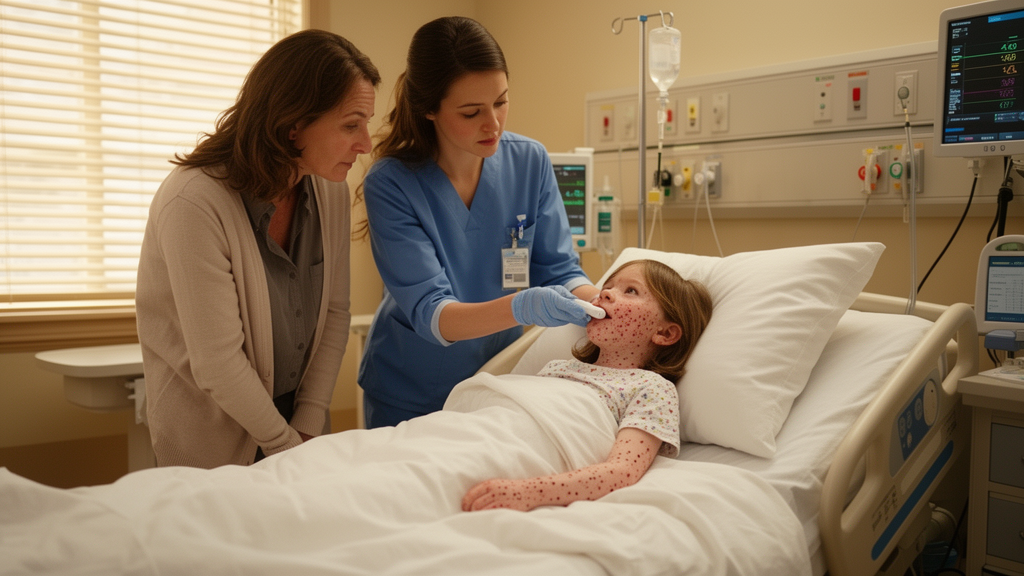
Chickenpox is often dismissed as a routine childhood illness, but a new study from Iran shows that when children land in the hospital with varicella, more than half develop serious complications. The research, published in BMC Infectious Diseases, followed 133 children admitted to a referral hospital in Karaj between June 2022 and June 2025. Clinicians documented at least one complication in 55.6 percent of these young patients, a figure that underscores how a virus widely regarded as mild can turn dangerous once it reaches a hospital ward.
The study was conducted at Imam Ali Hospital, a referral center affiliated with Alborz University of Medical Sciences. Researchers retrospectively reviewed medical records of children aged one month to 18 years who were admitted with clinically diagnosed varicella over a three-year period. They extracted demographic characteristics, underlying conditions, corticosteroid exposure, previous hospitalization history, complication categories, intensive care unit admission, mortality, and length of stay. Statistical analysis combined chi-square and Fisher’s exact tests with the Mann–Whitney U test and binary logistic regression, reporting odds ratios with 95 percent confidence intervals.
Cutaneous complications emerged as the most frequent category, affecting 27.1 percent of hospitalized children. These included secondary bacterial skin infections and other dermatological problems that arise when the characteristic vesicular rash is scratched or becomes inflamed. Gastrointestinal or hepatic complications followed at 21.1 percent, a surprisingly high figure that points to liver involvement in a substantial share of severe cases. Neurological complications, which can include encephalitis and cerebellar ataxia, occurred in 9.8 percent of patients, while hematological or vascular complications were documented in 8.3 percent.
The severity of disease in this population was striking. Intensive care was required for 12.0 percent of admitted children, and in-hospital mortality reached 2.3 percent. Median hospital stay doubled among children with complications compared with those without, extending from three days to six days, a difference that was highly statistically significant. Children with complications also showed higher adjusted odds of intensive care admission, although this association did not reach statistical significance in the regression model.
Perhaps the most sobering finding was what the researchers could not identify. No baseline factor, whether demographic characteristic, underlying condition, corticosteroid exposure, or previous hospitalization, showed a consistent independent association with overall complications. This means clinicians cannot reliably predict which hospitalized child will deteriorate based on information available at admission. The absence of clear risk factors complicates triage decisions and suggests that all hospitalized varicella patients warrant close monitoring regardless of their apparent profile.
Varicella-zoster virus is a highly contagious herpesvirus that establishes latency in sensory ganglia after primary infection. In immunocompetent children, primary infection is usually self-limiting, resolving within a week or two with nothing more than supportive care. However, the virus can disseminate beyond the skin, invading the central nervous system, the liver, the lungs, and the hematological system. Secondary bacterial infections, particularly with Streptococcus pyogenes and Staphylococcus aureus, represent another major threat, as the broken skin barrier provides an entry point for pathogens.
The neurological complications of varicella deserve particular attention. Cerebellar ataxia is the most common, typically appearing in the first week after rash onset and usually resolving without sequelae. Encephalitis, though rarer, carries greater risk of lasting neurological damage. Reye syndrome, once a feared complication of varicella in children given aspirin, has become less frequent but remains a concern. The 9.8 percent rate of neurological complications in this hospitalized cohort reflects the fact that children who develop such symptoms are more likely to be admitted in the first place.
Hepatic involvement in varicella is often subclinical, but the 21.1 percent rate of gastrointestinal or hepatic complications in this study suggests that clinicians at this center were actively identifying and documenting these problems. Elevated transaminases, abdominal pain, and vomiting can all signal visceral spread of the virus. In severe cases, varicella hepatitis can progress to fulminant liver failure, particularly in immunocompromised patients. The high rate documented here may partly reflect diagnostic vigilance and the referral nature of the hospital.
The study’s limitations are important to acknowledge. It was conducted at a single center, and the hospitalized population at a referral hospital is not representative of all children with varicella in the community. Children admitted to such a facility are likely to have more severe disease by selection. The retrospective design also means that the researchers relied on documentation that may have varied across clinicians and years. Larger multicenter studies are needed to confirm these findings and to identify risk factors that could guide clinical decision-making.
Despite these constraints, the study carries significant public health implications. Iran has not yet introduced universal varicella vaccination into its national immunization program, leaving children vulnerable to primary infection and its potential complications. The findings add weight to arguments for vaccination, which has dramatically reduced varicella hospitalizations in countries that have adopted it. As the researchers note, the frequent complications and doubled hospital stay among affected children highlight the clinical and economic burden that varicella imposes on health systems where the virus still circulates freely.
Subject of Research: Complications and associated factors among children hospitalized with varicella in Iran: a retrospective cohort study
Article Title: Complications and associated factors among children hospitalized with varicella in Iran: a retrospective cohort study
Article References: Shahbabaie Ashtiani, M. A., Seyedahmadi, F. S., Bakhtiari, M., & Hajialigol, A. (2026). Complications and associated factors among children hospitalized with varicella in Iran: a retrospective cohort study. BMC Infectious Diseases. https://doi.org/10.1186/s12879-026-14474-1
Image Credits: AI Generated
DOI: 10.1186/s12879-026-14474-1
Keywords: Complications, associated, factors, children, hospitalized, varicella, Iran, retrospective, cohort, scientific research
Cite Scienmag News
Kristina Jarvis. (October 17, 2026). Chickenpox complications strike over half of hospitalized Iranian children. Scienmag. https://scienmag.com/chickenpox-complications-strike-over-half-of-hospitalized-iranian-children/
Kristina Jarvis. "Chickenpox complications strike over half of hospitalized Iranian children." Scienmag, 17 October 2026, https://scienmag.com/chickenpox-complications-strike-over-half-of-hospitalized-iranian-children/. Accessed 17 October 2026.
Kristina Jarvis. "Chickenpox complications strike over half of hospitalized Iranian children." Scienmag. October 17, 2026. https://scienmag.com/chickenpox-complications-strike-over-half-of-hospitalized-iranian-children/


