


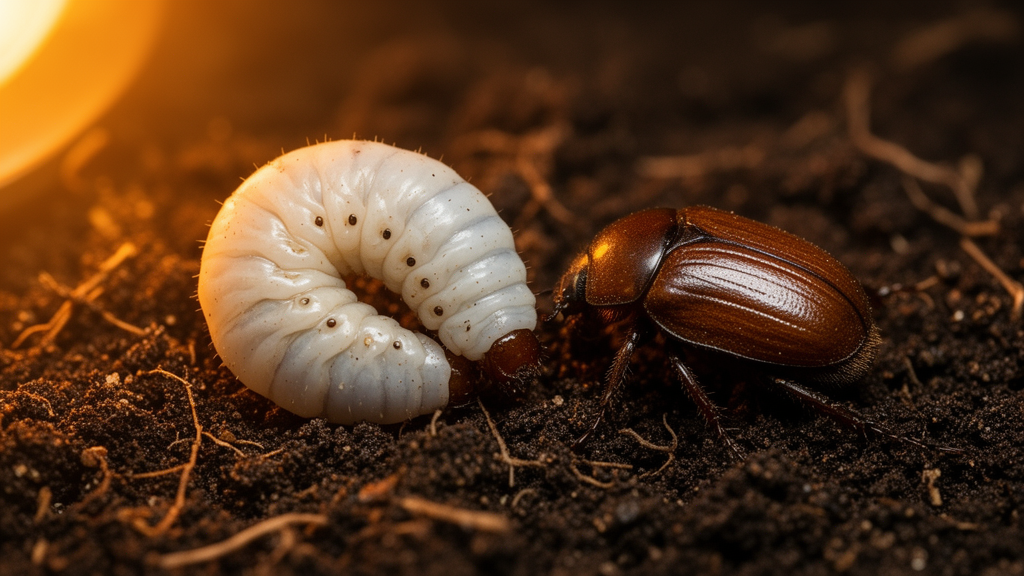
Deep beneath the limestone hills of southeastern Spain, a tiny blind beetle is quietly rewriting what scientists thought they knew about climate vulnerability. In the first study of its kind, researchers have shown that the larvae of the cave-dwelling beetle Anillochlamys tropica are dramatically more sensitive to rising temperatures than the adults of the same species. The finding, published in the journal Subterranean Biology, suggests that the early life stages of subterranean insects may be the hidden weak link in how climate change threatens life underground, and that the danger to Mediterranean cave biodiversity could be far more severe than adult-focused studies have implied.
Anillochlamys tropica is a Leptodirini beetle, a member of a tribe of highly specialized cave dwellers in the family Leiodidae. Like many subterranean lineages, it has evolved a life cycle with two larval stages before adulthood, an arrangement known as an intermediary cycle. The species is endemic to the southeastern Iberian Peninsula, and the adults used in the study were collected from Meravelles cave near Alzira in Valencia in February 2024. The animals were transported to the laboratory under cool, humid, and dark conditions to minimize stress, then randomly divided into two groups: one of 48 adults for thermal tolerance testing and one of 15 adults for breeding.
Subterranean ecosystems are among the most stable environments on Earth. Temperatures in caves barely fluctuate across daily, seasonal, or annual cycles, closely mirroring the mean annual surface temperature above. This stability, combined with permanent darkness and simplified ecological interactions, makes caves ideal natural laboratories for testing how species respond to warming. Yet despite extending beneath at least 19 percent of Earth’s land surface, subterranean habitats have been largely overlooked in conservation and climate change agendas. Recent work has begun to change that, revealing that subterranean beetles generally possess low upper thermal limits and a limited capacity for thermal acclimation compared with most surface-dwelling invertebrates.
What has been missing from nearly all of this research is any consideration of life stages other than adults. In surface-dwelling invertebrates, it is well established that early developmental stages are often more sensitive to environmental stressors, including temperature. But collecting larvae in caves is notoriously difficult, and rearing them under laboratory conditions presents significant logistical challenges. The Spanish team overcame these obstacles by breeding adults in Petri dishes lined with clay and moss, feeding them baker’s yeast, and monitoring eggs every two days. The first-instar larvae that hatched were then used for the thermal tolerance experiments, providing the first empirical estimate of thermal tolerance for the larval stage of any subterranean species.
The experimental design was straightforward but rigorous. Adults and larvae were exposed to constant temperatures of 17, 20, 23, 25, and 27.5 degrees Celsius for seven days, with relative humidity above 90 percent and in complete darkness. These values represent both natural and extreme conditions for subterranean Leptodirini, according to previous studies with Pyrenean relatives of the study species. Each treatment included 8 to 10 adults or 13 to 20 larvae, and the animals were monitored daily for survival while environmental conditions were continuously recorded with data loggers. Survival was analyzed using Kaplan-Meier curves and Cox models to test the effects of temperature, life cycle stage, and their interaction, and the upper thermal limit was estimated as the temperature causing 50 percent mortality after seven days, known as the LT50.
The results were striking. Adults maintained high survival, between 90 and 100 percent, at temperatures from 17 to 25 degrees Celsius for the full seven days, but all died within a single day at 27.5 degrees Celsius. Larvae told a very different story. While they survived well at 17 degrees Celsius, with 100 percent survival, mortality rose to 27 percent at 20 degrees Celsius, and exposure to 23 and 25 degrees Celsius caused progressive mortality reaching roughly 80 percent by day seven. No larvae survived beyond one day at 27.5 degrees Celsius. The estimated LT50 after seven days was 26.1 plus or minus 0.73 degrees Celsius for adults but only 21.47 plus or minus 0.53 degrees Celsius for larvae, a gap of nearly five degrees.
Statistical analysis confirmed that the difference was real and significant. Temperature, life cycle stage, and their interaction all significantly affected survival in the Cox model, with p-values below 0.001 for stage and temperature and 0.003 for the interaction. Post-hoc analyses showed that the mean probability of mortality did not differ between stages at 17 and 20 degrees Celsius, but larvae showed significantly higher mortality than adults at 23 and 25 degrees Celsius. In other words, the two life stages are equally comfortable in cool conditions, but as temperatures climb toward the upper end of the natural range, larvae begin to falter while adults remain largely unscathed.
Why would larvae be so much more heat-sensitive than adults? The researchers suggest several non-mutually-exclusive explanations. Larvae are smaller and invest heavily in growth, which raises their metabolic demands and may limit their ability to activate energetically costly thermal regulation mechanisms, such as the production of heat stress proteins. Their thinner cuticle compared with adults may also imply higher sensitivity to desiccation and heat stress. Such ontogenetic differences in thermal sensitivity are likely widespread among subterranean insects, and the study’s authors argue that assessing all life stages is essential when evaluating vulnerability to climate change.
The most alarming implication concerns the thermal safety margin, the difference between an organism’s upper thermal limit and its habitat temperature. The cave where Anillochlamys tropica lives currently sits at around 17 degrees Celsius, meaning that the larvae’s LT50 is only a few degrees above the temperature they experience today. Unlike most surface-dwelling species, subterranean beetles cannot avoid heat through migration because of their limited dispersal capacity. Nor can they synchronize development with seasonal climate patterns, as some surface larvae do to avoid the warmest periods of the year, because deep caves have minimal seasonal temperature fluctuation. Behavioral thermoregulation by microhabitat selection is equally infeasible in the homogeneous and stable cave environment. Projected temperature increases in the Mediterranean region, which is warming faster than many other areas, could further threaten the species’ persistence.
The study has limitations that the authors acknowledge. They focused solely on first-instar larvae, leaving the responses of eggs, second-instar larvae, and pupae unexplored, because logistical constraints made it impossible to obtain enough reproducing adults to rear sufficient numbers of later stages. The assays also measured only lethal effects, whereas sublethal impacts such as reduced growth or delayed development may occur at lower, non-lethal temperatures. Thermal sensitivity often operates hierarchically, so processes most sensitive to environmental change can limit overall fitness even when survival is possible over a wider range of temperatures. The study did not account for interactions with other key environmental stressors, such as ambient humidity, which is highly constant and near saturation in subterranean habitats but could influence survival and thermal tolerance. Notably, a recent report documented a decline in Anillochlamys tropica populations, suggested to be related to a drop in relative humidity, with records in the cave reaching as low as 75 percent, conditions that may no longer constitute a suitable refuge. Future research, the authors advocate, should investigate sublethal effects on fitness-related traits, examine all developmental stages, incorporate multiple interacting environmental variables, and integrate laboratory data with detailed cave microclimate modeling to better predict species persistence under climate change.
Subject of Research: Ontogeny shapes vulnerability to climate change underground: Larvae of a subterranean beetle are more sensitive to temperature increase than adults
Article Title: Ontogeny shapes vulnerability to climate change underground: Larvae of a subterranean beetle are more sensitive to temperature increase than adults
Article References: Colado, R., Sendra, A., Pallarés, S., Plaza-Buendía, J., Velasco, J., & Sánchez-Fernández, D. (2025). Ontogeny shapes vulnerability to climate change underground: Larvae of a subterranean beetle are more sensitive to temperature increase than adults. Subterranean Biology, 54, 23-33. https://doi.org/10.3897/subtbiol.54.174031
Image Credits: AI Generated
DOI: 10.3897/subtbiol.54.174031
Keywords: climate change, subterranean ecosystems, cave beetles, thermal tolerance, ontogeny, Anillochlamys tropica, Leptodirini, LT50, Iberian Peninsula, conservation, shapes, vulnerability
Cite Scienmag News
Gavin Prescott. (October 17, 2026). Underground beetle larvae far more heat-sensitive than adults, study finds. Scienmag. https://scienmag.com/underground-beetle-larvae-far-more-heat-sensitive-than-adults-study-finds/
Gavin Prescott. "Underground beetle larvae far more heat-sensitive than adults, study finds." Scienmag, 17 October 2026, https://scienmag.com/underground-beetle-larvae-far-more-heat-sensitive-than-adults-study-finds/. Accessed 17 October 2026.
Gavin Prescott. "Underground beetle larvae far more heat-sensitive than adults, study finds." Scienmag. October 17, 2026. https://scienmag.com/underground-beetle-larvae-far-more-heat-sensitive-than-adults-study-finds/


