


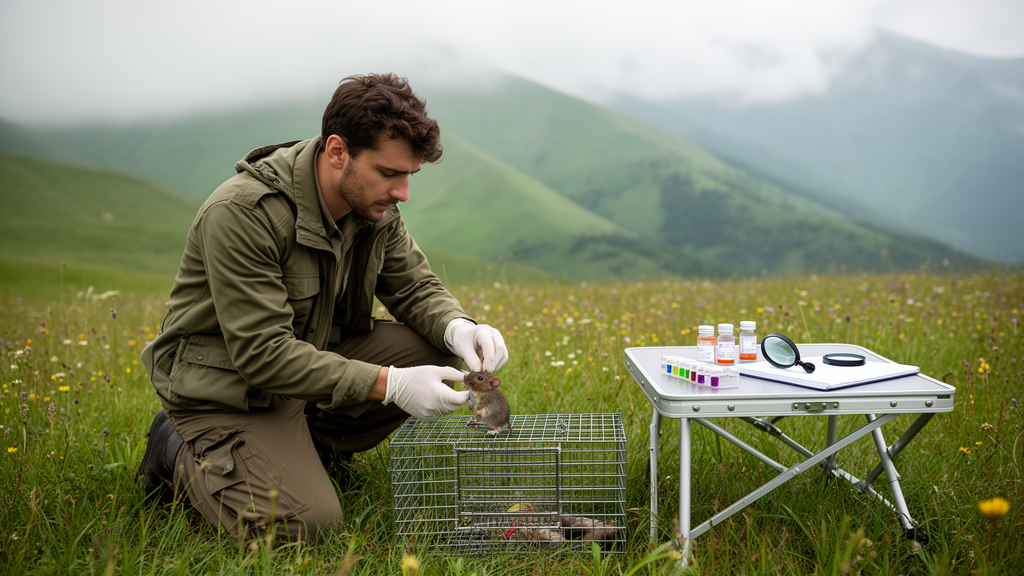
In the highland forests of Usholta, a remote locality in Racha, Western Georgia, a team of zoologists has uncovered a surprisingly rich community of gastrointestinal helminths living inside small mammals. The study, published in the journal Caucasiana, examined 19 specimens of rodents and a small carnivore collected in 2022, and identified ten species of parasitic worms, including one cestode never before recorded in this host group in Georgia. The finding is more than a curiosity: among the parasites was Echinococcus multilocularis, the larval stage of a tapeworm notorious for causing alveolar echinococcosis, one of the most dangerous parasitic diseases of humans.
The research fills a conspicuous gap in the parasitological record of the South Caucasus. Systematic surveys of gastrointestinal helminths in Georgian small mammals were last conducted in the mid-twentieth century by Kirshenblat, Rodonaia, Matsaberidze, and Kurashvili, with only a single recent paper documenting a cestode in the mole-rat Nannospalax xanthodon. The vicinity of Usholta, located within the Oni Municipality at coordinates N42°29’59”, E43°24’07”, sits at the border of forest and subalpine landscape zones and had never been explored for these parasites. The region is faunistically rich, with records of around 42 mammal species, making it an ideal natural laboratory for studying host-parasite relationships in an unexplored highland ecosystem.
The collected hosts included eight specimens of the lesser wood mouse Apodemus uralensis (family Muridae), eight Daghestan voles Microtus daghestanicus (family Cricetidae), and three common weasels Mustela nivalis (family Mustelidae). For each animal, the gastrointestinal tract and related organs were examined for helminths. The researchers calculated standard parasitological indicators, including prevalence, mean intensity of infestation, parasitation range, and mean abundance, following the protocols of Bush et al. (1997), Anikanova et al. (2007), and Dege et al. (2019). Cestodes were washed, fixed in 70-degree alcohol, and rendered transparent with a glycerin-lactic acid mixture before being stained in aceto-carmine and mounted in Canada balsam. Nematodes were similarly fixed and cleared for morphological and morphometric study under a stereomicroscope with dual illumination and a 10-megapixel digital camera. Voucher material is stored in the collection of the Institute of Zoology at Ilia State University.
The results were striking. Five of the eight wood mice carried one or more helminth species, while every single vole and every weasel examined was infected, yielding an overall infection rate of 84.2 percent across all 19 animals. This is remarkable given that the summer of 2022 in Usholta was characterized by unusually low rodent numbers and a limited species composition. Ten helminth species were detected in total: four cestodes and six nematodes. The cestodes included Paranoplocephala omphalodes, Versteria mustelae, larval Echinococcus multilocularis, and Rodentolepis asymmetrica. The nematodes comprised Heligmosomoides polygyrus, Heligmosomum costellatum, Syphacia obvelata, an unidentified Syphacia species, Trichuris muris, and Molineus patens.
The most consequential discovery came from a single wood mouse whose liver harbored approximately 60 larvocysts of Echinococcus multilocularis, each vesicle measuring between 1 and 3 millimeters. This represents a novel host record for the parasite in Georgia, as larvocysts of this species had never been found in the genus Apodemus within the country. The larval stage of Echinococcus differs from the adult strobilar stage in its exceptionally wide distribution and pathogenicity. Mouse-like rodents, particularly voles, typically serve as the main intermediate hosts, and the presence of larvae in a wood mouse is most plausibly explained by local environmental conditions and food sources. Historically, Kurashvili first registered the larval form in the social vole Microtus socialis in Georgia in 1961, and Matsaberidze later found it in the liver of the mountain vole M. roberti across forest, subalpine, and alpine zones of Eastern Georgia. In neighboring Russia, Kirillova and Kirillov documented infestation rates of 1.3 percent in the common vole and 1.2 percent in the field mouse. The Usholta finding allows researchers to predict the spread of this dangerous helminth both among rodent intermediate hosts in the zone and among its final hosts, the Canidae.
Among the nematodes of the wood mouse, Heligmosomoides polygyrus emerged as the dominant species with a prevalence of 3 out of 8 hosts, a parasitation range of 3 to 39 worms, and a mean abundance of 6.75. Trichuris muris appeared in only one mouse with two specimens, giving the lowest mean abundance of 0.25. Syphacia obvelata, by contrast, reached a mean intensity of 66 worms in a single infected host, with 66 specimens recovered from the cecum of one individual and a mean abundance of 8.25. These figures align well with historical data from Matsaberidze, who recorded abundances of 1 to 300 for S. obvelata in rodents across Eastern Georgian vegetation zones. All three nematodes are obligate, widespread parasites of rodents previously documented in different regions of Georgia and in adjacent South Caucasus republics.
The Daghestan vole hosted two cestode species, Paranoplocephala omphalodes and Rodentolepis asymmetrica, with the latter showing a higher prevalence of 3 out of 8 hosts, a range of 1 to 4 worms, and a mean abundance of 0.75. Both are obligate rodent parasites recorded several times in Transcaucasia, and Kirshenblat originally discovered them in the Daghestan vole in the forest zone at 1040 meters above sea level near the village of Ermani. According to Kirillova and Kirillov, infection with adult cestodes such as P. omphalodes occurs through the accidental ingestion, along with grassy food or while digging burrows, of small soil invertebrates, including mites and springtails, which act as intermediate hosts. Because M. daghestanicus is an herbivore feeding on plant parts above the soil, the researchers believe a similar feeding-driven invasion process operates for P. omphalodes at the forest-subalpine border of Usholta. A single vole also carried the nematode Heligmosomum costellatum, and one vole harbored 158 specimens of an unidentified Syphacia species, yielding a mean abundance of 19.75.
The common weasel, Mustela nivalis, a carnivore widely distributed in Georgian forest and subalpine zones up to 3000 meters above sea level, was infected with the cestode Versteria mustelae and the nematodes Molineus patens and Syphacia sp. The presence of Syphacia sp. in the intestinal tract of M. nivalis is a new host record for Georgia. This finding is intriguing because Syphacia nematodes are strict-specific parasites, mostly host-specific at the genus level, and typically parasitize rodents rather than carnivores. The researchers invoke the concept of post-cyclic parasitism, documented by Varodi et al. (2017), in which mustelids acquire diverse rodent nematode communities by preying on infected prey. Molineus patens, by contrast, is a highly specific parasite of Carnivora, widespread in the Mustelidae, and commonly detected in Georgian weasels by Rodonaia in the mid-twentieth century. Versteria mustelae, formerly classified as Taenia tenuicollis, was recorded by Rodonaia in Georgian weasels and classified based on the descriptions of Petrov and Abuladze. Bagnato and colleagues have suggested that all new species of the genus Versteria are potential zoonotics, and the Usholta team similarly considers V. mustelae a possible source of zoonotic invasion in the wild.
Only one wood mouse was simultaneously infected with two nematode species, Syphacia sp. and Trichuris muris, while a single weasel carried three helminth species at once: Versteria mustelae, Molineus patens, and Syphacia sp. Mixed infections of this kind illustrate the complexity of parasite communities within individual hosts and the ecological connections linking carnivores to their rodent prey through shared parasite faunas. The pattern in which mean intensities remained relatively low despite high overall prevalence suggests that the basic conditions for the functioning of the parasite-host system are preserved in this parasitologically unexplored region, agreeing with findings previously obtained in different regions of Georgia by Kirshenblat, Matsaberidze, and Rodonaia.
The formation of the micromammal helminth fauna in Usholta is tied to the local ecosystem, a complex of biotic and abiotic factors including food type, soil-related lifestyle, and the availability of intermediate hosts. Rodents act as definitive, intermediate, and reservoir hosts of helminths and serve as vectors of numerous zoonotic diseases, making primary biodiversity data on these parasites crucially important for preventing parasitic diseases in humans and livestock. The new data from Usholta supplement existing knowledge on helminth biodiversity, expand understanding of their distribution and host specificity in Georgia, and underscore the importance of continued research on wildlife parasites in the Caucasus, a mountainous hotspot where ecosystems are shifting and host-parasite dynamics remain only partially mapped.
Subject of Research: Gastrointestinal helminth diversity and host-parasite relationships in small mammals near Usholta, Georgia
Article Title: Gastrointestinal helminths of small mammals ( Rodentia and Carnivora ) in the vicinity of Usholta, Georgia
Article References: Nikolaishvili, K., Lomidze, T., Arabuli, L., Asatiani, K., & Murvanidze, L. (2024). Gastrointestinal helminths of small mammals (Rodentia and Carnivora) in the vicinity of Usholta, Georgia. Caucasiana, 3, 245-256. https://doi.org/10.3897/caucasiana.3.e132243
Image Credits: AI Generated
DOI: 10.3897/caucasiana.3.e132243
Keywords: parasitology, helminths, Georgia, Echinococcus multilocularis, rodents, Mustela nivalis, zoonoses, Caucasus biodiversity, Gastrointestinal, small, mammals, Rodentia
Cite Scienmag News
Margaret Porter. (October 17, 2026). Parasites in the Highlands: Hidden Worms of Georgian Small Mammals Reveal New Host Record. Scienmag. https://scienmag.com/parasites-in-the-highlands-hidden-worms-of-georgian-small-mammals-reveal-new-host-record/
Margaret Porter. "Parasites in the Highlands: Hidden Worms of Georgian Small Mammals Reveal New Host Record." Scienmag, 17 October 2026, https://scienmag.com/parasites-in-the-highlands-hidden-worms-of-georgian-small-mammals-reveal-new-host-record/. Accessed 17 October 2026.
Margaret Porter. "Parasites in the Highlands: Hidden Worms of Georgian Small Mammals Reveal New Host Record." Scienmag. October 17, 2026. https://scienmag.com/parasites-in-the-highlands-hidden-worms-of-georgian-small-mammals-reveal-new-host-record/


