


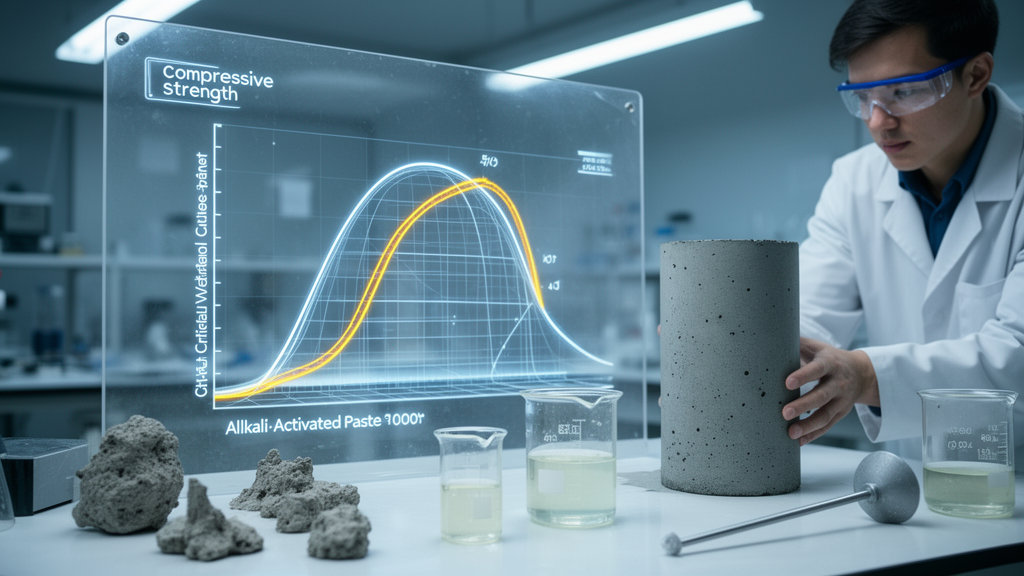
Concrete is one of the largest sources of human-made carbon emissions, and the race to replace it with greener alternatives has just received a powerful new tool. In a study published in Discover Sustainability, researchers from JSS Science and Technology University in Mysuru, India, and Hanyang University in Ansan, Republic of Korea, built a set of machine learning models that can predict how strong an alkali-activated material will be before anyone mixes a single batch. The twist that makes the work stand out is that the models do not just predict; they explain themselves, revealing exactly which ingredients matter most and where the critical limits lie.
Alkali-activated materials are often described as the most credible low-carbon alternative to ordinary Portland cement. Instead of clinker produced by firing limestone in kilns that reach around 1,450 degrees Celsius, these binders are made by activating industrial by-products such as fly ash and ground granulated blast furnace slag with alkaline solutions. The chemistry is elegant, but it is also unforgiving. Small changes in the sodium oxide content, the silica-to-soda ratio, or the amount of water in the mix can swing the final compressive strength by tens of megapascals. Traditionally, engineers have navigated this complexity through trial and error, casting and crushing dozens of test specimens to find a formulation that works.
The research team, led by J. S. Siddesh and M. S. Mukesh with collaborators M. S. Kendagannaswamy and K. N. Shivaprasad, wanted to shortcut that laborious process. They compiled a dataset in which each alkali-activated mix was described by five key design variables: the fly ash content, the ground granulated blast furnace slag content, the sodium oxide content, the silica-to-sodium oxide ratio, and the water-to-binder ratio. The target variable was the compressive strength that each mix ultimately achieved. From this foundation, they trained four of the most widely used ensemble learning algorithms in modern data science: Random Forest, Gradient Boosting Decision Tree, XGBoost, and LightGBM.
Ensemble models work by combining the outputs of many simpler learners, and each of the four approaches does this in a slightly different way. Random Forest builds hundreds of decision trees on random subsets of the data and averages their predictions, which makes it robust against overfitting. Gradient Boosting Decision Tree, XGBoost, and LightGBM instead build trees sequentially, with each new tree correcting the errors of the previous ones. The team evaluated all four models on held-out test data using three standard metrics: the coefficient of determination R², the root mean square error, and the mean absolute error.
The Random Forest emerged as the clear winner. It achieved a test R² of 0.762, meaning it explained roughly three-quarters of the variance in compressive strength across unseen mixes, with a root mean square error of 9.23 megapascals and a mean absolute error of 6.38 megapascals. In practical terms, if the model predicts that a mix will reach 40 megapascals, the true value is likely to fall within roughly 6 to 9 megapascals of that estimate. For a material whose strength depends on the complex interplay of geopolymerisation reactions, precursor dissolution, and pore structure evolution, that level of accuracy from mix design variables alone is a meaningful achievement.
But accuracy alone was never the goal. The researchers then applied explainable artificial intelligence techniques to open up the Random Forest model and determine how much each input variable contributed to every prediction. This step matters because machine learning models in construction are often treated as black boxes, producing numbers without reasons. For engineers who must defend a mix design in front of clients, regulators, and structural codes, an unexplained prediction is of limited use. The explainability analysis turned the model into something closer to a transparent design assistant.
The results were strikingly consistent. The water-to-binder ratio was revealed as the single most dominant factor governing compressive strength, followed by the sodium oxide content, the fly ash content, and the silica-to-sodium oxide ratio. Even more intriguingly, the analysis uncovered a clear nonlinear threshold at a water-to-binder ratio of approximately 0.5. Below that value, predicted strength held up well. Beyond it, the predicted compressive strength dropped rapidly. This kind of sharp behavioural boundary is exactly the sort of insight that trial-and-error experimentation might stumble upon slowly, but that an interpretable model can expose directly from the data.
The physical explanation for the threshold is rooted in the chemistry of alkali activation. Excess water dilutes the alkaline activator, slows the dissolution of the fly ash and slag precursors, and leaves behind a more porous microstructure after curing, all of which undermine the strength of the final binder. By quantifying precisely where the cliff edge lies, the model gives mix designers a hard number to design around rather than a vague caution about using too much water.
The implications extend beyond the laboratory. Because the framework minimises trial-and-error experimentation, it could reduce the number of physical specimens that need to be cast, cured, and crushed during mix development, saving time, materials, and energy. That efficiency gain compounds with the environmental argument for alkali-activated materials themselves, which divert fly ash and slag from landfills while avoiding the carbon-intensive clinker production process. A design tool that makes these greener binders easier to formulate could accelerate their adoption in real construction projects, from precast elements to structural concrete.
The study, which was received in June 2026, accepted in October 2026, and published as an open-access article in Discover Sustainability, demonstrates that the future of sustainable construction may depend as much on algorithms as on chemistry. By pairing strong predictive performance with genuine interpretability, the researchers have shown that machine learning can speak the language of mix design, telling engineers not just what a binder will do, but why. As the construction industry confronts mounting pressure to decarbonise, tools that combine accuracy with transparency may prove to be the catalyst that finally moves low-carbon binders from the margins of research into the mainstream of building practice.
Subject of Research: Explainable machine learning for predicting compressive strength of alkali activated material: a comparative modelling and interpretability study
Article Title: Explainable machine learning for predicting compressive strength of alkali activated material: a comparative modelling and interpretability study
Article References: Siddesh, J. S., Mukesh, M. S., Kendagannaswamy, M. S., & Shivaprasad, K. N. (2026). Explainable machine learning for predicting compressive strength of alkali activated material: a comparative modelling and interpretability study. Discover Sustainability. https://doi.org/10.1007/s43621-026-04969-x
Image Credits: AI Generated
DOI: 10.1007/s43621-026-04969-x
Keywords: Explainable, machine, learning, predicting, compressive, strength, alkali, activated, material, comparative, modelling, interpretability
Cite Scienmag News
Violet Maxwell. (October 17, 2026). Explainable AI predicts alkali-activated concrete strength and reveals a critical water threshold. Scienmag. https://scienmag.com/explainable-ai-predicts-alkali-activated-concrete-strength-and-reveals-a-critical-water-threshold/
Violet Maxwell. "Explainable AI predicts alkali-activated concrete strength and reveals a critical water threshold." Scienmag, 17 October 2026, https://scienmag.com/explainable-ai-predicts-alkali-activated-concrete-strength-and-reveals-a-critical-water-threshold/. Accessed 17 October 2026.
Violet Maxwell. "Explainable AI predicts alkali-activated concrete strength and reveals a critical water threshold." Scienmag. October 17, 2026. https://scienmag.com/explainable-ai-predicts-alkali-activated-concrete-strength-and-reveals-a-critical-water-threshold/


