


When researchers compare how well university students regulate their own learning across countries, they usually assume the questionnaire behind the comparison measures the same psychological construct in both groups. A new psychometric study, published in Frontiers in Psychology, put that assumption to a rigorous test for a learning-management scale used in Chile and Ecuador, and the results offer a rare, carefully bounded green light for cross-national comparisons in Latin American higher education.
The instrument at the center of the analysis is the Learning Management of University Students Scale, known as GAEU-1, a 19-item self-report questionnaire developed for undergraduates in Chile and Ecuador. Students rate statements about planning, motivation, and study techniques on a five-point agreement scale. Earlier validation work had retained three of the scale’s dimensions: a self-regulated learning factor covering study preparation and time management, a dimension of conscious motivational strategies, and a dimension of deep learning techniques. The new study, led by Xinglong Pang, Lin Zhou, and Jin-Ho Cho, asked whether these three retained dimensions produce measurement parameters that are statistically comparable across the two countries.
The question matters because score differences between groups can be deceptive. If an item functions differently in Chile than in Ecuador, an apparent gap in self-regulated learning might partly reflect group-specific item behavior rather than genuine psychological differences. Measurement invariance testing addresses this by progressively constraining model parameters to be equal across groups and checking whether the fit of the model deteriorates meaningfully. For Likert-type items, the technical challenge is sharper still: ordered responses arise from thresholds on underlying response propensities, so procedures designed for continuous indicators cannot simply be transferred. The team therefore used weighted least squares mean- and variance-adjusted estimation, WLSMV, with theta parameterization, treating all 15 retained indicators as ordered categorical variables.
The data came from an openly licensed Version-5 dataset containing 1,316 undergraduates, 631 in Chile and 685 in Ecuador, with a mean age of 20.45 years. All 19 items were complete and within range, and only nine participants, less than one percent, showed zero response variance across the full item set. Internal consistency was adequate for the three analyzed dimensions, with pooled coefficient alpha values of 0.782 for self-regulated learning, 0.793 for conscious motivational strategies, and 0.753 for deep learning techniques, and model-based omega estimates reaching 0.890 for the motivation dimension. A fourth dimension, perceived academic performance, was excluded from the invariance model because it had shown weaker reliability in the original validation.
Country-specific confirmatory factor analysis produced a mixed picture. The comparative fit index and standardized root mean square residual were relatively favorable in both countries, with CFI of 0.947 in Chile and 0.952 in Ecuador and SRMR of 0.059 in both. But the root mean square error of approximation told a different story, reaching 0.094 in Chile and 0.085 in Ecuador, above conventional close-fit values. The researchers did not gloss over this. Analytical power calculations showed the elevated RMSEA could not be attributed to low statistical sensitivity, meaning the baseline models carried genuine residual misspecification. Their conclusion was therefore deliberately conditional: the inherited three-dimensional representation was usable for invariance testing, but it was not a perfectly specified model.
The core of the study was a staged multigroup invariance sequence following the Wu-Estabrook identification framework for ordinal indicators. The sequence moved from a configural model, in which the same factor structure was imposed in both countries, to equality constraints on item thresholds, then on thresholds plus factor loadings, and finally on the intercept-related parameters required by the identified ordinal model. The decision guides were prespecified: a decrease in CFI no larger than 0.010 and an increase in RMSEA no larger than 0.015 at each stage. Every planned stage passed. Constraining thresholds changed CFI by only 0.001 while RMSEA actually improved. Adding loading equality improved both indices further, and the intercept-related constraints changed CFI by less than 0.001. No partial invariance was needed, and all 15 indicators retained their cross-group equality constraints through the strong, or scalar, level.
Complementary differential item functioning analyses added an item-level view. Using iterative hybrid ordinal logistic regression procedures with Chile as the reference group, the team found statistically detectable DIF signals for eight items after false discovery rate correction. Yet the largest total change in McFadden pseudo-R-squared was 0.0103, for item GA3, well below the prespecified 0.020 practical-effect criterion. No item therefore required release from the multigroup constraints. The researchers were careful to note that this conclusion depends on the chosen threshold: a sensitivity analysis showed GA3 would be flagged under a more permissive 0.010 rule. The finding supports small rather than absent item-level differences, a distinction the authors argue future work should address with formal equivalence testing rather than simply failing to detect effects.
Post hoc diagnostics sharpened the study’s limitations. The strongest residual dependence was localized to the pair GA7-GA8, both items involving motivational self-talk, in both samples, with residual correlations of 0.174 in Chile and 0.201 in Ecuador. A deliberately parsimonious one-factor model fit appreciably worse than the retained three-factor representation in both countries, with CFI drops of 0.059 and 0.069, arguing against simple unidimensionality. Discriminant validity evidence was mixed: polychoric HTMT values all fell below the conventional 0.85 heuristic, but Fornell-Larcker diagnostics were not satisfied for factor pairs involving the self-regulated learning factor, whose latent correlations with the other dimensions were substantial, reaching 0.836 in Chile. The factors are not empirically identical, but their separation is criterion-dependent.
After invariance was established, the team estimated latent sample contrasts as a secondary illustration. With effects coded Ecuador minus Chile, the latent contrast for self-regulated learning was small and non-significant, while conscious motivation and deep learning showed significant latent differences favoring Chile, with latent Cohen’s d of 0.225 and 0.284 respectively. The researchers stressed these values are descriptive of these two samples after measurement adjustment, not estimates of national or cultural effects, because the samples differed markedly in gender and university-sector composition. Women made up 46.9 percent of the Chilean sample but 65.7 percent of the Ecuadorian sample, and private-university students represented 57.5 percent in Chile versus 98.4 percent in Ecuador.
Two planned sensitivity analyses, one removing zero-variance respondents and one allowing residual covariances for the data-informed item pairs, preserved the main comparability result, as did a post hoc private-university-only analysis of 1,037 respondents. The overall conclusion is bounded but useful: the three retained GAEU-1 dimensions showed approximately stable thresholds, loadings, and intercept-related parameters across these Chilean and Ecuadorian university samples, conditional on the inherited scoring representation. For researchers using the scale in similar Latin American university settings, that is meaningful evidence for model-based cross-sample comparison, while broader structural, equivalence, and country-level claims remain outside what was actually tested.
Subject of Research: Ordinal measurement invariance testing of the GAEU-1 learning-management scale across Chilean and Ecuadorian university students
Article Title: Ordinal measurement invariance of three retained GAEU-1 dimensions in Chilean and Ecuadorian university samples
Article References: Pang, X., Zhou, L., & Cho, J.-H. (2026). Ordinal measurement invariance of three retained GAEU-1 dimensions in Chilean and Ecuadorian university samples. Frontiers in Psychology, 17, Article 1990515. https://doi.org/10.3389/fpsyg.2026.1990515
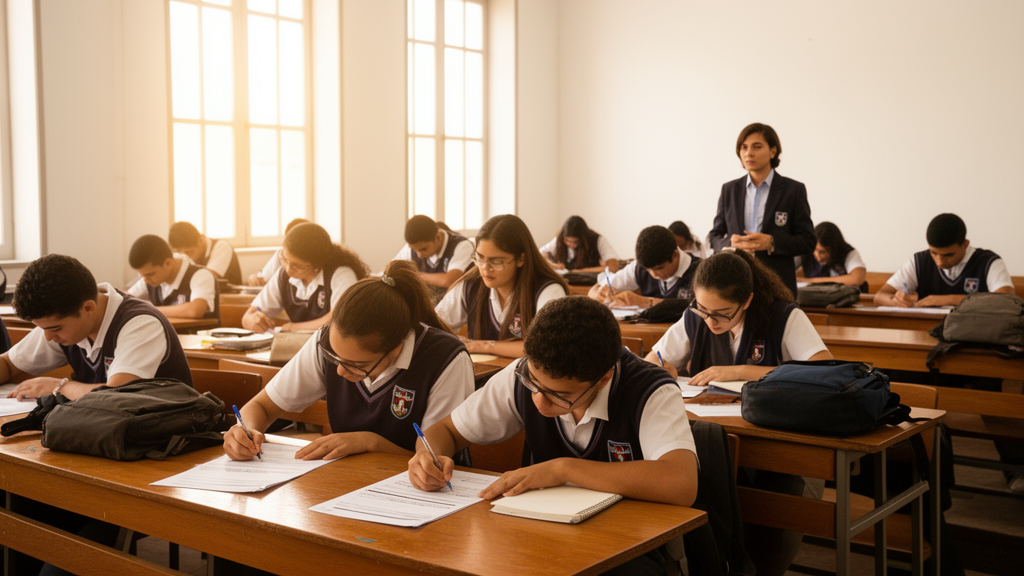
Image Credits: AI Generated
DOI: 10.3389/fpsyg.2026.1990515
Keywords: measurement invariance, self-regulated learning, GAEU-1, Chile, Ecuador, higher education, psychometrics, differential item functioning, Ordinal, measurement, invariance, three
Cite Scienmag News
Glenn Wilkins. (October 17, 2026). Learning survey scores hold steady across Chilean and Ecuadorian universities. Scienmag. https://scienmag.com/learning-survey-scores-hold-steady-across-chilean-and-ecuadorian-universities/
Glenn Wilkins. "Learning survey scores hold steady across Chilean and Ecuadorian universities." Scienmag, 17 October 2026, https://scienmag.com/learning-survey-scores-hold-steady-across-chilean-and-ecuadorian-universities/. Accessed 17 October 2026.
Glenn Wilkins. "Learning survey scores hold steady across Chilean and Ecuadorian universities." Scienmag. October 17, 2026. https://scienmag.com/learning-survey-scores-hold-steady-across-chilean-and-ecuadorian-universities/


