


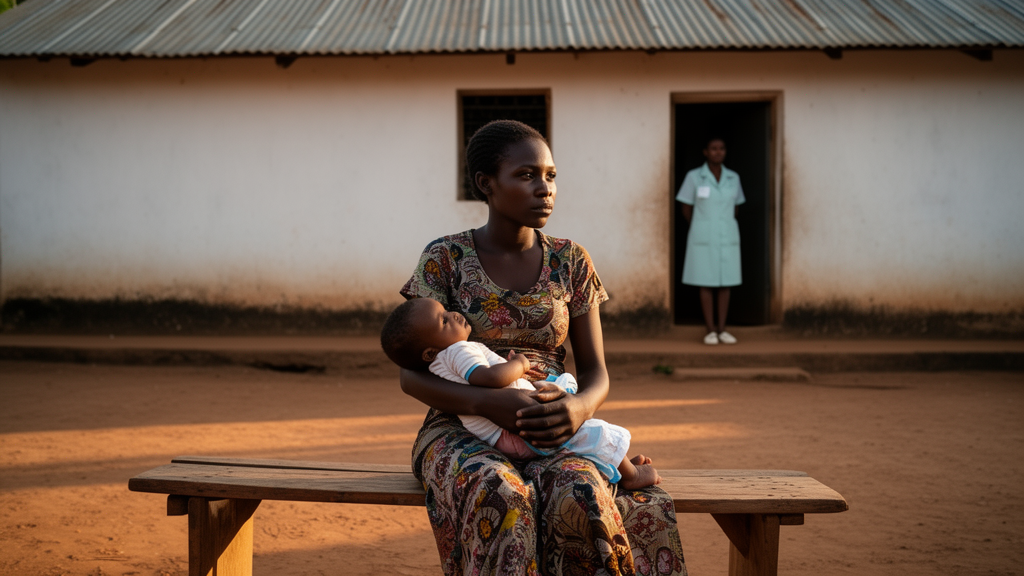
Every year, roughly 99 percent of the world’s maternal deaths occur in low- and middle-income countries, a statistic that has stubbornly resisted decades of clinical guidelines, donor funding, and global campaigns. The paradox at the heart of this figure is that the medical knowledge needed to prevent most of these deaths already exists. Postpartum hemorrhage, preeclampsia, sepsis, and obstructed labor are well understood conditions with evidence-based protocols that fit on a laminated card. Yet women continue to die from them at rates that would be unthinkable in high-income settings. A new qualitative study published in BMC Health Services Research argues that the missing piece is not another guideline but a systematic understanding of what actually happens when a pregnant woman in Rosario, Argentina, or Addis Ababa, Ethiopia, tries to reach and receive that care.
The research team, led by Kathleen Gamble of Unity Health Toronto’s Li Ka Shing Knowledge Institute and Lisa M. Puchalski Ritchie of the University of Toronto, together with collaborators at the Centro Rosarino de Estudios Perinatales in Argentina and the Ethiopian Public Health Institute, set out to capture something the maternal health literature has largely ignored: the patient’s own account of the barriers and facilitators to evidence-based maternal care. Most prior studies of this question have interviewed providers, administrators, or policymakers, leaving the people who actually navigate the system to be described secondhand. The new study flips that perspective, interviewing 58 women of reproductive age and their families across the two countries and conducting eight focus groups, then analyzing the transcripts with a framework approach to content analysis anchored in implementation science constructs such as the Theoretical Domains Framework and the Consolidated Framework for Implementation Research.
The technical design matters because it allows the researchers to organize what patients said into three nested levels: the patient and community level, the provider level, and the health system level. This architecture, borrowed from implementation science, is what makes the findings actionable. If a barrier is identified at the community level, the remedy might be education or social mobilization; if it sits at the provider level, the remedy might involve training, supervision, or accountability mechanisms; if it is a system-level barrier, the response requires infrastructure, financing, or organizational redesign. The study was registered on the Open Science Framework in June 2022, and it received ethics approval from research boards in Canada, Argentina, and Ethiopia, following the ethical principles of the Declaration of Helsinki.
At the patient and community level, the most striking convergence between the two countries was the identification of lack of knowledge as a fundamental barrier. Women and their families in both Argentina and Ethiopia described situations in which the danger signs of pregnancy went unrecognized, the purpose of antenatal visits was misunderstood, or the availability of lifesaving interventions was simply unknown. Against this, participants in both sites identified community belief in the value of maternal care as a facilitator, a social current that pulls women toward clinics rather than away from them. But the two countries diverged in revealing ways. Only in Ethiopia did participants describe cultural beliefs, gender roles, and household decision-making dynamics as barriers, noting that husbands and male relatives often controlled whether and when a woman could seek care. Only in Ethiopia, too, did participants point to community funding schemes that help with healthcare costs and to education programs specifically targeting husbands as facilitators, an acknowledgment that in that context, reaching the male decision-maker is a precondition for reaching the mother.
The provider level produced the study’s most uncomfortable findings. In both Argentina and Ethiopia, participants identified mistreatment by health care providers as a barrier to accessing and receiving care. Women described experiences of being scolded, ignored, or handled roughly, experiences that the global literature on obstetric violence and respectful maternity care has documented extensively but that patients themselves rarely get to report in implementation research. In Ethiopia, participants added mistrust of providers and a preference for male providers as additional barriers, a configuration that reflects local norms about modesty and authority. In Argentina, by contrast, participants identified trust in providers as a facilitator, and in Ethiopia, they pointed to local maternal health champions and providers drawn from the local community as facilitators, suggesting that social proximity and shared identity can function as powerful bridges between women and the health system.
At the health system level, the barriers were structural and, in many ways, the most amenable to policy intervention. Participants in both countries identified lack of coordination of care and transportation as barriers, describing the difficulty of reaching facilities and the fragmentation that occurs when a woman is referred from one level of care to another. Health care worker shortages were also identified in both sites, a reminder that even the best-designed referral system collapses when there are not enough skilled hands to deliver the care. Only in Ethiopia did participants identify financial constraints as a system-level barrier, reflecting the out-of-pocket costs that can accumulate even when services are nominally free. The facilitators at this level were equally context-specific: in Argentina, participants pointed to patient education groups and the use of social media as tools that connect women to information and services, while in Ethiopia, they identified increased rural health centers and better organization of care as the structural changes that would make the difference.
The study’s authors are careful to note that many of the barriers and facilitators identified by patients overlap with those found in studies conducted with providers. What the patient perspective adds is texture and variability. The same barrier, such as mistreatment by providers, is experienced differently by a woman in Rosario than by a woman in Addis Ababa, and the same facilitator, such as community belief in maternal care, operates through different social mechanisms in each setting. This variability is precisely why the authors argue that implementation strategies must be tailored to context rather than imported wholesale from one setting to another. A husband-targeted education program that makes sense in Ethiopia would have no obvious counterpart in Argentina, where the gender dynamics of household decision-making were not identified as a barrier at all.
The implications of the study extend beyond the two countries where it was conducted. The Sustainable Development Goals include a target for reducing maternal mortality, and the World Health Organization has long emphasized that the gap between evidence and practice in maternal health is a problem of implementation, not knowledge. Studies like this one provide the granular, patient-centered evidence that implementation scientists need to design strategies that actually work. The framework approach used by the researchers, which organizes findings into nested levels and links them to established implementation constructs, offers a template for how similar studies could be conducted in other low- and middle-income countries, building a comparative evidence base that could inform global policy.
What makes the study particularly compelling is its methodological honesty. Qualitative research of this kind cannot tell us how common each barrier is, only that it exists in the lived experience of the participants. But that limitation is also its strength: by capturing the full range of what patients and their families described, without imposing a priori categories, the researchers produced a map of the maternal health landscape as seen from below. The 58 interviews and eight focus groups were conducted in the participants’ own languages and settings, and the analysis was performed by a multidisciplinary team that included clinicians, implementation scientists, and local researchers from both countries, reducing the risk that findings would be distorted by outsider assumptions.
The study’s publication comes at a moment when the global maternal health community is rethinking its approach. The recognition that 99 percent of maternal deaths occur in low- and middle-income countries has led to a proliferation of guidelines, but the persistence of the problem suggests that guidelines alone are insufficient. The new research adds a crucial dimension to the conversation by demonstrating that the people who use maternal health services have clear, specific, and actionable ideas about what prevents them from receiving care and what would help them receive it. From mistreatment by providers to the shortage of health care workers, from the need for better transportation to the value of social media campaigns, the barriers and facilitators identified by patients in Argentina and Ethiopia offer a roadmap for change that begins not with another guideline but with listening to the women the system is meant to serve.
Subject of Research: Patient-identified barriers and facilitators to maternal health care in lmics: a qualitative study in Argentina and Ethiopia
Article Title: Patient-identified barriers and facilitators to maternal health care in lmics: a qualitative study in Argentina and Ethiopia
Article References: Gamble, K., Vila Ortiz, M., Berhanu, A. T., Abalos, E., Duhau, M., Getachew, T., Fahim, C., Straus, S. E., Gebregiorgis, A. H., Althabe, F., Tollera, G., & Puchalski Ritchie, L. M. (2026). Patient-identified barriers and facilitators to maternal health care in lmics: a qualitative study in Argentina and Ethiopia. BMC Health Services Research. https://doi.org/10.1186/s12913-026-15688-4
Image Credits: AI Generated
DOI: 10.1186/s12913-026-15688-4
Keywords: Patient-identified, barriers, facilitators, maternal, health, care, lmics, qualitative, Argentina, Ethiopia, scientific research
Cite Scienmag News
Harold Sullivan. (October 17, 2026). Why Mothers in Argentina and Ethiopia Say They Avoid Maternal Health Care. Scienmag. https://scienmag.com/why-mothers-in-argentina-and-ethiopia-say-they-avoid-maternal-health-care/
Harold Sullivan. "Why Mothers in Argentina and Ethiopia Say They Avoid Maternal Health Care." Scienmag, 17 October 2026, https://scienmag.com/why-mothers-in-argentina-and-ethiopia-say-they-avoid-maternal-health-care/. Accessed 17 October 2026.
Harold Sullivan. "Why Mothers in Argentina and Ethiopia Say They Avoid Maternal Health Care." Scienmag. October 17, 2026. https://scienmag.com/why-mothers-in-argentina-and-ethiopia-say-they-avoid-maternal-health-care/


