


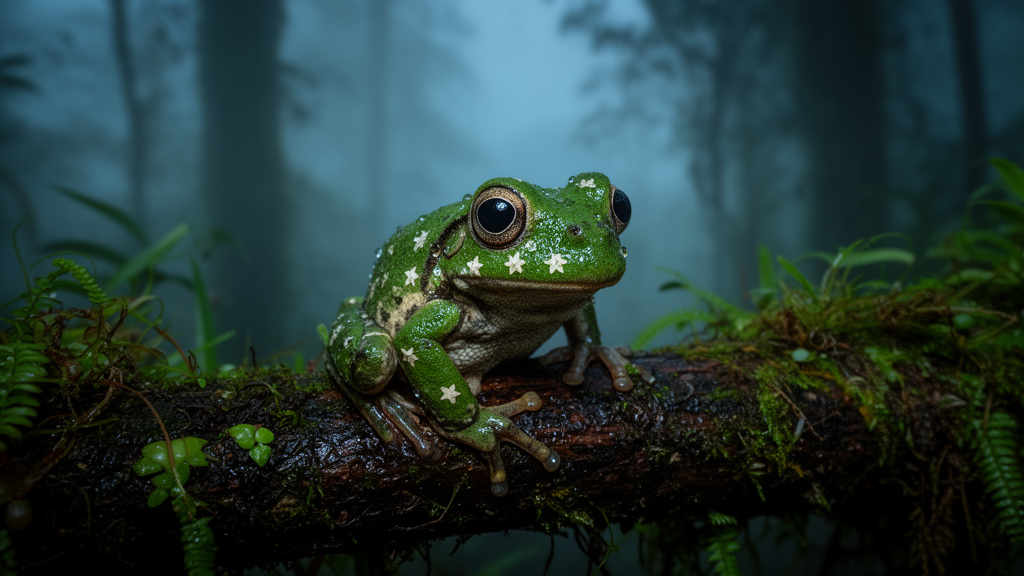
Deep in the cloud forests of the Sierra Juárez in northern Oaxaca, Mexico, herpetologists have identified a treefrog so distinctive that its eyes appear to be filled with stars. The new species, formally described as Charadrahyla viruela in the journal Herpetozoa, had been hiding in plain sight for decades, confused with a related frog called C. nephila with which it shares steep, cascading streams on the humid windward slopes of the Sierra Madre Oriental. The discovery brings the number of recognized species in this exclusively Mexican genus to eleven and adds urgency to conservation assessments for a group in which several members are already considered at imminent risk of extinction.
The name viruela is Latin for smallpox, a reference to the extensive tubercles that pockmark the dorsum of this frog. That bumpy skin is one of the most obvious traits separating C. viruela from its closest relatives. Where C. nephila has smooth dorsal skin, the new species is covered in reddish-brown or tan tubercles set against an emerald green ground coloration with large dark military green blotches. The combination of colors and textures gives the animal what the authors describe as a mossy appearance, in contrast to the military camouflage look of C. nephila. The iris is golden and heavily reticulated with black, producing the starry-eyed effect, whereas the iris of C. nephila is a solid, unpatterned copper. A distinctive white blotch on the upper lip posterior to the eye, flared protruding nostrils, and a short snout that is truncate in both dorsal and lateral profiles round out the suite of external characters that make the new species readily diagnosable in life.
Adult males of C. viruela measure between 53.3 and 61.8 millimeters in snout-vent length, with females reaching at least 76.8 millimeters. The species shows an unusual sexual dimorphism in finger disc size: females have much larger discs than males, with the width of the pad on the third finger ranging from 2.4 to 2.7 times the width of the finger in females compared with 1.7 to 2.3 times in males. Subarticular tubercles on some fingers are distinctly bifid, a rare trait within the genus shared only with the two smallest members, C. pinorum and C. juanitae. The holotype, a subadult female collected on 6 May 2021 along Highway 175 between Vista Hermosa and La Esperanza in the Municipio de Santiago Comaltepec at 1,589 meters above sea level, is deposited at the Instituto de Investigaciones sobre los Recursos Naturales of the Universidad Michoacana de San Nicolás de Hidalgo, with paratypes housed at the Museo de Zoología of the Universidad Nacional Autónoma de México and the Colección Nacional de Anfibios y Reptiles.
The molecular evidence rests on a concatenated alignment of 3,699 base pairs drawn from five loci: three mitochondrial genes, 12S, 16S, and ND1, and two nuclear genes, Rag-1 and rhodopsin. The dataset included 18 individuals of Charadrahyla and five of the closely related genus Megastomatohyla, which is endemic to the cloud forests of central Veracruz and Oaxaca. Phylogenetic inference using maximum likelihood in IQ-TREE, with node support estimated from 1,000 ultrafast bootstrap replicates, recovered Charadrahyla as monophyletic and sister to Megastomatohyla. Within the genus, C. taeniopus emerged as sister to all remaining species with 100 percent ultrafast bootstrap support, followed by C. chaneque at 89 percent. The two samples of the new species formed a monophyletic clade with 100 percent support, and the new species was recovered as sister to C. nephila, although that relationship received low support at 41 percent, suggesting the two lineages diverged recently.
Genetic distances reinforce the distinctness of the new lineage. For the mitochondrial 12S gene, interspecific distances within Charadrahyla ranged from 4.1 to 11.8 percent, with the new species showing its lowest divergence, 4.1 percent, relative to C. nephila and reaching 11.8 percent in comparisons with C. juanitae. Intraspecific divergence between the two samples of the new species was 1.6 percent. For the 16S gene, the new species differed from C. nephila by 3.4 percent and from C. juanitae by up to 6.3 percent, while interspecific distances within the genus ranged from 2.4 to 6.3 percent. By comparison, intergeneric distances between Charadrahyla and Megastomatohyla ranged from 11.7 to 15.6 percent for 12S, and intriguingly, some interspecific distances within Megastomatohyla, as low as 1.2 percent for 16S, fell below many comparisons within Charadrahyla, hinting at how much unrecognized diversity may persist in Mexican hylids.
The description also draws on the tadpole, a life stage rarely documented for members of this genus. A single tadpole of C. viruela collected in Gosner Stage 35 from a stream about 500 meters northeast of La Esperanza had a total length of 63.1 millimeters, an ovoid body, a robust caudal musculature, and a large oral disc with a labial keratodont row formula of 2(2)/4(1). In life the body was pale brown dorsally with pale green spots, the caudal musculature yellowish with cream spots, and the iris golden with black reticulations. As the tadpoles progressed through metamorphosis, the adult characteristics became evident in sequence: dark spots on an emerald green ground coloration, the black and gold reticulations of the eye, the white upper lip markings, and the tuberculate dorsal texture, first pronounced on the limbs. Juveniles of C. nephila, by contrast, have an unpatterned iris with no black reticulation, allowing the two species to be distinguished even at this early stage.
Charadrahyla viruela appears to be endemic to moderate elevations on the northern slopes of the Sierra Juárez, occurring between 600 and 1,725 meters above sea level in lower montane rainforest and lower montane cloud forest. Individuals have been found active throughout the year at night along streams, perched on branches from 30 centimeters to 3 meters above the ground, sometimes within the splash zones of waterfalls. The stream near the type locality, known locally as Arroyo Tres Manantiales, maintains humidity between 70 and 77 percent and an ambient temperature of 18 to 19 degrees Celsius. Approximately 50 individuals were recorded over a year at a stream near Santa Cruz Tepetotutla in streams with limited human activity, suggesting the species may be sensitive to human presence. Habitat studies indicate the frogs favor streams where rocks dominate the channel cover, with high tree densities and streamside shrubs at least two meters tall serving as perches.
The taxonomic history of the new species is tangled with that of C. nephila, described in 1999 with 53 paratypes from the Sierra Mixe, Sierra Juárez, and Sierra de Zongolica. The authors reviewed photographs of 51 of those paratypes and reassigned two to C. viruela, positively identifying 40 as C. nephila. The confusion centers on a locality referenced as 4.2 kilometers south of Vista Hermosa, where both species have been reported. The authors propose two scenarios: either two different streams were referenced with the same locality name by different collectors, or both species occur along the same stream but separated by elevation, one below Highway 175 and the other above it. Every specimen collected at that locality after 1990 is clearly identifiable as C. viruela. One specimen from Arroyo Buena Vista possesses intermediate characters between the two species and may be a hybrid, though no photographs of it in life exist to confirm this.
The paper also reports a novel population of the endangered C. sakbah from the Sierra Monteflor portion of the Sierra Madre Oriental, extending its known range approximately 104 kilometers to the northeast from the nearest reported locality near Tlaxiaco, Oaxaca. Thirty individuals were observed in a single night along two streams on Cerro Monteverde in pine-oak forest and humid oak woodland during March, though a later visit during the rainy season produced no individuals in the same streams. Molecular confirmation of the population’s identity was provided through a Middle American hylid phylogeny. With this record, C. sakbah is now known from both the Sierra Madre del Sur and the Sierra Madre Oriental, and the authors recommend a re-evaluation of its IUCN status with the new localities taken into consideration.
Conservation recommendations for the genus are sobering. The authors propose that at least four species should be considered Endangered. C. chaneque, currently listed as Vulnerable based on a larger assumed range that stemmed from past taxonomic confusion, can only be confirmed from four localities in the last 25 years and faces extreme habitat degradation from agriculture and siltation from slash-and-burn practices. C. viruela itself is known from just six localities within a 23-kilometer radius of the type locality, all restricted to a single biogeographical formation, and the authors propose it be provisionally classified as Endangered under IUCN criterion B1ab(iii), given an occurrence area of less than 100 square kilometers, a single threat-defined location, and ongoing decline in habitat extent and quality from small-scale cattle ranching, illegal logging, and varied agricultural practices. Several populations of other Charadrahyla species have not been observed or collected in half a century or more and may be locally extinct. The Sierra Juárez now harbors four species of the genus, two of which, C. sakbah and C. esperancensis, occur on either side of the high continental divide, while C. viruela, C. nephila, and C. esperancensis share the humid windward slopes, with C. viruela and C. nephila largely separated by elevation. The extreme topography of Oaxaca, coupled with heavy rainfall, can cause very different habitats to occur within close proximity on the same slope, allowing similar species to be isolated by habitat types within a few hundred meters of each other, a pattern that likely conceals further undiscovered diversity in these mountains.
Subject of Research: New treefrog species Charadrahyla viruela described from Oaxaca, Mexico, with molecular and morphological evidence and conservation assessment of the genus
Article Title: A new treefrog of the genus Charadrahyla ( Anura , Hylidae ) from Oaxaca, Mexico, with comments on the conservation status and distribution of related species
Article References: Canseco-Márquez, L., Grünwald, C. I., Reyes-Velasco, J., Montaño-Ruvalcaba, C., & Campbell, J. A. (2026). A new treefrog of the genus Charadrahyla (Anura, Hylidae) from Oaxaca, Mexico, with comments on the conservation status and distribution of related species. Herpetozoa, 39, 49-79. https://doi.org/10.3897/herpetozoa.39.e184954
Image Credits: AI Generated
DOI: 10.3897/herpetozoa.39.e184954
Keywords: Charadrahyla viruela, treefrog, Oaxaca, Mexico, Sierra Juárez, cloud forest, amphibian conservation, new species, Herpetozoa, endangered species, molecular phylogeny, Sierra Madre Oriental
Cite Scienmag News
Margaret Porter. (October 17, 2026). New mossy treefrog species emerges from Oaxaca cloud forests with a starry-eyed gaze. Scienmag. https://scienmag.com/new-mossy-treefrog-species-emerges-from-oaxaca-cloud-forests-with-a-starry-eyed-gaze/
Margaret Porter. "New mossy treefrog species emerges from Oaxaca cloud forests with a starry-eyed gaze." Scienmag, 17 October 2026, https://scienmag.com/new-mossy-treefrog-species-emerges-from-oaxaca-cloud-forests-with-a-starry-eyed-gaze/. Accessed 17 October 2026.
Margaret Porter. "New mossy treefrog species emerges from Oaxaca cloud forests with a starry-eyed gaze." Scienmag. October 17, 2026. https://scienmag.com/new-mossy-treefrog-species-emerges-from-oaxaca-cloud-forests-with-a-starry-eyed-gaze/


