


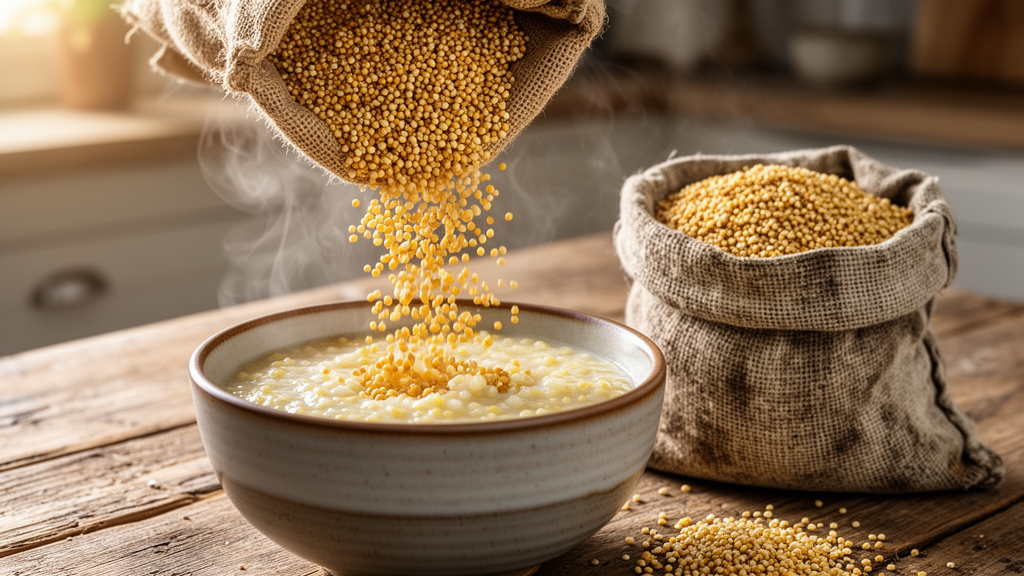
Foxtail millet has fed communities across arid China for thousands of years, prized for its drought tolerance, nutrition, and adaptability. But as consumers shift from caring only about yield to caring about how food tastes and smells, the grain’s aroma quality has become a serious scientific question. Now, a team of Chinese researchers has traced exactly how storage quietly transforms the chemistry of foxtail millet—and how those hidden changes erupt into flavor the moment the grain is cooked into porridge, its most common form of consumption.
The study, published in Food Chemistry: X, tackled a deceptively simple problem: what happens to porridge flavor when the millet it is made from has been sitting in storage? The answer required an unusually broad analytical arsenal. The researchers combined oxidation indicators, Maillard reaction markers, volatile profiling by gas chromatography–mass spectrometry, lipidomics, and metabolomics into a single integrated framework, allowing them to follow the molecular story from stored grain to finished porridge.
To compress years of storage into weeks, the team used accelerated oxidation. Fresh foxtail millet of the Jinmiao K1 variety, obtained from Xinzhou City in Shanxi Province, was sealed in polyethylene bags and stored in the dark at 50 degrees Celsius and 60 percent relative humidity. Using the Arrhenius relationship with a Q10 of 1.5, eight weeks under these conditions corresponds to roughly 22 weeks at room temperature. The researchers were careful to note that accelerated oxidation is not a fully equivalent substitute for normal storage, but it provides a mechanistic window into the reactions that accumulate over time.
At two-week intervals, samples were split in two: one portion ground raw, the other cooked into porridge with water at a 1:30 ratio for 30 minutes, then freeze-dried for analysis. The chemical readouts were striking. Malondialdehyde, a hallmark of lipid oxidation, rose in raw millet from 0.5669 to 0.6288 milligrams per kilogram over eight weeks, while cooked porridge samples carried far higher levels, climbing from 1.1616 to 1.3494 milligrams per kilogram. Peroxide values, which track early-stage oxidation, also increased during storage, from 0.6675 to 1.4155 milliequivalents per kilogram in raw grain. Cooking told a more complicated story: peroxides formed during heating but simultaneously decomposed, so the net effect depended on how long the grain had been stored beforehand.
Proteins were not spared. Carbonyl content, a classic marker of protein oxidation, increased in raw millet from 22.79 to 24.01 nanomoles per milligram of protein, and jumped dramatically after cooking, reaching 29.11 nanomoles per milligram by week eight. Free amino groups fell in raw millet as oxidation and Maillard-type reactions consumed them, but rose after cooking, suggesting heat-induced protein hydrolysis partly offset the losses. Total sulfhydryl groups dropped during storage as exposed thiols oxidized into disulfide bonds, yet increased after cooking, likely reflecting protein unfolding and disruption of disulfide structures. Surface hydrophobicity declined in both raw and cooked samples, indicating that hydrophobic regions became progressively buried through oxidation, Maillard chemistry, and heat aggregation.
Amino acid oxidation products told a parallel tale. Dityrosine, formed by oxidative crosslinking of tyrosine residues, and kynurenine and N′-formylkynurenine, products of tryptophan degradation, all increased during storage and rose further after cooking. The team interpreted this as evidence that heating expands the protein structure, exposing aromatic amino acid residues to oxidation. Meanwhile, soluble fluorescent advanced glycation end products—hallmarks of protein-sugar crosslinking—climbed steadily in both raw and cooked samples, from roughly 302 to 359 units per microgram of protein in raw millet, confirming continuous Maillard reaction activity throughout storage and cooking.
Reducing sugars, the other half of the Maillard equation, declined during storage in both sample types, from 4.69 to 4.47 milligrams per gram in raw millet, consistent with their consumption in AGE formation. 5-Hydroxymethylfurfural, an intermediate Maillard marker, actually fell in raw millet from 7.05 to 0.32 micrograms per gram, a pattern the researchers attributed to protein competition: free amino groups capture Maillard intermediates like 3-deoxyglucosone, blocking 5-HMF formation, while preexisting 5-HMF is consumed in late-stage reactions with proteins. In fresh millet, cooking decreased 5-HMF further, likely because heating exposes amino residues that trap it into undetectable adducts.
The volatile compounds—the molecules we actually smell—changed markedly. After cooking, acids and aldehydes dominated the profile, indicating that heating intensified both lipid oxidation and Maillard reactions. Screening by odor activity values and multivariate statistics identified 20 key volatiles during storage. Nonanal, 2-pentylfuran, 1-octen-3-ol, 2-heptanone, and pentanal traced back to lipid oxidation, while benzaldehyde, maltol, acetophenone, and 3-methylbutanal arose from Maillard and Strecker chemistry. After cooking, compounds like (E,E)-2,4-decadienal and (E)-2-octenal emerged as lipid thermal degradation products. Venn analysis revealed 10 storage-specific, 9 cooking-specific, and 10 shared volatiles, with shared compounds like hexanoic acid, decanal, and nonanal generally increasing after cooking—evidence that heating triggered volatile formation from precursors already altered by storage.
Lipidomics identified 181 lipids across seven major classes, with glycerolipids making up over half. Volcano plots showed progressively more differential lipids with storage time: 4, 17, 25, and 32 lipids changed significantly at 2, 4, 6, and 8 weeks in raw millet, predominantly down-regulated. Oxidation derivatives like FA 18:1;O3 and FA 18:2;O3 accumulated while membrane phospholipids like PA 36:4 declined, indicating ongoing hydrolysis and oxidation driven by lipase and reactive oxygen species. After cooking, the pattern shifted: free fatty acids dropped while oxygenated derivatives rose, reflecting accelerated thermal oxidation. Metabolomics identified 108 metabolites, dominated by fatty acids, carbohydrates, and amino acids. Sixteen metabolites changed in both raw and cooked samples, including trehalose, galactose 1-phosphate, gluconic acid, and oxidized fatty acids like 9-HODE and 13-HOTrE—suggesting that the same precursor-conversion pathways operate in stored grain and porridge alike.
Correlation networks tied the molecular threads together. Oxidized fatty acids like FA 18:2;O2 were positively associated with 3-methylbutanal, acetophenone, hexanoic acid, and benzaldehyde, while gluconic acid showed the highest connectivity in the metabolite-volatile network, linked to acetophenone, 3-methylbutanal, hexanoic acid, and 2-pentylfuran. The team built a conceptual diagram summarizing how lipid oxidation, protein oxidation, and Maillard reactions may jointly shape the volatile profile of porridge. The findings provide a chemical basis for understanding storage-related quality changes in foxtail millet porridge and may guide future studies under realistic storage conditions. For a grain that has sustained civilizations, the science of its flavor is finally catching up with its history.
Subject of Research: Storage-driven lipid oxidation, protein oxidation, and Maillard chemistry reshaping foxtail millet porridge volatiles
Article Title: Effects of accelerated foxtail millet storage on porridge volatiles: An integrated multi-omics study
Article References: Wen, R., Liang, Y., Qiao, J., Bai, Y., Yu, L., Niu, W., Zhao, S., & Zhang, L. (2026). Effects of accelerated foxtail millet storage on porridge volatiles: An integrated multi-omics study. Food Chemistry: X, 40, Article 104606. https://doi.org/10.1016/j.fochx.2026.104606
Image Credits: AI Generated
DOI: 10.1016/j.fochx.2026.104606
Keywords: foxtail millet, porridge, food chemistry, lipid oxidation, Maillard reaction, volatiles, lipidomics, metabolomics, storage quality, flavor chemistry, Effects, accelerated
Cite Scienmag News
Bethany Barker. (October 17, 2026). Accelerated storage rewires the chemistry behind foxtail millet porridge aroma. Scienmag. https://scienmag.com/accelerated-storage-rewires-the-chemistry-behind-foxtail-millet-porridge-aroma/
Bethany Barker. "Accelerated storage rewires the chemistry behind foxtail millet porridge aroma." Scienmag, 17 October 2026, https://scienmag.com/accelerated-storage-rewires-the-chemistry-behind-foxtail-millet-porridge-aroma/. Accessed 17 October 2026.
Bethany Barker. "Accelerated storage rewires the chemistry behind foxtail millet porridge aroma." Scienmag. October 17, 2026. https://scienmag.com/accelerated-storage-rewires-the-chemistry-behind-foxtail-millet-porridge-aroma/


