


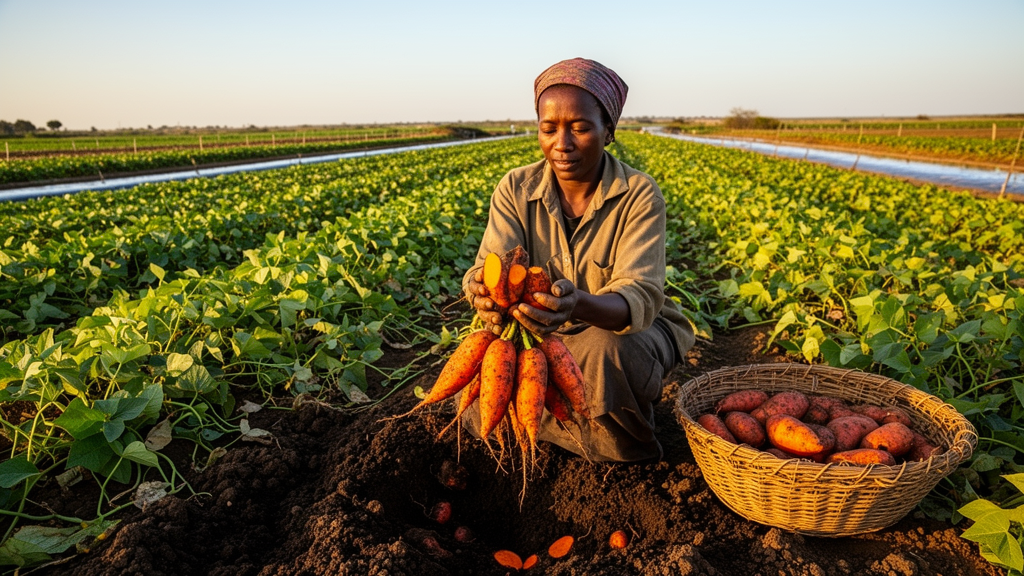
Sweet potato has long been a quiet workhorse of Ethiopian food security, a crop that keeps producing when drought flattens cereals and legumes. Now a carefully run on-farm demonstration in the Sedeni irrigation scheme of Habru district, in the North Wollo Zone of the Amhara region, has shown how two improved orange-fleshed varieties perform when farmers, researchers, and extension agents evaluate them side by side under real field conditions. The trial, published in Innovations in Agriculture, pits the Birtukanie variety against Jari across six host farmers’ fields, and the results carry implications that stretch well beyond a single district.
The stakes are nutritional as much as agronomic. Vitamin A deficiency remains a serious public health concern across the developing world, causing night blindness, stunted growth, and increased mortality risk, with the heaviest burden falling on young children, pregnant and lactating women, and rural populations living in poverty. Orange-fleshed sweet potato varieties are naturally rich in β-carotene, which the human body converts into vitamin A, offering an affordable and year-round source of the nutrient for low-income households. The varieties officially released in Ethiopia are notably dense in macro- and micronutrients, containing β-carotene at 20.01 milligrams per 100 grams, protein at 7.08 percent, iron at 2.55 milligrams per 100 grams, and zinc at 1.42 milligrams per 100 grams, alongside substantial sugars including fructose, glucose, and sucrose.
Ethiopia’s sweet potato story is one of remarkable recent transformation. For many years the national average yield on farms languished below 9 tonnes per hectare, but expansion of production, adoption of improved varieties, and better agronomic practices have pushed productivity to 36 tonnes per hectare according to national statistics. The crop ranks third among the country’s root crops, after enset and potato, and is an integral part of the cropping system in the eastern, southern, and south-western parts of the nation. Its ability to thrive under poor environmental conditions with low input requirements makes it a critical safety crop in regions where unfavourable weather can cause the failure of staple cereals and legumes.
Yet the adoption of improved technologies by Ethiopian farmers remains limited, largely because of weak connections between farmers and research institutions and insufficient dissemination of research outputs. Erratic and irregular rainfall is a growing problem across the country, and micronutrient deficiency is a serious issue generally and particularly in the Amhara region. To bridge this extension gap, the research team turned to the Farmers–Research–Extension Group approach, an innovation platform that brings together farmers, researchers, and agricultural experts from district to kebele levels for collaborative problem identification, joint planning, implementation, monitoring, and evaluation. In the Sedeni irrigation scheme, a group of 33 farmers was established and actively involved throughout the demonstration, electing a chairperson and a secretary after discussions with a multidisciplinary research and extension team.
The demonstration itself was deliberately practical. Host farmers were purposively selected in collaboration with district and kebele agriculture offices based on land accessibility, willingness to participate, and soil suitability. Before planting, training was provided to agricultural experts and development agents covering the sweet potato production package, disease and pest management, post-harvest handling, and utilization, reaching 43 participants in total, including 33 farmers, two development agents, and eight researchers. The two orange-fleshed varieties were planted on six host farmers’ fields in 10 by 10 metre plots, with recommended spacing of 1 metre between ridges and 0.3 metres within plants. Field days were organized at physiological maturity and during harvesting, including post-harvest sensory evaluation, drawing 47 participants and even promotion through Amhara Television programs and North Wollo communication affairs.
The yield data tell a subtle but significant story. Statistical analysis using a t-test in Gen Stat version 17 revealed that most yield and yield-related traits showed no significant difference between the two varieties, with one striking exception: root number per plant. Birtukanie produced an average of 13 roots per plant, whereas Jari produced only 4, a difference that proved statistically significant and contributed substantially to Birtukanie’s numerically higher total root yield of 33.56 tonnes per hectare compared with Jari’s 31.23 tonnes per hectare. This finding aligns with earlier research showing that a higher number of tuberous roots per plant is a key yield-determining trait and an important criterion for selecting adaptable, high-yielding sweet potato varieties.
The inverse relationship between root number and root size adds an intriguing twist. Jari, with fewer roots per plant, recorded the highest average root weight at 549.1 grams, whereas Birtukanie recorded a much lower 108.9 grams, although this variation was not statistically significant. Jari also produced a higher yield per plant, 1775 grams against Birtukanie’s 1409 grams, attributable to its larger average root size. The two varieties thus embody contrasting yield-component profiles: Birtukanie is characterized by many roots and higher total yield, while Jari produces fewer but larger roots with higher per-plant output. From a practical farming perspective, these differences offer distinct strategic advantages depending on production objectives, whether maximizing bulk yield for household consumption and local markets or meeting market and industrial preferences for large, uniform tubers that may command premium prices.
Farmers’ evaluations, analyzed using a five-point Likert scale and the Relative Importance Index, revealed a clear pattern of preference. Jari was favoured for root size and firmness, corresponding with its higher average root weight and better quality after cooking, while both varieties received similar scores for root shape, color, and easiness for cooking. Birtukanie, however, received a higher preference score for productivity, reflecting its greater total root yield, and was strongly preferred for taste and palatability, indicating superior consumer acceptance despite its smaller individual root size. Feedback gathered from farmers and stakeholders painted a consistent picture: sweet potato was valued as an easy-to-grow, low-cost, drought-tolerant crop with minimal pest and disease problems that performs well on poor soils, and the propagation method using stem cuttings was perceived as simple, efficient, and cost-effective. Farmers particularly appreciated Birtukanie for its many tubers, marketable size, high productivity, and cake-like taste, while Jari’s large root size was seen as a potential market liability that made cooking, consumption, and sale more difficult.
The demonstration’s conclusions point toward scaling up Birtukanie across Habru district and similar agro-ecologies, supported by extension services promoting recommended production practices including planting, disease management, and harvesting. Researchers emphasize that efforts should also focus on ensuring the availability of quality planting materials through strengthened stem cutting propagation systems, and on establishing strong market linkages for the sale of sweet potato tubers and vines. Further on-farm trials in diverse locations are encouraged to validate adaptability under varying management practices, and incorporating farmers’ feedback through participatory approaches remains essential to adoption and sustainability. For a crop that can still produce harvests when drought or unfavourable weather causes the failure of cereals and legumes, the message from North Wollo is unambiguous: matching improved varieties to both yield potential and farmers’ preferences can enhance productivity, income, and household food security in food-insecure regions, one irrigated field at a time.
Subject of Research: Pre-extension demonstration of sweet potato varieties under the Sedeni irrigation scheme in Habru district, North Wollo
Article Title: Pre-extension demonstration of sweet potato ( Ipomoea batatas L.) varieties under the sedeni irrigation scheme in Habru district, North Wollo
Article References: Haile, A., Siyum, N., Gashaw, B., & Zemene, B. (2026). Pre-extension demonstration of sweet potato (Ipomoea batatas L.) varieties under the sedeni irrigation scheme in Habru district, North Wollo. Innovations in Agriculture, 9, Article e180520. https://doi.org/10.3897/ia.2026.180520
Image Credits: AI Generated
Keywords: sweet potato, Ethiopia, orange-fleshed sweet potato, vitamin A, food security, agriculture, crop yield, farmer preference, North Wollo, irrigation, Pre-extension, demonstration
Cite Scienmag News
Alan Morgan. (October 17, 2026). Orange-Fleshed Sweet Potato Delivers a Yield Surprise on Ethiopian Irrigated Farms. Scienmag. https://scienmag.com/orange-fleshed-sweet-potato-delivers-a-yield-surprise-on-ethiopian-irrigated-farms/
Alan Morgan. "Orange-Fleshed Sweet Potato Delivers a Yield Surprise on Ethiopian Irrigated Farms." Scienmag, 17 October 2026, https://scienmag.com/orange-fleshed-sweet-potato-delivers-a-yield-surprise-on-ethiopian-irrigated-farms/. Accessed 17 October 2026.
Alan Morgan. "Orange-Fleshed Sweet Potato Delivers a Yield Surprise on Ethiopian Irrigated Farms." Scienmag. October 17, 2026. https://scienmag.com/orange-fleshed-sweet-potato-delivers-a-yield-surprise-on-ethiopian-irrigated-farms/


