


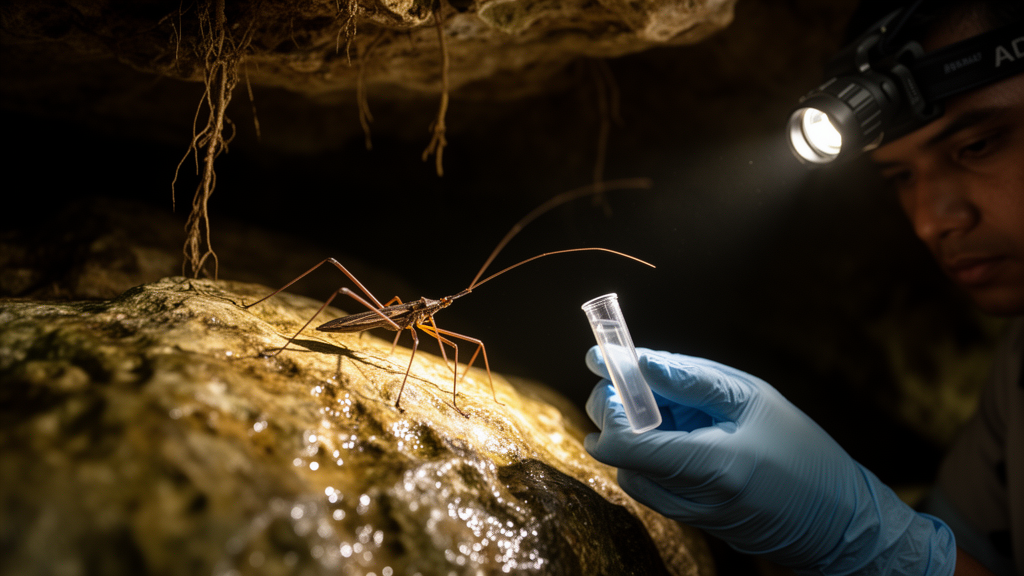
Deep inside the limestone caves of Baratang Island, a team of Indian researchers has stumbled upon a creature that science had not seen alive for a full century. Thread-legged assassin bugs are among the most cryptic predators in the insect world, with bodies so elongated and slender that they are often mistaken for twigs or crane flies. One species in particular, Myiophanes kempi, described in 1924 from Siju Cave in what was then Assam and is now Meghalaya, had never been collected again since its original discovery. That changed in 2019, when two male specimens turned up during a systematic survey of caves on the Andaman Islands, a tropical archipelago in the Bay of Bengal. The find, published in the journal Subterranean Biology, marks the first record of this bug from the Andaman Islands and confirms that a living population of M. kempi still exists after 100 years.
The rediscovery is remarkable not only for its rarity but also for its geography. The type locality of M. kempi lies in the Garo Hills of northeastern India, while the new specimens were collected more than 1,000 kilometres to the southeast on Baratang and Interview Islands. Geologically, the Andaman–Nicobar archipelago is the emergent crest of a long submarine ridge extending from the Arakan–Yoma ranges of western Myanmar in the north to Sumatra in the south, and it sits roughly 1,200 kilometres from the Indian mainland. Whether the Andaman population is native or the result of transport by human agency remains an open question. Thread-legged assassin bugs are known to have an unusually high spreading potential, and some emesine species are distributed across entire biogeographical regions, yet it is often uncertain whether such ranges are natural or human-caused.
The genus Myiophanes is one of the emesine lineages in which many species are found in caves. Emesinae, the thread-legged subfamily of the assassin bug family Reduviidae, can be recognized by a distinctive suite of characters: an elongate, slender body, forecoxae at least four times as long as wide, fore acetabular openings directed anteriorly, absent ocelli with a single exception, unequal fore tarsal claws armed with comb-like teeth or lamellae, thread-like mid and hind legs, and the absence of the fossula spongiosa on all legs. The genus is currently subdivided into three subgenera and occurs across the Ethiopian, Oriental, Australian and Palearctic regions. The nominotypical subgenus contains ten described species, of which three are known from India. M. kempi is the oldest of these, known for a century only from type material preserved in the Natural History Museum in London.
The specimens were collected by a team surveying cave fauna as part of a conservation project for the edible-nest swiftlet, Aerodramus fuciphagus, in the Andaman Islands. The first male was taken on 13 January 2019 from a cave on Interview Island, the largest wildlife sanctuary in the archipelago, an uninhabited carbonate island harbouring 35 known limestone caves. The second was collected on 16 February 2019 from Baratang Island, which hosts the most significant cave complex on the islands, with more than 175 limestone caves packed into less than one square kilometre of protected reserve forest. Both specimens were preserved in 100 percent ethanol and later examined morphologically at the SACON facility, where they were identified as males of M. kempi using established keys and the original species description.
The habitat details are telling. The Interview Island cave is a horizontal, multi-chambered structure measuring 89.4 metres in length, oriented north-northeast to south-southwest, with two openings and clear zonation. It serves as habitat for both swiftlets and bats, and the specimen was collected from the wall in the dark zone. The Baratang cave is a shorter horizontal passage of 21.1 metres with a single entrance and distinct zones: an entrance zone from one to eight metres, a twilight zone from eight to thirteen metres, and a dark zone from fourteen to twenty-two metres. The bug was found on the right wall surface about fourteen metres from the entrance, at the confluence of the twilight and dark zones, in crevices roughly two metres above the ground, where the substrate is mixed with edible-nest swiftlet guano.
Because the original 1924 description was never accompanied by illustrations, the new study provides the first illustrated account of the species, including the first detailed depictions of the male genitalia. The redescription portrays a medium-sized, elongate, macropterous emesine bug of about 20 millimetres total length, with a pilose body, contrasting colour markings on the pronotum, fore legs and abdomen, and translucent pale-brown forewings with dark-brown veins. The head is elongate and fusiform, almost as long as the anterior lobe of the pronotum, with large globular eyes and a strongly bent labium. The antennae, inserted at the middle of the anteocular region, are much longer than the body, with the first two segments very long and equal in length. The fore legs carry two series of spiniferous processes on the ventral side of the femur, the posteroventral series beginning close to the base with ten long processes, while the fore tarsus is very short, about one-tenth of the tibia, with unequal claws bearing comb-like sub-basal processes.
The male genitalia reveal characters of particular taxonomic significance. The pygophore is cup-like, convex ventrally and not covered dorsally, with a sharp superoposterior spine surrounded by curved, criss-crossing parameres. After potassium hydroxide treatment, a blunt tubercle becomes visible at the base of the long spine, a feature apparently unique among males of the Oriental subgenus and one also observed by a researcher who dissected the pygophore of the syntype male in London. China’s original phrase describing a genital segment with three pale yellow styles strongly curved and almost contiguous at their apices actually refers to the two curved parameres around the median pygophoral spine. The phallus is symmetrical with a stout articulatory apparatus, and the parameres are curved in their distal third, pointed at the apex and armed with long setae in the distal half.
Comparisons with photographs of the syntype and allotype females preserved in London, kindly shared by colleagues, confirmed the identity of the Andaman specimens. The colouration of the head, pronotum, fore legs and forewing venation matches the century-old type material, though the syntypes have faded over years of preservation. Some variation is evident: one male has a blackish abdomen speckled with black ventrally as originally described, while the second shows midventral and lateral black lines similar to the abdominal colouration of the female syntype. The new specimens also appear to have somewhat longer mid and hind legs than the measurements recorded in 1924. Among Oriental species, M. kempi is distinguished by its much longer head and neck, a uniquely shaped pronotum whose anterior lobe is as long as the head, and the absence of the transverse black annuli on the abdomen seen in relatives such as M. zebrina, M. incompta, M. greeni and M. wygodzinskyi.
The rediscovery carries biogeographical weight. A recent survey of Siju Cave in February 2019 failed to recover either M. kempi or the emesine Bagauda cavernicola, both reported from that cave a century ago, making the Andaman population all the more significant. The researchers note that similar specimens resembling P. cavernicola have recently been collected from Andaman caves and are currently under study. The story also echoes that of M. greeni, described from Sri Lanka in 1903 but not recorded from India for over a hundred years until its report from a cave in Satara, Maharashtra, in 2016, a pattern the authors attribute to a lack of surveys and expertise and a general disregard for insects in biodiversity assessments.
Caves are island-like habitats that support distinct ecosystems of highly specialised organisms, and while many studies attribute the presence of assassin bugs inside caves to prey availability, limited ecological information exists for these predators. None of the cave-dwelling Myiophanes show features of true troglobites, such as loss of pigmentation or eyes, and M. kempi itself has been found both within and outside cave environments. The authors argue that systematic surveys to document cave diversity in the Andaman Islands are essential, both to reveal whether other invertebrates from northeastern Indian caves also occur on the islands and to strategize conservation priorities for these fragile karst ecosystems. For now, a slender predator that vanished from scientific view for a hundred years is once again on the record, lurking in the dark zones of tropical limestone caves.
Subject of Research: Rediscovery of the cave-dwelling assassin bug Myiophanes kempi in the Andaman Islands
Article Title: Rediscovery and redescription of thread-legged assassin bug Myiophanes kempi China, 1924 ( Heteroptera , Reduviidae , Emesinae ) from caves in the Andaman Island, India
Article References: Kawalkar, D., Patil, P., Ghate, H. V., & Manchi, S. (2026). Rediscovery and redescription of thread-legged assassin bug Myiophanes kempi China, 1924 (Heteroptera, Reduviidae, Emesinae) from caves in the Andaman Island, India. Subterranean Biology, 55, 77-94. https://doi.org/10.3897/subtbiol.55.181079
Image Credits: AI Generated
DOI: 10.3897/subtbiol.55.181079
Keywords: entomology, cave biology, Reduviidae, Andaman Islands, taxonomy, biogeography, subterranean ecosystems, Rediscovery, redescription, thread-legged, assassin, Myiophanes
Cite Scienmag News
Gavin Prescott. (October 17, 2026). Assassin bug lost for 100 years found alive in Andaman Island caves. Scienmag. https://scienmag.com/assassin-bug-lost-for-100-years-found-alive-in-andaman-island-caves/
Gavin Prescott. "Assassin bug lost for 100 years found alive in Andaman Island caves." Scienmag, 17 October 2026, https://scienmag.com/assassin-bug-lost-for-100-years-found-alive-in-andaman-island-caves/. Accessed 17 October 2026.
Gavin Prescott. "Assassin bug lost for 100 years found alive in Andaman Island caves." Scienmag. October 17, 2026. https://scienmag.com/assassin-bug-lost-for-100-years-found-alive-in-andaman-island-caves/


