


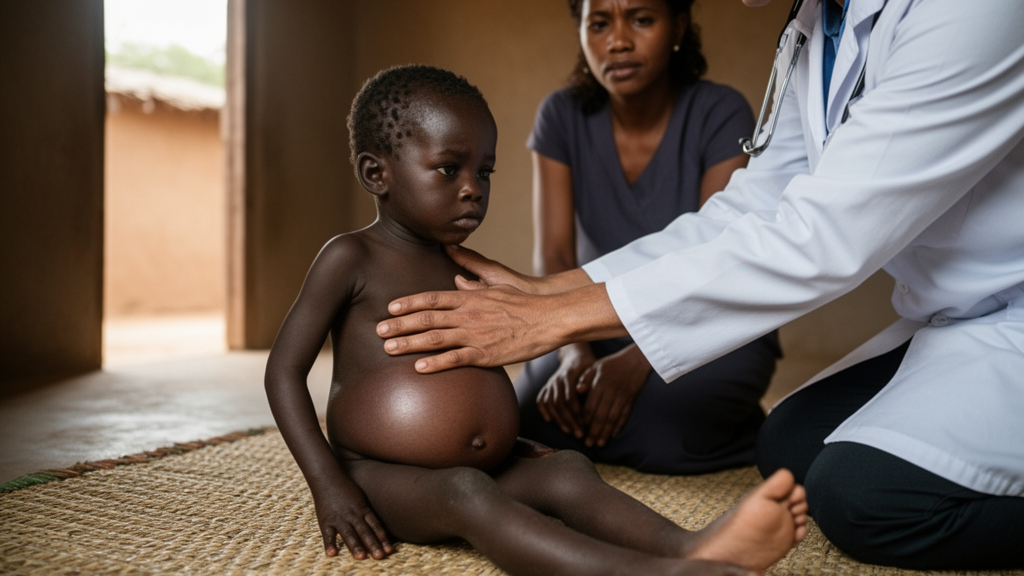
For nearly a century, doctors have puzzled over one of medicine’s most haunting questions: why do two children in the same village, eating the same inadequate diet, fall into two entirely different forms of severe malnutrition? One child wastes away, all skin and bone, while the other develops kwashiorkor, the swollen, edematous form of malnutrition marked by fluid-filled limbs, skin lesions, fatty liver, and a far higher risk of death. Now, a large genetic study published in Nature Communications points to a striking answer buried in the children’s DNA: variants in genes that govern one-carbon metabolism, carried on ancestral haplotypes common in East African populations, appear to shape which form of severe acute malnutrition a child develops.
Severe acute malnutrition affects an estimated 16.9 million children worldwide, most of them under five years old, and contributes directly or indirectly to more than a million childhood deaths each year. Clinicians recognize two distinct syndromes. Non-edematous malnutrition, historically called marasmus, is dominated by profound wasting of body tissues. Edematous severe acute malnutrition, which includes kwashiorkor and marasmic-kwashiorkor, presents with bilateral pitting swelling of the extremities and severe systemic involvement that can include skin and hair changes, fatty liver, and multi-system organ failure. Among children hospitalized with medical complications, the edematous form carries mortality rates of 10 to 20 percent, and it accounts for a larger share of hospitalized cases in east and central Africa and the Caribbean.
Decades of epidemiological research have failed to find consistent differences in protein intake, any other single dietary factor, or infectious exposures between children who develop the two forms. That failure pushed researchers toward biochemistry. One-carbon metabolism, the cellular circuitry that shuttles methyl groups through the folate and methionine cycles, has emerged as a leading suspect. The pathway supplies substrates for mitochondrial energy production, building blocks for DNA repair, and the methyl groups needed to maintain DNA methylation in dividing cells. Children with the edematous form show significantly lower serum methionine, dysregulated asymmetric dimethylarginine, lower cysteine, impaired cysteine synthesis, and reduced acylcarnitine production. Mice fed a maize-vegetable diet resembling that of malnourished Malawian children develop a fatty liver like that seen in kwashiorkor, and the phenotype disappears when the methyl-group donor choline is supplemented.
Earlier work by the same team found that children with edematous malnutrition have significantly lower DNA methylation in buccal cells during acute illness than children with the wasting form, consistent with slowed methionine turnover, and that these differences vanish in adults who recovered years earlier. But none of these findings explained why only some children in the same environment develop the deranged metabolic profile. A clue came from readmission records: children who survive one bout of severe malnutrition tend to return with the same form if they relapse, hinting at an inherited predisposition. Previous genetic studies, however, amounted to only three small candidate-gene analyses conducted decades ago in samples of fewer than 200 people.
The new study, led by Natasha Lie and Neil Hanchard of the National Human Genome Research Institute with collaborators in Jamaica, Malawi, and the United States, is by far the largest genetic investigation of edematous malnutrition to date. The team assembled DNA from 833 children in Jamaica and Malawi, roughly evenly split between the edematous and non-edematous forms at each site. After quality control, 711 samples and nearly 1.8 million genotyped SNPs remained. Rather than scanning the whole genome, the researchers took a hypothesis-driven approach, compiling a curated list of 103 genes involved in one-carbon metabolism and testing more than 54,000 genotyped and imputed variants at 95 of those loci for association with the edematous form.
Six loci showed evidence of association. The strongest signal sat within the first intron of GABBR2 on chromosome 9, a gene previously linked to lower plasma homocysteine in European populations, with the protective minor allele enriched among children with the wasting form. A second intronic signal appeared at PRICKLE2 on chromosome 3, another locus tied to folate levels. Four of the six loci, including AHCYL1, PRICKLE2, GABBR2, and PLD2, directly influence the production or breakdown of homocysteine, the pivotal metabolite of the methionine cycle. Notably, a coding variant in exon 17 of PLD2, an enzyme that generates the methyl-donor choline from phosphatidylcholine, was enriched among edematous cases and is a known expression quantitative trait locus associated with reduced PLD2 transcription.
Because metabolic flux reflects the cumulative activity of many enzymes, the team also tested whether one-carbon variants as a group were enriched for association. A permutation test comparing the pathway’s SNPs against randomly sampled genome-wide SNPs found a significant excess of associations, with a z-score of 3.2 at the strictest threshold, and an even more dramatic separation at more permissive cutoffs. The signal held up against a matched background of ketone metabolism SNPs and vanished for a negative control pathway, sphingolipid metabolism, suggesting the enrichment was specific to one-carbon biology rather than an artifact of linkage disequilibrium.
To probe function, the researchers turned to an unusual resource: cell-free DNA extracted from stored serum samples of an independent Malawian metabolomics cohort. Genotyping four associated variants from that cfDNA and using them as instruments in two-sample Mendelian randomization, they found that the variants mediated causal effects of cystathionine and betaine, metabolites either derived from homocysteine or involved in its reconversion to methionine, on the risk of edematous disease. The results strengthen the case that deficient remethylation of homocysteine to methionine lies at the heart of the syndrome, and they lend support to ongoing trials of choline supplementation in severe malnutrition.
Perhaps the most surprising finding came from population genetics. Effects were consistently stronger in Malawi than in Jamaica despite similar allele frequencies, and when the team used the TRACTOR framework to condition association tests on local ancestry, the signal emerged only on East African-derived haplotypes, not West African ones. Cumulative association was likewise significant for East African ancestry variants but not West African ones. The researchers propose that a shared East African ancestral haplotype, common in Malawi and present in Jamaica through the transatlantic slave trade, carries the risk-modifying variants. Consistent with a history of famine exerting selective pressure, whole-genome sequencing of 151 Malawian children and selection statistics from seven African countries revealed signatures of recent selection at one-carbon loci, with the PLD2 coding variant showing the strongest signal among the associated variants.
The authors caution that the study has limits: heritability estimates carry large standard errors, imputation panels underrepresent African genomic diversity, and no replication cohort yet exists. Still, the work delivers a conceptual breakthrough. It confirms aberrant one-carbon metabolism as a genuine etiological contributor to the world’s deadliest form of childhood malnutrition, demonstrates that intra-continental African admixture can be harnessed to map disease risk, and offers a concrete metabolic target for intervention. For the millions of children who face starvation each year, the difference between wasting and swelling may ultimately rest on methylation chemistry written into their genomes long before they were born.
Subject of Research: Genetic variants in one-carbon metabolism genes and East African ancestry underlying edematous severe acute malnutrition
Article Title: Aberrant one-carbon metabolism and ancestral genetics underlie edematous severe acute malnutrition
Article References: Lie, N. C., Han, Y., Li, Q., Jajoo, A., Redmond, J., Haldipur, A., Zewdu, S., Banfield, E., Swaminathan, S., Howell, S., Brown, O., Sadat, R., Hall, N. J., Marshall, K., Schulze, K. V., May, T., Reid, M. E., Taylor-Bryan, C., Manary, M. J., … Hanchard, N. A. (2026). Aberrant one-carbon metabolism and ancestral genetics underlie edematous severe acute malnutrition. Nature Communications, 17(1), Article 10798. https://doi.org/10.1038/s41467-026-74239-x
Image Credits: AI Generated
DOI: 10.1038/s41467-026-74239-x
Keywords: kwashiorkor, severe acute malnutrition, one-carbon metabolism, homocysteine, folate, GABBR2, PLD2, Mendelian randomization, local ancestry, East African ancestry, genetic association study, choline
Cite Scienmag News
Juliet Wilcox. (October 17, 2026). Ancient Genes and Broken Methylation May Decide Which Starving Children Swell. Scienmag. https://scienmag.com/ancient-genes-and-broken-methylation-may-decide-which-starving-children-swell/
Juliet Wilcox. "Ancient Genes and Broken Methylation May Decide Which Starving Children Swell." Scienmag, 17 October 2026, https://scienmag.com/ancient-genes-and-broken-methylation-may-decide-which-starving-children-swell/. Accessed 17 October 2026.
Juliet Wilcox. "Ancient Genes and Broken Methylation May Decide Which Starving Children Swell." Scienmag. October 17, 2026. https://scienmag.com/ancient-genes-and-broken-methylation-may-decide-which-starving-children-swell/


