


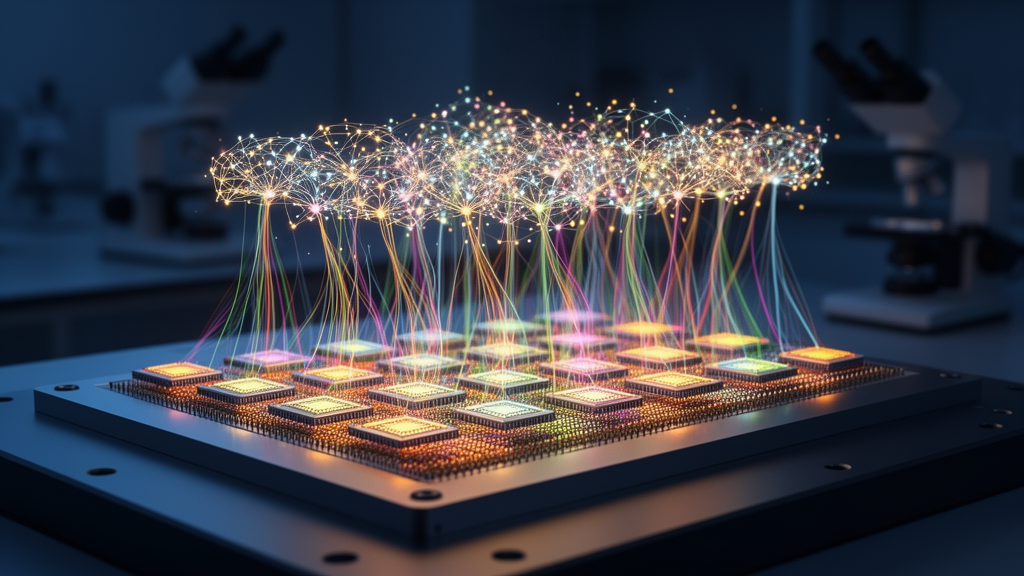
Machine learning has quietly become one of the most powerful tools in the photonics toolbox, and a new collection of research published in Frontiers in Photonics shows just how far the marriage between artificial intelligence and light-based engineering has progressed. The editorial, authored by Georgios D. Barmparis, Giorgos P. Tsironis, and Demetri Psaltis, draws together studies spanning data-driven modeling, physics-informed neural networks, and all-optical computing, painting a picture of a field that is rapidly outgrowing the trial-and-error methods that defined its early decades.
For most of the history of optics, designing a lens, a waveguide, or a laser cavity meant relying on analytical formulas and iterative refinement. That approach worked well enough for linear optical components, where light behaves predictably and design spaces remain manageable. But modern photonics has moved far beyond simple lenses and mirrors. Today’s researchers build metasurfaces that manipulate light at the nanoscale, nonlinear metamaterials whose properties change with intensity, and integrated photonic circuits that route signals across chips with extraordinary precision. Each of these platforms involves enormous design spaces and highly nonlinear interactions between light and complex materials, making purely analytical design methodologies increasingly impractical.
The editorial argues that machine learning offers a fundamentally new engineering strategy for this new era. Data-driven methods can explore vast parameter landscapes that would overwhelm human designers, identifying optimal configurations for advanced optical devices. Yet the authors also highlight a crucial limitation: purely data-driven approaches often struggle to capture the underlying physical principles that govern complex optical phenomena. A neural network trained only on examples may interpolate well within its training distribution but fail catastrophically when asked to extrapolate beyond it, and it may offer little insight into why a particular design works.
This is where physics-informed and physics-inspired machine learning frameworks come in. By integrating physical constraints and prior knowledge directly into the learning process, these hybrid approaches yield models that are more accurate, more robust, more interpretable, and more computationally efficient than their purely data-driven counterparts. The editorial emphasizes that such methods are not merely accelerating device design; they are also improving our fundamental understanding of light propagation and nonlinear optical dynamics, and enabling the discovery of novel materials with targeted functionalities.
One of the collected studies, by Yang and colleagues, demonstrates the power of data-driven frameworks for capturing fundamental wave dynamics. The researchers applied Sparse Identification of Nonlinear Dynamics, known as SINDy, to numerically capture the evolution of moment quantities associated with the nonlinear Schrödinger equation, which governs a wide range of nonlinear wave phenomena. By combining sparse regression with optimization techniques, the method effectively reproduces complex nonlinear dynamics, rediscovers known analytical closures, and provides reduced-order descriptions even for systems lacking exact analytical formulations. This kind of capability is essential for developing all-optical computing and signal-processing technologies that rely on understanding nonlinear wave behavior.
Physics-inspired neural architectures also play an increasingly important role in inverse problems arising in optical sensing and spectroscopy. Witteveen and colleagues tackled the challenge of retrieving optical properties from diffuse scattering media, a computationally demanding task when based solely on traditional diffusion theory. Their physics-inspired neural network extracts physiological parameters from diffuse reflectance spectroscopy and hyperspectral imaging data. Trained on datasets generated by diffusion theory, the model achieves accurate retrieval of quantities such as blood volume fraction and scattering amplitudes while dramatically reducing computational cost relative to conventional inversion methods. The approach holds particular promise for medical and biomedical imaging, where rapid and accurate parameter extraction can directly impact diagnostic workflows.
Machine learning is likewise proving valuable in parameter optimization and experimental design. Aledda and colleagues investigated several machine learning strategies for wavelength selection in tunable mid-infrared laser systems, where protein and peptide characterization requires identifying optimal wavelength ranges across broad spectral domains. The researchers compared sparse modeling, filter-based approaches, and compression algorithms, and introduced a new method called w-CovSel. Their work demonstrates how data-driven optimization can improve the performance and efficiency of laser-based analytical instruments tailored to specific biochemical applications such as peptide analysis, showing that intelligent wavelength selection can make sophisticated spectroscopy more accessible and more effective.
The editorial also highlights a growing shift toward photonics for machine learning, where optical hardware itself is used to accelerate computational tasks. While much current research applies machine learning to photonic design, an emerging direction seeks to embed machine learning algorithms directly within optical systems to achieve ultrafast and energy-efficient information processing. Mahmoud and colleagues contribute to this direction by proposing an Optical Particle Swarm Optimization algorithm that employs an all-optical computational update mechanism. By exploiting the natural properties of coherent optical dynamics, including nonlinear light-matter interactions and complex-domain computation, their approach demonstrates that optical computing can significantly enhance search-space exploration and improve dyslexia detection performance using eye-tracking data.
Taken together, the studies indicate that photonics is entering a new era characterized by the synergistic integration of physics-informed artificial intelligence, nonlinear optical science, and optical computing hardware. The field is evolving beyond computationally assisted optimization toward increasingly autonomous and intelligent photonic design paradigms, where machine learning algorithms operate under explicit physical constraints and interact directly with optical hardware platforms. This represents a departure from the conventional workflow in which a human designer formulates a problem, a computer explores it, and a physicist interprets the results; instead, the entire loop is becoming more tightly integrated and more intelligent.
Looking forward, substantial challenges remain. Progress will require access to large, high-quality datasets, while experimental data acquisition, particularly in sensitive fields such as biophotonics, often remains costly and difficult. Transitioning from software-based machine learning models to scalable physical optical neural networks presents major challenges associated with scalability, robustness, and signal-to-noise limitations. Nevertheless, the contributions collected in this Research Topic provide a strong foundation for addressing these obstacles and point toward a future in which machine learning and photonics become deeply integrated components of a unified technological framework for scientific discovery and advanced device engineering.
Subject of Research: Machine-learning-assisted photonic design spanning fundamental physics and advanced devices
Article Title: Editorial: Machine-learning-assisted photonic design: from fundamental physics to advanced devices
Article References: Barmparis, G. D., Tsironis, G. P., & Psaltis, D. (2026). Editorial: Machine-learning-assisted photonic design: from fundamental physics to advanced devices. Frontiers in Photonics, 7, Article 1884316. https://doi.org/10.3389/fphot.2026.1884316
Image Credits: AI Generated
DOI: 10.3389/fphot.2026.1884316
Keywords: photonics, machine learning, physics-informed neural networks, metasurfaces, nonlinear optics, optical computing, inverse design, biophotonics, Editorial, Machine-learning-assisted, photonic, design
Cite Scienmag News
Katie Riggs. (October 17, 2026). Machine Learning Rewrites the Rules of Photonic Design from Physics to Devices. Scienmag. https://scienmag.com/machine-learning-rewrites-the-rules-of-photonic-design-from-physics-to-devices/
Katie Riggs. "Machine Learning Rewrites the Rules of Photonic Design from Physics to Devices." Scienmag, 17 October 2026, https://scienmag.com/machine-learning-rewrites-the-rules-of-photonic-design-from-physics-to-devices/. Accessed 17 October 2026.
Katie Riggs. "Machine Learning Rewrites the Rules of Photonic Design from Physics to Devices." Scienmag. October 17, 2026. https://scienmag.com/machine-learning-rewrites-the-rules-of-photonic-design-from-physics-to-devices/


