


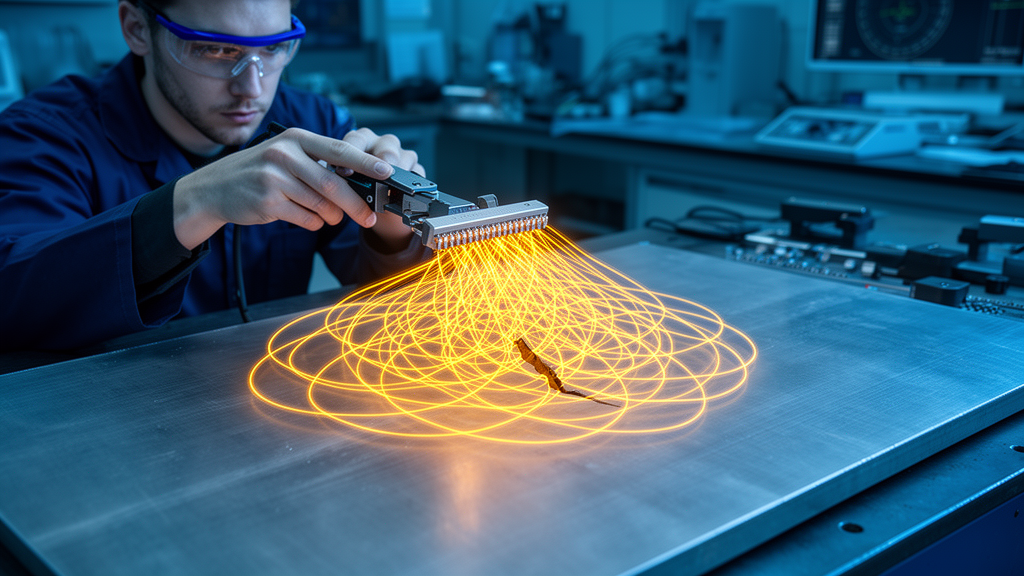
Ultrasonic testing is one of the quiet workhorses of modern industry. From checking the wall thickness of pipelines to hunting for cracks in turbine disks, the technique relies on a simple principle: a transducer sends an acoustic pulse into a material, the pulse bounces off the back wall or a defect, and the time it takes to return — the time-of-flight — reveals thickness, material properties, or flaws. But as test cases grow more complex, engineers increasingly turn to multi-transducer systems, where several probes work together for higher accuracy or entirely new measurement capabilities. There is a catch, and it is a frustrating one: when each channel must be excited and evaluated one after another, execution time and data volume balloon faster than linearly with the number of channels.
A team at the Fraunhofer Institute for Nondestructive Testing IZFP in Saarbrücken and Technische Universität Ilmenau has now borrowed a trick from an unexpected place — the satellite navigation system GPS — to break that bottleneck. In a study published in Frontiers in Acoustics, Marius W. Schäfer, Giovanni Del Galdo, and Sarah C. L. Fischer demonstrate that orthogonal spread code sequences, the same family of codes that keeps GPS satellites from jamming each other, can drive every channel of an ultrasonic testing system simultaneously. The signals overlap in the specimen, yet post-processing separates them cleanly, turning a sequential chore into a fully parallel one.
The underlying idea comes from code division multiple access, or CDMA, a cornerstone of digital communications. In direct sequence spread spectrum, each channel is assigned a different code sequence, and orthogonality — the mathematical property that lets decorrelation separate the signals within the cross-correlation ratio — is achieved by modulating orthogonal codes onto channels sharing the same frequency band. Alternatives exist. Time division multiple access waits for each ultrasonic signal to fade before the next channel fires, which becomes painfully slow as channels multiply. Frequency division splits channels into separate bands, but narrowband transducers make channel-to-channel transmission difficult, and wideband transducers leave only a sliver of bandwidth per channel. Simpler keying schemes such as phase, frequency, or amplitude shift keying work for single transmissions but degrade badly when signals overlap. CDMA, the authors argue, is best suited to ultrasonic testing because it keeps transmission time short while preserving accuracy across a large bandwidth.
Choosing the right codes was the first hurdle. The researchers compared three candidate sets: random binary sequences, random Gaussian sequences, and Gold codes, which are generated by combining two maximum length sequences with different seeds using shift registers. With six linear-feedback shift register elements, the Gold code set yielded 63 codes, or 65 orthogonal sequences including the two initial ones — enough for 65 potential parallel channels. The cross-correlation statistics told a clear story. All three sets averaged a cross-correlation maximum of roughly 25 to 26 percent, but the worst case separated them dramatically: 36.0 percent for Gold codes against 52.4 percent for random binary and 51.0 percent for random Gaussian. Gold codes simply never let any two sequences become uncomfortably similar, which is precisely why GPS relies on them.
The experimental platform was a custom-built two-channel ultrasonic testing system designed to behave in a fully linear manner, a property achieved by driving the transducers in differential mode with operational amplifiers. The transducers themselves are 3:1 piezoelectric composites of PZ29 ceramic and araldite epoxy, with a nominal center frequency of 5 MHz, mounted on a 60 mm-thick steel block using ring magnets and engine oil as the coupling fluid. The system includes an arbitrary signal generator based on 2048-element look-up tables and a 16-bit data acquisition section, operating at a digital frequency of 125 MHz — one sample every 8 ns. Measurements ran in pulse-echo mode, with a digital rectangular filter allowing a passband between 2 and 11 MHz.
The first experiments revealed a sobering truth about physics. Two Gold codes measured independently had a sharp auto-correlation maximum and a cross-correlation distance of 72 percent in the digital domain. Once converted into ultrasonic signals by the real hardware, that distance collapsed to 25 percent — far too ambiguous for reliable time-of-flight determination. The culprit is the system’s transfer function: gain and phase variations across the bandwidth distort the transmitted codes, destroying the carefully engineered correlation properties. Direct evaluation of raw ultrasonic echoes, the team found, is simply not suitable for separating overlapping coded signals.
The solution was compensation. By applying the inverse of the system’s transfer function to the recorded echoes, the researchers restored much of the original code character. The auto-correlation distance climbed back to 60 and 70 percent, and the cross-correlation side lobe distance reached 50 percent. In the two-transducer validation, both codes were correctly detected in every evaluation window — the echo from the opposing transducer, the backwall echo from the recording transducer, and the reflected echo from the opposing channel — even though the signals were inverted at the specimen boundaries. Remarkably, correlating the compensated echoes directly with the digital codes also worked, showing that single-echo computation is not even required for a successful code decision.
To prove the method scales, the team simulated a nine-transducer setup by superposing nine Gold code sequences with random time offsets between 0 and 8000 ns and random amplitude factors between 0.5 and 1, mimicking the overlapping echoes of different amplitudes that arrive at a receiver in a complex test object. After compensation, every code was localized with an error of less than 4 ns — half the system’s sampling interval — using a polynomial fit to resolve fractional delays. Only one code, scaled to the lowest amplitude with an unfortunate overlap, came close to the cross-correlation level, with a side lobe distance of just 7 percent. The uncompensated ultrasonic signal, by contrast, mostly failed evaluation, exactly as the earlier single-code experiments predicted.
The compensation is not free. Applying the inverse transfer function amplifies noise alongside the signal, and bandwidth limitations mean some parts of the code are never fully reconstructed. The average cross-correlation maximum for compensated ultrasonic signals was 44.8 percent, better than the 66.5 percent of uncompensated signals but still well above the 24.5 percent of the ideal digital codes. The authors also flag practical constraints: when many channels fire at once, the summed sound pressure may push the material beyond its linear acoustic range, introducing nonlinear effects that the linear transfer function cannot cover. Constructive overlap at a receiver can also overdrive amplifiers or the ADC, so gain must be reduced or code selection and clever delays used to manage the interaction area — a delay even shorter than the code duration can help while keeping the measurement in a single cycle.
Even with those caveats, the implications are striking. Compared with recent approaches — Golay codes for medical imaging, TOP-CS sequences for low-power ultrasonics, Hadamard and chirp schemes simulating 256 channels — this work offers a short code duration of about 1 second and 65 usable orthogonal codes, letting specimens with small geometry and high sonic velocity be evaluated without echoes colliding with ongoing excitation. Techniques such as full matrix capture, which fires transducers sequentially and suffers accordingly long acquisition times, could profit enormously; even running a fraction of channels in parallel cuts execution time by the number of simultaneous senders. The authors see particular promise in hazardous environments, where reducing personnel exposure time matters more than anything, and note that coded sequences improve the sharpness of correlation maxima — and therefore image sharpness — while CDMA modulation performs well in multipath environments and resists narrowband interferers. The next step, they say, is porting the method to state-of-the-art test systems, potentially using on-board FPGAs to separate superimposed coded echoes in real time.
Subject of Research: Ultrasonic Testing
Article Title: Compensated orthogonal spread codes for full parallel usage of multi-transducer ultrasonic testing systems in NDE
Article References: Schäfer, M. W., Del Galdo, G., & Fischer, S. C. L. (2025). Compensated orthogonal spread codes for full parallel usage of multi-transducer ultrasonic testing systems in NDE. Frontiers in Acoustics, 3, Article 1620233. https://doi.org/10.3389/facou.2025.1620233
Image Credits: AI Generated
DOI: 10.3389/facou.2025.1620233
Keywords: ultrasonic testing, non-destructive evaluation, Gold codes, CDMA, coded excitation, signal processing, NDE, acoustics, Compensated, orthogonal, spread, codes
Cite Scienmag News
Carl Richardson. (October 17, 2026). GPS-Inspired Gold Codes Let Ultrasonic Testers Fire All Transducers at Once. Scienmag. https://scienmag.com/gps-inspired-gold-codes-let-ultrasonic-testers-fire-all-transducers-at-once/
Carl Richardson. "GPS-Inspired Gold Codes Let Ultrasonic Testers Fire All Transducers at Once." Scienmag, 17 October 2026, https://scienmag.com/gps-inspired-gold-codes-let-ultrasonic-testers-fire-all-transducers-at-once/. Accessed 17 October 2026.
Carl Richardson. "GPS-Inspired Gold Codes Let Ultrasonic Testers Fire All Transducers at Once." Scienmag. October 17, 2026. https://scienmag.com/gps-inspired-gold-codes-let-ultrasonic-testers-fire-all-transducers-at-once/


