


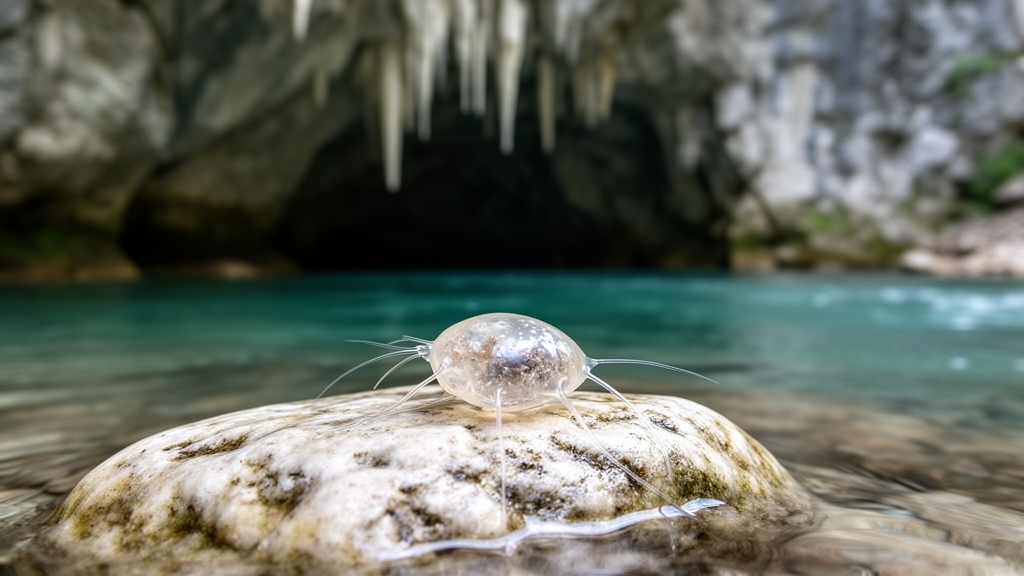
Deep beneath the limestone plateaus of Bosnia and Herzegovina, a seven-year survey of single-celled organisms is rewriting how scientists understand the connections between surface rivers and the subterranean worlds they feed. The study, published in the journal Subterranean Biology, tracked testate amoebae — shelled protists named for the protective test, or shell, that encloses their amoeboid bodies — across an extraordinary range of karst habitats, from aphotic caves to sunlit lakes, from springs touched only by diffuse light to the thin surface layer of soils. The results offer one of the most detailed comparative pictures yet of how microbial assemblages transform as water travels through a karst system.
The research team collected 107 samples at the end of August or the beginning of September over seven years — 2013, 2014, 2018, 2019, 2021, 2023 and 2024 — as part of the International Caving Expedition Ponor Kovači–Izvor Ričine. Sampling sites spanned the Outer Dinarides, a landscape underlain predominantly by Jurassic and Cretaceous limestones and dolomites at elevations between 716 and 1414 metres above sea level. The surveyed network included ten caves, three springs, two lakes, the Šuica River and the sinkhole-type cave Ponor Kovači into which it disappears, together with soil locations across the karst poljes of Hercegbosanska and Zapadnohercegovačka counties.
The hydrological architecture of the study area is what makes it scientifically compelling. The Šuica River, with a total length of 48.5 kilometres, emerges from the Veliki Stražanj spring-cave on an elevated plateau between the karst fields Kupreško Polje and Šuičko Polje. It flows through Šuičko Polje, partly within canyons, and then enters Duvanjsko Polje, a 112-square-kilometre karst field subject to periodic flooding. There the river sinks into Ponor Kovači and continues underground toward the Vrilo Spring at the southeastern margin of Livanjsko Polje — a connection confirmed decades ago by dye tracing across an aerial distance of 5150 metres. During active periods, the Vrilo Spring forms a short surface stream, the Ričina, which flows into the artificial Buško Blato Lake, a reservoir covering 55.92 square kilometres with a maximum depth of 17 metres.
In total, the survey identified 45 taxa of testate amoebae to the species level, along with more than 10 additional taxa identified only at the genus level — more than 50 taxa overall. The highest overall biodiversity was recorded in cave habitats, with 33 identified species, followed by soil with 26 species and spring habitats with 23. Caves also yielded the greatest number of unique species, 11 in total, ahead of soil with 7 and lakes with 6. A notable similarity in species composition emerged among soil, spring and cave habitats, which shared six species. Site-level richness peaked at Ponor Kovači and the Vrilo Spring, each with 23 species, followed by soil above Ponor Kovači with 18 species and the Šuica River with 17.
Among the most striking findings was the detection of Psammonobiotus dinarica, a species originally described from caves, in live preparations from the upper course of the Šuica River — a pristine surface karst river roughly 200 metres downstream of its source. This represents the first reliable record of the species outside a cave environment. Its sister discovery, Centropyxis bipilata, another cave-described species, was found exclusively in caves during this study, supporting the hypothesis that it may be a true troglobiont — a cave-adapted organism, a status so far attributed mainly to cave metazoans. The absence of P. dinarica from the middle and lower sections of the Šuica River, which are impacted by municipal wastewaters and agrochemicals and characterized by higher water temperatures and conductivity, hints at a possible sensitivity to environmental stressors and raises the question of whether the species could serve as a bioindicator of good ecological conditions in karst waters.
Statistical analysis revealed a pattern that surprised the researchers. A hierarchical cluster analysis based on Jaccard similarity produced a clear separation of lake assemblages from all others, with the remaining cluster dividing into two subclusters: one containing cave and soil assemblages, the other containing spring and river assemblages. A more detailed site-level analysis based on Bray-Curtis similarity, tested with the SIMPROF routine at the 5% significance level, confirmed four statistically significant clusters grouping lakes, caves and soil by habitat type. Non-metric multidimensional scaling, with a two-dimensional stress value of 0.13, reinforced the same picture. The literature had long suggested that cave assemblages are composed of aquatic and soil species — but the new results show that this composition does not include lake assemblages, at least in this system.
The most notable result of the entire study, however, was the statistically significant linkage of the hydrologically connected trio: the Šuica River, the sinkhole cave Ponor Kovači, and the Vrilo Spring. These three sites are bound by water — the river sinks into the cave and reappears after approximately 5.2 kilometres at the resurgence spring — and the testate amoebae assemblages reflect that connection. At Ponor Kovači, the studied habitat was a small lateral channel that had remained hydrologically disconnected from the river for several months before sampling. The community there had undergone a transformation: imported phototrophs passively introduced during flood events gradually disappeared, dissolved and particulate organic carbon was consumed, and conditions shifted toward oligotrophy. The data from this channel therefore approximate the processes occurring in the deeper sections of the cave.
One result defied expectation. The Vrilo Spring, which is actually the entrance to a 2.3-kilometre-long cave system, showed greater similarity to the Šuica River than to Ponor Kovači. The researchers had anticipated the opposite, given the spring’s subterranean provenance. The key difference, they argue, lies in light. The studied habitats at Vrilo Spring sit under diffuse daylight, while Ponor Kovači’s channel is entirely aphotic. Fully illuminated rivers and lakes, and habitats with diffuse light such as springs, allow the development of phototrophic organisms — algae, cyanobacteria and plants — that contribute to the overall availability of organic matter. Microphototrophs serve as food for predatory testate amoebae such as Arcellinida, and the entire ecosystem is shaped by the presence of this organic matter. Light conditions, running from photic through aphotic to diffuse light and back, may thus represent one of the important ecological factors structuring testate amoebae assemblages in karst landscapes.
The study also documented two geographically distant caves — Bilobrkova Cave on the border of Viničko Polje and Velika Bukovačka on the border of Duvanjsko Polje — that formed a distinct subcluster despite being exclusively aphotic habitats during prolonged dry periods. Both lack concentrated surface inflows, yet their assemblages resembled those of the Šuica–Ponor Kovači–Vrilo Spring system in the ordination, suggesting that the lotic, flowing-water character during hydrologically active periods leaves a specific imprint on the microbial community. Meanwhile, repeated detections of testate amoebae with distinct, well-visible morphological features that could not be assigned to any known species suggest that the Dinaric karst may still conceal protist species unknown to science — a region where several new protist species have recently been described and where caves, with their considerable evolutionary potential for speciation driven by strong natural selection, remain highly promising habitats.
The authors emphasize that the total biodiversity of testate amoebae in these habitats is almost certainly greater than documented, given the small sample volumes processed and the exclusive focus on the summer season. Methods that process large volumes of sediment work well for surface habitats but cannot be applied to caves, which are often extremely poor in suitable sediment. Future research, they argue, should include monitoring of abundance and more detailed environmental parameters — substrate structure, microhabitat characteristics, light and hydrology — to enable parametric analyses that would clarify the role of these factors in shaping microbial communities. Because every ecosystem rests on its microbial base, understanding trophic interactions in caves and across karst gradients will be essential for the holistic, science-based protection of both surface and subterranean karst ecosystems in the Dinarides and beyond.
Subject of Research: Biodiversity and community structure of testate amoebae across surface and subterranean karst habitats in the Dinaric karst of Bosnia and Herzegovina
Article Title: Comparative study of testate amoebae biodiversity in surface and subterranean karst habitats – example from Dinaric karst (South-Eastern Europe)
Article References: Baković, N., Baković, R., Siemensma, F., & Pipan, T. (2026). Comparative study of testate amoebae biodiversity in surface and subterranean karst habitats – example from Dinaric karst (South-Eastern Europe). Subterranean Biology, 56, 29-49. https://doi.org/10.3897/subtbiol.56.189049
Image Credits: AI Generated
DOI: 10.3897/subtbiol.56.189049
Keywords: testate amoebae, karst habitats, Dinaric karst, Bosnia and Herzegovina, subterranean biology, cave ecosystems, protists, hydrology, biodiversity, bioindicators, Šuica River, karst springs
Cite Scienmag News
Morgan Morrow. (October 17, 2026). Testate amoebae reveal hidden links between Dinaric karst rivers, caves and springs. Scienmag. https://scienmag.com/testate-amoebae-reveal-hidden-links-between-dinaric-karst-rivers-caves-and-springs/
Morgan Morrow. "Testate amoebae reveal hidden links between Dinaric karst rivers, caves and springs." Scienmag, 17 October 2026, https://scienmag.com/testate-amoebae-reveal-hidden-links-between-dinaric-karst-rivers-caves-and-springs/. Accessed 17 October 2026.
Morgan Morrow. "Testate amoebae reveal hidden links between Dinaric karst rivers, caves and springs." Scienmag. October 17, 2026. https://scienmag.com/testate-amoebae-reveal-hidden-links-between-dinaric-karst-rivers-caves-and-springs/


