


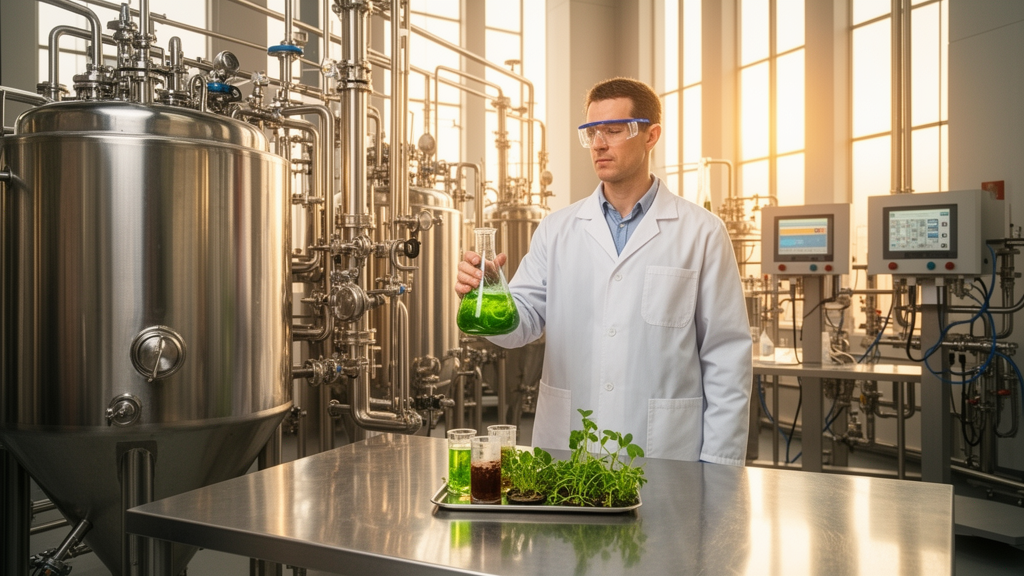
For more than a century, industrial microbiology has been built around a seductively simple image: the microorganism as a microscopic factory. In this framing, a microbe is a production chassis to be tuned for higher titers, faster rates and better yields, then benchmarked against techno-economic performance. A strain is deemed industrial if it can be integrated into a plant, scaled reliably and compete on unit cost. That logic has delivered bulk chemicals, amino acids, organic acids and enzymes at remarkable efficiency, but it may also be blinding the field to the most valuable things microbes actually do. A new opinion article published on 19 January 2026 in Frontiers in Industrial Microbiology argues that we may be misreading microbial value, and that the very definition of industrial relevance needs a regenerative reboot.
The article, written by Priscilla Zwiercheczewski of the University of Mons in Belgium and Joyce Siqueira of the Federal University of Pernambuco in Brazil, examines a paradox at the heart of the circular bioeconomy. Policy documents and strategic roadmaps celebrate microorganisms as key enablers for closing carbon cycles, recycling waste and replacing fossil-derived inputs. Yet many implementations remain centered on feedstock substitution rather than system redesign. Biofuels and bioplastics frequently aim to swap fossil carbon for biomass-derived inputs while leaving production chains and end-of-life pathways largely unchanged. The result, the authors contend, is a circular narrative evaluated with linear criteria, a mismatch that confines microbes to converting inputs into products within a pipeline and keeps even advanced fields such as precision fermentation largely product-centric.
The dominant logic of industrial relevance is easy to recognize. Desirable strains exhibit high product yield and productivity, robust performance under specific process conditions, genetic tractability and compatibility with existing reactor infrastructure and downstream processing. In practice, this profile is embodied by a small group of domesticated hosts, including Escherichia coli, Saccharomyces cerevisiae, Corynebacterium glutamicum and Bacillus species, which are repeatedly optimized and standardized through design-build-test-learn cycles, high-throughput phenotyping pipelines and machine learning-guided workflows. Even when discussions broaden to include robustness, stability or risk reduction during scale-up, the underlying representation remains production-centered: microbial systems appear as single-input, single-output units in process flow diagrams, with performance collapsed into titers, rates, yields and cost per unit of product.
That representation creates systematic blind spots. The ecological complexity that characterizes multispecies communities, including division of labor, cross-feeding, niche complementarity and long-term resilience, is difficult to translate into standard metrics and therefore rarely enters formal decision criteria. Wild strains and naturally assembled consortia, which evolved to operate in heterogeneous, fluctuating environments and to distribute functions across partners, often appear noisy or inefficient when forced into pure-culture, fixed-input, single-product processes, even when their native interaction patterns would be advantageous at the scale of a regenerative system. Microorganisms that excel at metabolizing heterogeneous waste streams, stabilizing microbiomes or sustaining soil functions over long timeframes may perform modestly when judged only by liters of product per hour and cost per kilogram, and so they tend to be sidelined even when their most significant contributions are systemic rather than linked to a single molecule.
Outside controlled bioreactors, microbes rarely behave as single-product factories at all. They assemble into multispecies communities and microbiomes in which functions are distributed across taxa and constantly reshaped by interactions. Properties emerge at the community level: taxonomic and functional diversity, metabolic exchanges, niche complementarity across space and time, feedbacks with the surrounding environment and redundancy that sustains function under disturbance. These features allow microbial communities to decompose complex organic matter, cycle nutrients, modulate host physiology and coordinate interactions across trophic levels, thereby supporting the regeneration of soils, waters and biogeochemical cycles. The authors connect this to the etymology of regenerare, to create again, a concept in which life creates conditions conducive to life. Long-term regenerative agriculture, for example, has been shown to improve soil organic carbon, enhance nutrient availability and restructure bacterial communities in ways associated with healthier, more resilient soils, benefits that escape short-term yield metrics yet are crucial for sustained productivity and climate adaptation.
Some of the most compelling evidence comes from infrastructure that already runs at industrial scale. Activated sludge, the workhorse of municipal and industrial wastewater treatment, relies on complex microbial communities that remove organic load, transform nitrogen and phosphorus and attenuate pollutants. Metagenome-based analyses of full-scale plants indicate that the activated sludge microbiome is structured into distinct functional niches, with different taxa contributing to carbon degradation, nutrient transformations and the handling of metals and other stressors. Even more striking are full-scale transplantation experiments showing that these communities are remarkably resilient: exchanging the entire sludge between donor and recipient wastewater treatment plants maintained effluent quality, while the recipient microbiome gradually re-established a site-specific community structure over successive solid-retention times. Effluent quality persisted even as the community reorganized itself, a textbook demonstration of emergent, regenerative value that no single strain metric could capture.
Resource-oriented configurations built around purple non-sulfur bacteria extend this logic further. Photoanaerobic treatment of wastewater using these phototrophic microbes has been proposed as an alternative to conventional aerobic polishing, coupling organic load removal with microbial biomass accumulation. High-rate photobioreactors fed with agro-industrial or domestic effluents can recover nitrogen and energy while producing biomass, and mixed-culture systems have been evaluated for single-cell protein and polyhydroxyalkanoate production from domestic wastewater, linking treatment to feed and bioplastic precursors. Nutritional tuning of purple non-sulfur bacteria grown on hydrogen and carbon dioxide further illustrates how such platforms can supply tailored protein profiles for food and feed applications. The primary value of these configurations lies in maintaining water quality and protecting receiving environments over the long term while simultaneously recovering resources, yet this regenerative service is rarely described in terms of industrial relevance, even though it underpins the viability of multiple sectors.
Crucially, the tools needed to measure this hidden value already exist. Multi-omics and systems biology have transformed the capacity to analyze and engineer microorganisms, and in industrial contexts they are widely applied to identify bottlenecks, re-route flux and discover novel enzymes. The same toolbox can be directed toward different questions. Combined metagenomic and metabolomic studies of microbial consortia reveal how community composition, functional redundancy and cross-feeding contribute to robustness in waste degradation and nutrient recovery, characterizing resilience, adaptability and cooperative behavior that sustain function under real-world variability. Work on purple non-sulfur bacteria shows how integrated electrochemical, transcriptomic and metabolomic analyses of biofilms in microbial photo-electrosynthesis reveal how metabolic states can be tuned along redox and resource gradients, while nutrient-limited cultures grown on hydrogen and carbon dioxide show that nitrogen fixation and carbon allocation can be adjusted to modulate the nutritional profile of microbial biomass. Omics can thus function not only to intensify production but as a measurement system for ecological integration, regenerative capacity and network robustness.
To make this reframing operational, the authors propose expanding the notion of industrial relevance along three complementary dimensions. Regenerative capacity describes the ability to restore or maintain key functions in degraded or stressed systems, such as rebuilding soil organic matter, improving water quality or re-establishing balanced microbiomes. System integration measures the degree to which a microbial process can be embedded into existing material and energy flows, contributing to closed-loop configurations rather than operating as a stand-alone production island. Ecological robustness and modularity capture the presence of functional redundancy, syntrophic interactions and flexible network structures that maintain performance under variable inputs and conditions, reducing vulnerability to perturbations. These dimensions do not replace yield, productivity or economic feasibility, but they change what counts as a high-potential microbial platform, elevating non-model organisms and consortia that perform well in waste valorization, ecosystem repair or long-term soil health from niches labeled environmental to the center of industrial strategy.
The stakes extend well beyond microbiology. Recent analyses of nutrient management frameworks and circular economy initiatives for agri-food systems argue that circularity must be integrated with efficiency and sufficiency, yet they show that operational indicators still lean heavily on biomass utilization, productivity and gross domestic product. Studies of actors’ choices regarding nutrient recovery adoption in the food-processing industry and of nitrogen recovery supply chains reach similar conclusions: techno-economic metrics dominate decision-making even when circularity is a stated goal. This misalignment between rhetoric and metrics helps explain why many circular bioeconomy initiatives translate into feedstock shifts rather than structural redesign, risking a biological extension of the fossil paradigm with new inputs but similar logic. Recognizing regenerative functions as part of industrial value requires adjustments at three levels: conceptual, moving beyond the factory metaphor; methodological, using omics and modeling to characterize regenerative traits; and evaluative, integrating regenerative capacity, system integration and robustness into decision frameworks. In this reframing, the bioeconomy is not defined solely by replacing petroleum with cellular feedstocks, but by organizing production and regeneration around the ecological intelligence of microorganisms. Industrial microbiology guided by this perspective can contribute not only new molecules but restored systems, shifting the focus from what microbes manufacture to what they help keep alive.
Subject of Research: Microbiology
Article Title: Are we misreading microbial value? Reframing industrial relevance through regenerative systems thinking
Article References: Zwiercheczewski, P., & Siqueira, J. (2026). Are we misreading microbial value? Reframing industrial relevance through regenerative systems thinking. Frontiers in Industrial Microbiology, 3, Article 1757656. https://doi.org/10.3389/finmi.2025.1757656
Image Credits: AI Generated
DOI: 10.3389/finmi.2025.1757656
Keywords: industrial microbiology, microbial communities, circular bioeconomy, regenerative systems, purple non-sulfur bacteria, omics, misreading, microbial, value, Reframing, industrial, relevance
Cite Scienmag News
Morgan Morrow. (October 17, 2026). Microbes Are More Than Factories: Why Industrial Microbiology Needs a Regenerative Reboot. Scienmag. https://scienmag.com/microbes-are-more-than-factories-why-industrial-microbiology-needs-a-regenerative-reboot/
Morgan Morrow. "Microbes Are More Than Factories: Why Industrial Microbiology Needs a Regenerative Reboot." Scienmag, 17 October 2026, https://scienmag.com/microbes-are-more-than-factories-why-industrial-microbiology-needs-a-regenerative-reboot/. Accessed 17 October 2026.
Morgan Morrow. "Microbes Are More Than Factories: Why Industrial Microbiology Needs a Regenerative Reboot." Scienmag. October 17, 2026. https://scienmag.com/microbes-are-more-than-factories-why-industrial-microbiology-needs-a-regenerative-reboot/


