


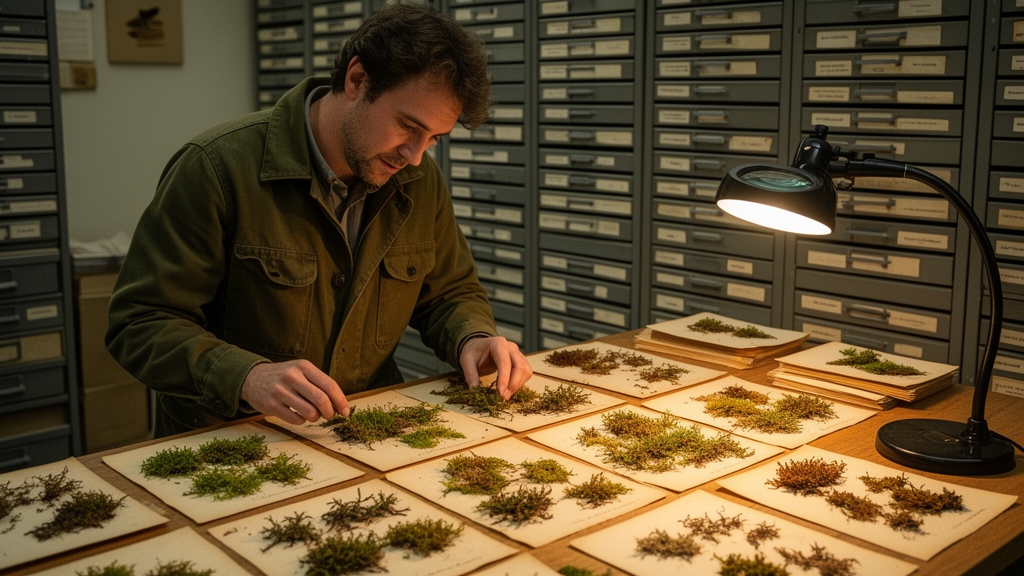
Deep in the high peaks of the Great Smoky Mountains National Park, a quiet ecological drama has been unfolding for decades, and the evidence has been sitting in museum cabinets all along. A new study published in Natural History Collections and Museomics shows that pressed bryophyte specimens collected over more than a century can be used to reconstruct how moss and liverwort communities responded to one of the most consequential invasions in the southern Appalachians: the arrival of the balsam woolly adelgid, a tiny sap-sucking insect that killed roughly ninety percent of the park’s fraser fir trees. The research demonstrates that herbarium collections, long treated as static archives, can function as a practical substitute for expensive long-term monitoring plots, at least for well-surveyed regions and organisms.
The balsam woolly adelgid, first documented severely impacting areas within the park boundary in 1962, devastated the high elevation fir forests that define the skyline of the southern Appalachians. When the firs died, the canopy opened dramatically, flooding the understory with light and altering the cool, humid microclimate on which bryophytes depend. Because bryophytes make up the bulk of the ground cover and species richness in these high elevation zones, any shift in canopy structure reverberates through the entire community. The researchers asked whether these changes left a detectable fingerprint in the specimen record, and whether different management strategies applied to different peaks produced measurably different outcomes.
To answer these questions, the team compiled bryophyte specimen data collected in the park between 1913 and 2022, drawing records from the Consortium of Bryophyte Herbaria and the Global Biodiversity Information Facility and supplementing them with specimens not yet available through online portals. Species names were synonymized using Tropicos and current moss and liverwort classifications to account for a century of taxonomic change, and duplicate records and genus-level identifications were removed. Each specimen was georeferenced and assigned an elevation extracted in ArcGIS Pro, then grouped spatially by mountain peak: Kuwohi, formerly known as Clingmans Dome, Mt. Kephart, Mt. LeConte, and Mt. Sterling, each of which experienced a different management trajectory after the invasion.
The peaks tell contrasting stories. Mt. LeConte and Mt. Kephart received little to no adelgid management because their remoteness made strategy implementation impractical. Kuwohi was treated with both chemical and biotic controls, an approach that had a positive impact on the fir community. Mt. Sterling received the most aggressive intervention of all, including clear-cutting strips of trees to create a buffer zone alongside biotic controls, yet reports from the time indicate this combination was largely unsuccessful at slowing the invasion. The specimen data were then divided into three ecologically defined timespans: pre-adelgid from 1934 to 1962, post-adelgid from 1963 to 1999, and initial canopy recovery from 2000 to 2022, the period beginning when the first study documented fir canopy recovery in the park.
Because sampling effort varied enormously across decades, driven by extensive survey campaigns in some eras and sparse collecting in others, raw species counts were misleading. Uncorrected richness appeared to decline steadily through time across the peaks, but this pattern largely reflected disparities in collection intensity rather than genuine biological change. The researchers therefore applied rarefaction, a statistical technique that standardizes richness by randomly subsampling community data down to the lowest level of sampling effort being compared. They ran 9,999 rarefaction iterations for each timespan on each peak, reporting the percentage of iterations in which one timespan exceeded another, which allowed them to infer differences in rarefied richness with confidence.
The rarefied results revealed two distinct patterns. On Mt. Sterling and Mt. Kephart, rarefied alpha diversity increased from the pre-adelgid to the post-adelgid timespan, when the canopy would have been most open, and then declined during initial canopy recovery as the forest closed overhead. Kuwohi and Mt. LeConte showed no difference between the first two timespans but a sharp decrease in rarefied richness during recovery. This pattern of initial increase followed by decline matches what permanent plot studies of bryophytes have documented after canopy-opening disturbances, since increased light and downed wood create new niches that disappear again as the canopy closes and logs decay. Rarefied dissimilarity between timespans exceeded 0.5 for all comparisons across all four peaks, with Mt. Sterling and Mt. Kephart consistently showing the highest values, indicating that community composition has shifted substantially and has not simply returned to its pre-invasion state.
The most striking finding concerned species traits. Comparing the pre-adelgid and initial canopy recovery timespans for the high elevation group, the team classified each species as a substrate specialist occupying one substrate type, flexible occupying two, or a generalist occupying three or more, based on the Flora of North America. A chi-square analysis revealed that substrate specificity significantly differed between species that were lost, persisted, or newly appeared. Fewer generalists were lost and more generalists persisted than expected by chance, and generalists persisted significantly more often than specialists. This aligns with ecological theory and prior field studies: species capable of living on many substrates have more routes to survival and recolonization when disturbance reshapes the habitat, while specialists tied to transient resources such as downed logs, which proliferate after fir mortality but inevitably decay and vanish, face steeper odds.
Taxonomic patterns added further texture. Liverworts tended to be lost more often than mosses, a non-significant trend that echoes the literature documenting liverwort sensitivity to canopy opening. Several taxonomic orders, including Jungermanniales, Porellales, Hypnales, Grimmiales, Bryales, Pottiales, and Dicranales, showed significantly more species lost than new, driven by small numbers of newly appearing species against large numbers lost or persisting. The authors note that these apparent losses could guide targeted searches to determine whether species are truly gone or simply under-sampled, and that some new species may be climbing from lower elevations as climate change alters available niches at high elevation.
A crucial caveat runs through the analysis: the effects of the adelgid invasion and the effects of management cannot be strictly disentangled with these data. Mt. Sterling, which was clear-cut and heavily managed, and Mt. Kephart, which was unmanaged, showed remarkably similar patterns of rarefied richness and dissimilarity, suggesting that the invasion itself, possibly amplified by proximity between peaks, may have driven much of the change. Still, the comparison hints that aggressive canopy-altering practices like clear-cutting may have been more harmful to the bryophyte community than either leaving a peak unmanaged or using the chemical and biotic controls that succeeded on Kuwohi, which showed the lowest dissimilarity and nearly identical rarefied richness between the pre- and post-adelgid timespans. The authors suggest land managers may want to favor less extreme strategies when the goal is protecting the entire community.
Beyond the specific findings, the study carries a broader message for conservation. Permanent plots remain the gold standard for tracking community change, but they are prohibitively expensive and labor-intensive for many managed lands, leaving gaps in knowledge precisely where biodiversity is most at risk. GBIF documents more than 1.3 million preserved bryophyte specimens identified to the species level from the United States, collected from the 1800s to the present, and the southeast is among the most thoroughly surveyed regions. The authors argue that herbarium collections could serve as a substitute for permanent plots on lands with limited resources or expertise, enabling managers to evaluate the consequences of their decisions decades later. Future work should compare herbarium records directly with permanent plot data from the same areas and timespans, and expand sampling through field botany courses, collection forays, and bioblitz events, ensuring that the specimen record keeps growing rich enough to answer the ecological questions of tomorrow.
Subject of Research: Using bryophyte herbarium specimens to detect community change following the balsam woolly adelgid invasion in the southern Appalachians
Article Title: Detecting community changes in response to management practices using bryophyte herbarium specimens collected in the southern Appalachians
Article References: Shershen, E., & Budke, J. M. (2026). Detecting community changes in response to management practices using bryophyte herbarium specimens collected in the southern Appalachians. Natural History Collections and Museomics, 3, 1-22. https://doi.org/10.3897/nhcm.3.175897
Image Credits: AI Generated
Keywords: bryophytes, herbarium specimens, balsam woolly adelgid, Great Smoky Mountains, community ecology, rarefaction, invasive species, forest management, conservation, substrate specificity, liverworts, mosses
Cite Scienmag News
Gavin Prescott. (October 17, 2026). Herbarium Specimens Reveal How Invasive Pests and Management Reshape Appalachian Bryophyte Communities. Scienmag. https://scienmag.com/herbarium-specimens-reveal-how-invasive-pests-and-management-reshape-appalachian-bryophyte-communities/
Gavin Prescott. "Herbarium Specimens Reveal How Invasive Pests and Management Reshape Appalachian Bryophyte Communities." Scienmag, 17 October 2026, https://scienmag.com/herbarium-specimens-reveal-how-invasive-pests-and-management-reshape-appalachian-bryophyte-communities/. Accessed 17 October 2026.
Gavin Prescott. "Herbarium Specimens Reveal How Invasive Pests and Management Reshape Appalachian Bryophyte Communities." Scienmag. October 17, 2026. https://scienmag.com/herbarium-specimens-reveal-how-invasive-pests-and-management-reshape-appalachian-bryophyte-communities/


