


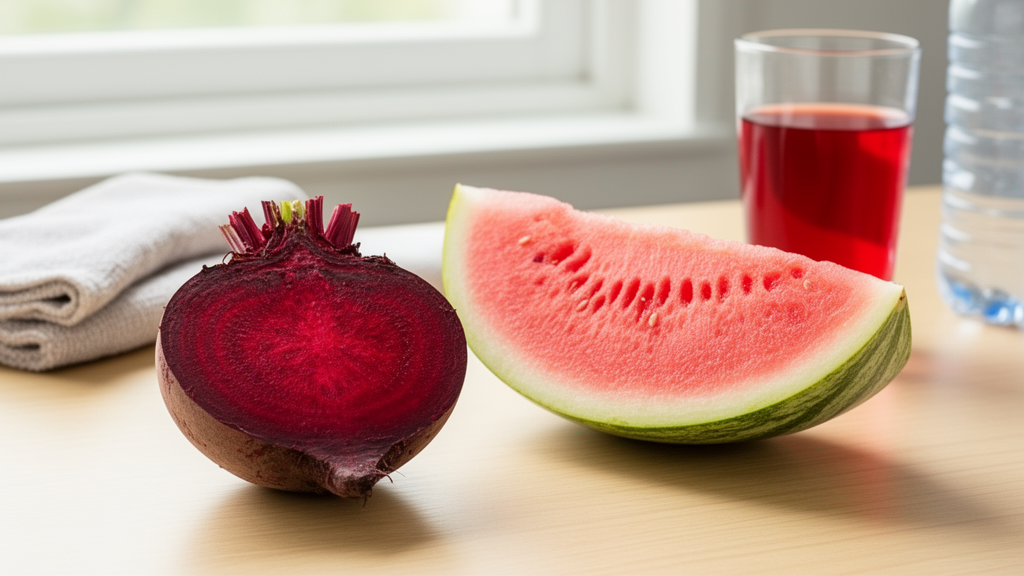
Every athlete knows the feeling: the day after a punishing workout, muscles stiffen and ache with a soreness that peaks around 72 hours and refuses to be ignored. Delayed onset muscle soreness, or DOMS, is one of the most familiar consequences of high-intensity or unaccustomed exercise, particularly eccentric movements that lengthen muscle under load. Now a systematic review and network meta-analysis published in Frontiers in Nutrition suggests that nitric oxide precursor supplements may ease this soreness, but only at specific recovery time points, and only for certain formulations. The findings, drawn from 19 randomized placebo-controlled trials involving 356 participants, point toward beetroot-derived nitrate and watermelon plus added citrulline as the most promising interventions, while cautioning that the evidence remains sparse and of low certainty.
The research team, led by Kai-Xuan Xu and Shuai Guo of Dankook University in South Korea, along with colleagues from Hunan Institute of Engineering and Xiangtan University in China, set out to resolve a persistent problem in sports nutrition. Previous reviews had often lumped all nitric oxide boosters together, despite fundamental differences in how they deliver their active ingredients. Synthetic precursors such as L-arginine and citrulline malate entered the market early and remain staples of pre-workout products, but evidence for their effects on DOMS has been inconsistent, with generally small benefits and several studies showing no significant improvements. Whole-food-derived precursors, by contrast, have attracted growing attention in recent years, reflecting the food-first approach promoted by the International Society of Sports Nutrition.
Technically, the distinction matters because the two supplement families support nitric oxide production through different biological pathways. Synthetic or isolated amino acid precursors primarily feed the nitric oxide synthase pathway, in which citrulline is converted to arginine and arginine is then converted to nitric oxide. Nitrate-containing interventions such as beetroot juice operate through the nitrate–nitrite–nitric oxide pathway, an alternative route that can remain active under hypoxic or acidic conditions, precisely the conditions that develop in damaged muscle during the inflammatory phase of recovery. Whole-food sources also bring additional compounds to the table: beetroot contains betalains and polyphenols with antioxidant and anti-inflammatory properties, while watermelon provides lycopene and vitamin C alongside its natural citrulline content. These components could plausibly complement nitric oxide-related effects, although the review acknowledges that such mechanisms have not been directly established in the context of DOMS.
To compare these interventions rigorously, the researchers searched PubMed, Embase, Web of Science, and the Cochrane Central Register of Controlled Trials from inception to February 2026, identifying 2,548 records. After removing 1,379 duplicates and screening titles, abstracts, and full texts, 19 trials published between 2010 and 2025 met the inclusion criteria. The studies, conducted in six countries including the United Kingdom, Iran, and Spain, enrolled healthy adults aged roughly 21 to 42 years who completed exercise protocols designed to induce muscle damage, ranging from eccentric jump exercise and repeated sprints to resistance training and high-altitude trekking. Interventions were classified into four nodes: beetroot-derived nitrate, watermelon-derived citrulline, synthetic or isolated amino acid precursors, and watermelon plus added citrulline, with placebo as the reference. Beetroot-derived nitrate was the most frequently investigated node, appearing in 10 studies.
The network meta-analysis, conducted separately at 24, 48, and 72 hours after exercise, revealed a striking time-dependent pattern. At 24 hours, watermelon plus added citrulline showed a significant reduction in DOMS compared with placebo, with a standardized mean difference of −0.97 (95% confidence interval −1.64 to −0.31), and beetroot-derived nitrate also showed a significant benefit, with a standardized mean difference of −0.67 (95% confidence interval −1.14 to −0.20). At 48 hours, when DOMS commonly reaches its peak, beetroot-derived nitrate was the only intervention with a statistically significant advantage over placebo, posting a standardized mean difference of −1.18 (95% confidence interval −1.91 to −0.45) and the highest exploratory SUCRA ranking of 92.5%. By 72 hours, however, no active intervention differed significantly from placebo, suggesting that the window for measurable benefit may close as natural recovery progresses.
Subgroup analyses added further nuance to the picture. Beetroot-derived nitrate significantly reduced 48-hour DOMS compared with placebo in the trained subgroup, with a standardized mean difference of −1.92 (95% confidence interval −3.33 to −0.51), but not in the untrained subgroup. The benefit also held in both acute and multi-day supplementation subgroups, though the effect estimate was considerably larger in the acute subgroup. Only one statistically significant network comparison between active interventions emerged, favoring watermelon plus added citrulline over synthetic or isolated amino acid precursors at 24 hours, a finding the authors interpret cautiously given the limited direct head-to-head evidence. Sensitivity analyses generally supported the primary findings, although the beetroot-derived nitrate estimate proved sensitive to certain restrictions related to the exercise-induced muscle damage model.
The biological framework proposed to explain these time-specific patterns is technically plausible. In the early phase of recovery, mechanical disruption and metabolic disturbance predominate, and citrulline may increase arginine availability to support nitric oxide production through nitric oxide synthase-dependent pathways, promoting local perfusion and metabolic recovery while watermelon contributes additional bioactive compounds. By 48 hours, soreness commonly peaks and coincides with greater inflammatory activity, oxidative stress, oedema, and changes in local oxygen availability. Under these hypoxic or acidic conditions, the nitrate–nitrite–nitric oxide pathway may provide an alternative route for nitric oxide generation that is less dependent on nitric oxide synthase activity, potentially explaining why beetroot-derived nitrate showed its strongest effect at this time point. Beetroot’s betalains and polyphenols may further complement nitrate-related effects during recovery.
Methodologically, the review followed PRISMA 2020 and the PRISMA-NMA extension, was registered with PROSPERO, and employed a frequentist random-effects network meta-analysis in Stata using multivariate models. Outcomes were expressed as standardized mean differences to allow pooling across different DOMS measures, including visual analog scales, pressure pain thresholds, Likert scales, and numerical rating scales. Risk of bias was assessed with the Cochrane Risk of Bias 2 tool, and 16 of the 19 studies, or 84.2%, were rated as low risk of bias, with two having some concerns and one rated high risk. Certainty of evidence was evaluated using the CINeMA framework, which rated the primary 48-hour outcome as low certainty, mainly because of imprecision and inconsistency in the network.
Despite these strengths, the authors emphasize that several limitations preclude firm clinical conclusions. The evidence network was sparse and relied mainly on placebo-controlled comparisons, with few direct comparisons between active interventions, meaning many treatment comparisons depended on indirect evidence and the comparability of included studies. Between-study heterogeneity was moderate to high at 24 hours and high at 48 and 72 hours, likely reflecting differences in participant training status, exercise protocols, supplement type, dose, timing, duration, and DOMS assessment methods. Women remain underrepresented in the evidence base, and the biological mechanisms proposed to explain the time-dependent patterns were not directly tested. The authors call for adequately powered head-to-head randomized trials using more standardized exercise protocols, supplementation regimens, and DOMS measures, along with biomarker assessment at key recovery time points and greater emphasis on female athletes.
For now, the practical message is one of cautious optimism rather than prescription. Nitric oxide precursor supplementation may reduce post-exercise DOMS at specific recovery time points, particularly with beetroot-derived nitrate and watermelon plus added citrulline, but recovery timing and supplement formulation appear to matter as much as the choice to supplement at all. The findings suggest that pooling outcomes across different recovery time points may have obscured real effects in previous analyses, and that future studies should treat the 24-to-72-hour recovery window as a dynamic process rather than a uniform endpoint. Until firmer evidence arrives, athletes and coaches considering these supplements should weigh the promising time-specific signals against the low certainty of the current evidence base, and recognize that no active intervention showed a significant benefit by 72 hours, when natural recovery may already be well underway.
Subject of Research: Nitric oxide precursor interventions for post-exercise delayed onset muscle soreness: a systematic review and network meta-analysis of randomized placebo-controlled trials
Article Title: Nitric oxide precursor interventions for post-exercise delayed onset muscle soreness: a systematic review and network meta-analysis of randomized placebo-controlled trials
Article References: Xu, K.-X., Guo, S., Xie, Z.-F., & Xiao, Y.-W. (2026). Nitric oxide precursor interventions for post-exercise delayed onset muscle soreness: a systematic review and network meta-analysis of randomized placebo-controlled trials. Frontiers in Nutrition, 13, Article 1868555. https://doi.org/10.3389/fnut.2026.1868555
Image Credits: AI Generated
DOI: 10.3389/fnut.2026.1868555
Keywords: Nitric, oxide, precursor, interventions, post-exercise, delayed, onset, muscle, soreness, systematic, review, network
Cite Scienmag News
Daisy Hatcher. (October 17, 2026). Beetroot and Watermelon Show Time-Specific Relief for Post-Exercise Muscle Soreness. Scienmag. https://scienmag.com/beetroot-and-watermelon-show-time-specific-relief-for-post-exercise-muscle-soreness/
Daisy Hatcher. "Beetroot and Watermelon Show Time-Specific Relief for Post-Exercise Muscle Soreness." Scienmag, 17 October 2026, https://scienmag.com/beetroot-and-watermelon-show-time-specific-relief-for-post-exercise-muscle-soreness/. Accessed 17 October 2026.
Daisy Hatcher. "Beetroot and Watermelon Show Time-Specific Relief for Post-Exercise Muscle Soreness." Scienmag. October 17, 2026. https://scienmag.com/beetroot-and-watermelon-show-time-specific-relief-for-post-exercise-muscle-soreness/


