


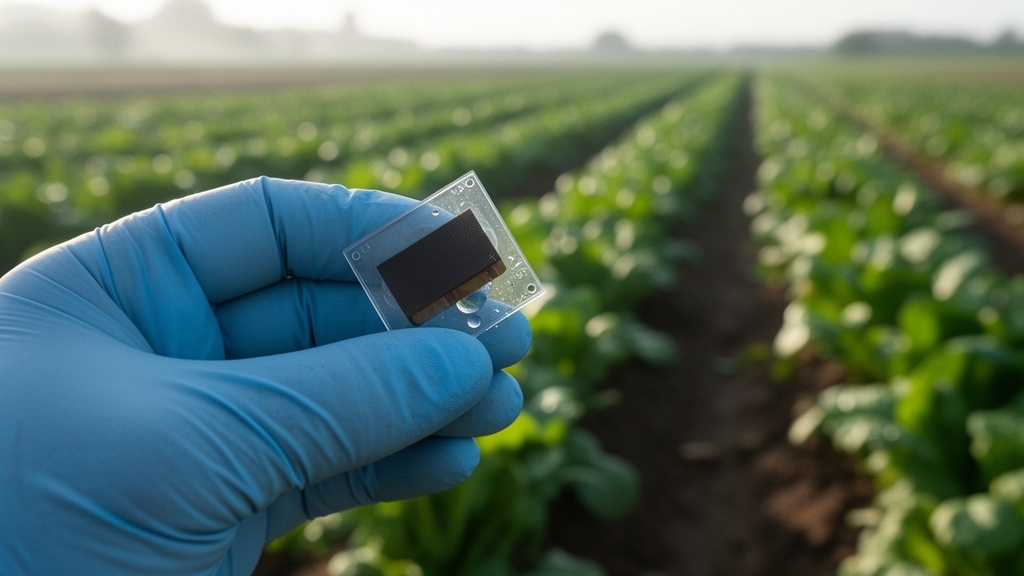
Pesticides have become one of agriculture’s most stubborn paradoxes. The same chemistry that protects crops from pests also infiltrates soils, seeps into groundwater, and accumulates in the food chain, where compounds notorious for resisting natural degradation can persist for years. A new review published in Frontiers in Carbon by researchers at James Cook University in Australia and the University of Houston in the United States argues that the answer to this monitoring crisis may lie in a single sheet of carbon atoms. The work, led by Muhammad Adeel Zafar and David Waligo under the supervision of Mohan V. Jacob and Oomman K. Varghese, surveys the rapid rise of graphene-based electrochemical biosensors and makes the case that these devices are close to delivering real-time, on-site pesticide detection for the farms that need it most.
The scale of the problem is difficult to overstate. Highly toxic pesticides that cause short- and long-term adverse impacts on human health and ecosystems are common contaminants of water sources and agricultural products. Their large residence time in the environment and their potential for bioaccumulation make detection and monitoring in soil, food, and groundwater critical tasks for agriculture, food safety, and environmental protection. Yet the traditional analytical techniques deployed against them, including colorimetry, spectrometry, and optical sensing, suffer from high costs, time-intensive procedures, and limited portability. Optical and mechanical sensors can demonstrate impressive sensitivity and selectivity, but they often require complex and bulky equipment that rules out real-time on-site applications. A farmer standing at the edge of a contaminated field cannot wait days for a laboratory result.
Electrochemical sensors were developed as a suitable alternative to overcome exactly these challenges. According to the definition adopted by the International Union of Pure and Applied Chemistry, a chemical sensor is a device that transforms chemical information into an analytically useful signal. An electrochemical sensor accomplishes this by converting the interaction between an analyte and an electrode into a measurable electrical response. The review focuses on two configurations that have proven outstanding in selectivity, sensitivity, and stability for pesticide detection: the classical three-electrode system and the field-effect transistor, or FET, operating on electrochemical principles.
The three-electrode geometry is the workhorse of electrochemical analysis. It comprises a working electrode, where the target reaction occurs; a reference electrode, which provides a stable potential; and a counter electrode, which completes the circuit. Charged molecules move through a thin electrolyte layer, and the interaction of the sensor with the target analyte generates an electrical signal proportional to the analyte’s concentration. The method offers high sensitivity and selectivity, linear response across broad concentration ranges, minimal space and power needs, on-site detection capability, and affordable instrumentation. Its weaknesses are equally well documented: reliance on an electrolyte introduces pH working-range limitations, electrode degradation demands frequent maintenance and calibration, and non-specific reactions between electroactive impurities on the electrode surface and the sample can hamper sensitivity.
This is where graphene enters the picture. With its extensive delocalized π-electron system and a theoretical specific surface area of approximately 2,630 square meters per gram, graphene exhibits exceptional adsorption capabilities for organic compounds, surpassing even metal nanoparticles. Its large surface area and outstanding electrical conductivity make it an ideal candidate for the working electrode, while its high surface-to-volume ratio enhances the interaction between analytes and the electrode surface, improving sensitivity and detection limits. Its excellent electron transfer properties facilitate the rapid and efficient redox reactions that electrochemical sensing depends on. Crucially, the electrochemical detection of pesticides relies on their oxidation and reduction reactions at the working electrode: nitro groups in nitro pesticides reduce to form hydroxylamine, the C=C bond structures in organophosphates undergo reduction, and organochlorines produce their characteristic peaks through the removal of one electron from chlorine.
The performance figures reported in the literature are striking. For carbofuran, a pesticide of significant toxicity to the human central nervous system, Tan and colleagues employed a reduced graphene oxide-gold nanocomposite modified with a molecularly imprinted polymer on a glassy carbon electrode, dramatically lowering the charge-transfer resistance compared with a bare electrode. For methyl parathion, Gong and co-workers used square wave voltammetry with a gold-graphene modified electrode to achieve an exceptionally low limit of detection of 0.002 micromolar, attributed to the synergistic effects of gold and graphene in enhancing electron transfer. Govindasamy’s team developed a graphene-molybdenum disulfide nanocomposite with a linear range spanning 10 nanomolar to 1.9 millimolar, while Li and colleagues pushed the limit down to 1 nanomolar using a graphene-gadolinium Prussian blue nanocomposite. Zhang’s group reported a nitrogen-doped graphene-gold nanocomposite for dimethoate with a limit of detection of 8.7 times ten to the minus thirteen molar.
Herbicides have proven equally vulnerable to graphene-based detection. Shams and colleagues demonstrated that a reduced graphene oxide-gold nanocomposite on a screen-printed electrode, analyzed by linear sweep voltammetry, detected the herbicide diuron across a broad 0.5 to 30.0 micromolar range with an excellent limit of detection. Zafar and co-workers then showed that pristine graphene-coated electrodes alone, without additional modification, could detect diuron with enhanced charge-transfer kinetics and higher peak currents than bare electrodes, achieving linearity from 20 to 1,000 micromolar. Silver-graphene modified boron-doped diamond electrodes have enabled the simultaneous detection of paraquat and carbaryl, and a reduced graphene oxide-copper/copper oxide-silver nanocomposite detected fenamiphos and carbaryl with low limits of detection and wide linear ranges. For glyphosate, the world’s most widely used herbicide, Thanh’s team achieved detection limits near 0.08 parts per billion in river water, Johnson’s group combined platinum-decorated laser-induced graphene with the enzyme glycine oxidase for selective detection in complex matrices, and Scandurra’s team reached nanomolar-level detection in drinking water using gold nanoelectrode arrays on graphene paper.
The second configuration, the graphene field-effect transistor, or GFET, takes a fundamentally different approach. In an FET, a semiconductor channel carries current between source and drain electrodes, while a gate voltage controls the electric field across the channel. The presence of analytes changes that field, and hence the transistor characteristics, which can be read as a shift in the charge neutrality point, the drain-source current, or the transconductance. To achieve selectivity, GFET biosensors incorporate biorecognition elements such as enzymes, antibodies, and aptamers immobilized on the sensor surface. Graphene itself does not readily react or bind with most materials, so it must be functionalized with linkers; graphene oxide and reduced graphene oxide, by contrast, possess carboxyl groups that bond directly with biorecognition elements via carbodiimide chemistry. The review notes that GFETs offer simple design, potential for high sensitivity, lower limits of detection, and label-free operation, reducing both cost and the risk of interference from electrochemical tags.
The reported GFET devices demonstrate what this architecture can do. Zhu and colleagues introduced a solution-gate GFET for the organophosphate isocarbophos, functionalizing the graphene channel with an acetylcholinesterase enzymatic complex using 3-mercaptopropanoic acid as a linker; the attachment of target molecules introduced a negative charge that increased the bias current. Islam’s team fabricated a graphene-FET immunosensor for chlorpyrifos through exfoliation on a silicon/silicon oxide substrate, achieving femtomolar detection, far below the micromolar performance of comparable devices. Zhang’s group used acetylcholinesterase-modified graphene to discriminate between the positive and negative enantiomers of the chiral pesticide methamidophos, integrating the sensor with smartphones for real-time detection. Tao and colleagues built a zirconium oxide/reduced graphene oxide functionalized gate for methyl parathion with an ultra-wide linear range, validated in Chinese cabbage, and Wang’s team unveiled graphene electrochemical transistors decorated with silver nanoparticles that detected paraquat down to 0.068 nanomolar while retaining selectivity against common interfering herbicides.
The review’s authors are candid about the hurdles that remain. Three-electrode sensors require comprehensive studies of selectivity and stability under long-term operation, and several promising devices left the mechanisms behind their enhancements unexplained. GFET biosensors demand careful surface functionalization and can suffer signal drift after extended periods, while biorecognition agents can degrade in performance at certain pH values and temperatures, and fabrication times remain long with limited shelf life. To advance the technology, the authors call for rigorous validation using actual samples from agricultural and environmental settings, systematic comparison with traditional analytical methods, integration with smartphone technology for portable devices, and investigation of how defects, morphology, and nanoparticle size affect sensor performance. Nevertheless, they conclude that the rapid developments now underway in semiconductor and graphene technologies should make these targets achievable in the near future, positioning graphene-based sensors as a cornerstone of proactive intervention to protect the health and diversity of agricultural ecosystems.
Subject of Research: Graphene-based electrochemical biosensors for on-site pesticide detection
Article Title: Advances in graphene-based electrochemical biosensors for on-site pesticide detection
Article References: Zafar, M. A., Waligo, D., Varghese, O. K., & Jacob, M. V. (2023). Advances in graphene-based electrochemical biosensors for on-site pesticide detection. Frontiers in Carbon, 2, Article 1325970. https://doi.org/10.3389/frcrb.2023.1325970
Image Credits: AI Generated
DOI: 10.3389/frcrb.2023.1325970
Keywords: graphene, electrochemical sensor, biosensor, pesticide detection, field-effect transistor, environmental monitoring, agriculture, Advances, graphene-based, electrochemical, biosensors, on-site
Cite Scienmag News
Neil Sanderson. (October 17, 2026). Graphene biosensors bring pesticide detection straight to the field. Scienmag. https://scienmag.com/graphene-biosensors-bring-pesticide-detection-straight-to-the-field/
Neil Sanderson. "Graphene biosensors bring pesticide detection straight to the field." Scienmag, 17 October 2026, https://scienmag.com/graphene-biosensors-bring-pesticide-detection-straight-to-the-field/. Accessed 17 October 2026.
Neil Sanderson. "Graphene biosensors bring pesticide detection straight to the field." Scienmag. October 17, 2026. https://scienmag.com/graphene-biosensors-bring-pesticide-detection-straight-to-the-field/


