


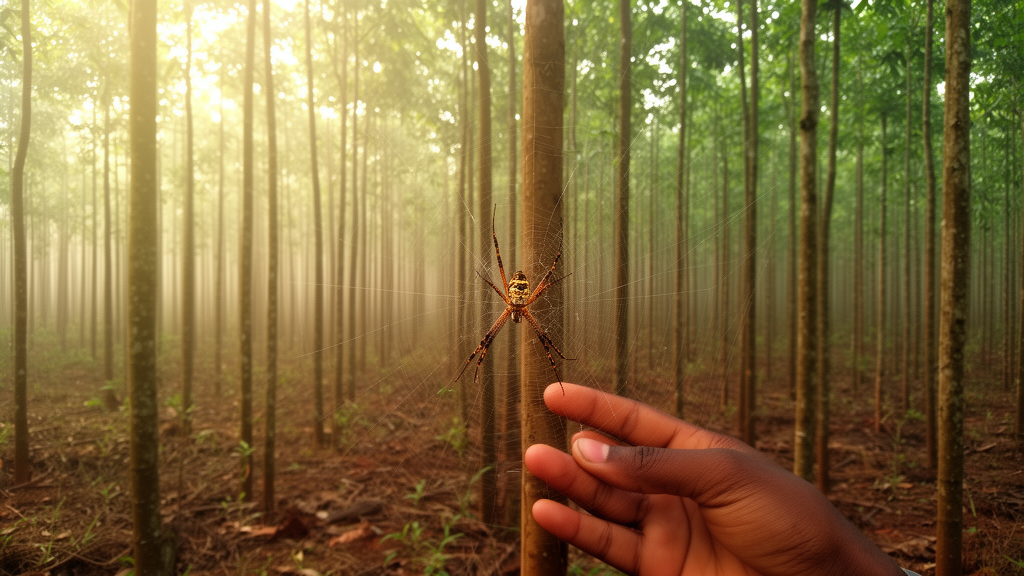
In the Ahafo region of Ghana, a gravel mine abandoned in the 1990s has become an unlikely laboratory for one of conservation biology’s most pressing questions: can we actually rebuild a forest ecosystem once it has been destroyed? A new study published in African Invertebrates offers a nuanced answer. After two decades of active restoration, the replanted forest at Terchire supports ground-hunting spider communities whose overall activity density now exceeds even that of a nearby reference natural forest. Yet the diversity and species composition of those communities tell a more complicated story, one that highlights the trade-offs inherent in restoration goals and the patience that true biodiversity recovery demands.
The research focused on three families of ground-hunting spiders: Ctenidae, Lycosidae, and Zodariidae. These spiders are ideal subjects for restoration monitoring because their habitat preferences are well documented. Wolf spiders of the family Lycosidae tend to favor open habitats, while many Ctenidae and Zodariidae are characteristic of tropical forests. Because spiders are dominant predators in terrestrial arthropod food webs, sensitive to environmental change, and providers of essential ecosystem services such as pest control and nutrient cycling, shifts in their populations can signal broader changes in ecosystem functioning. In West Africa, where most spider species have yet to be formally described, achieving species-level identification required visits to the Royal Museum for Central Africa in Belgium and the Naturmuseum Senckenberg in Germany, where original type specimens were examined.
The study compared five land-use types across the dry and wet seasons of 2019: the Asukese Forest Reserve as a primary natural forest reference, the Bosomkese Forest Reserve as an agroforestry system, the Terchire Restoration Area as an actively restored forest, a nearby arable field cultivated with maize, plantain, cassava and cocoa, and an unrestored gravel site colonized by shrubby plants such as Chromolaena odorata and Pennisetum purpureum. The restored forest covers 15.4 hectares and was replanted in 1999 with indigenous and fast-growing exotic nitrogen-fixing tree seedlings after gravel extraction for road construction ended. Eight replicated plots of 20 by 20 meters were established at each site, and five pitfall traps per plot were emptied weekly for ten weeks in each season, yielding a total catch of 1,852 individual spiders across all sites and seasons.
The results were striking. Overall activity density, which counts both juvenile and adult specimens, was highest in the restored forest, followed by the natural forest. Activity density was higher in the dry season than in the wet season across sites, and the interaction between land use and season was statistically significant. The restored forest reached its peak activity density in the dry season, while the arable field recorded its lowest values in the wet season. This pattern suggests that the complex vegetation structure, stable microclimate, and abundant prey availability of forested habitats support larger spider populations than open or agricultural land uses, where pesticides and tillage may reduce spider numbers through direct mortality and indirectly by reducing prey availability.
However, the inverse Simpson index, a measure sensitive to changes in the most abundant species in a community, told a different tale. The highest diversity values were recorded on the gravel site in the wet season, followed by the gravel site in the dry season and the natural forest in both seasons. The restored forest showed lower diversity values, indicating the dominance of very few spider species. The species Pardosa injucunda and Trochosa gentilis dominated the restored forest communities, while Africactenus monitor dominated the natural forest and Hogna gratiosa dominated the gravel site. This dominance structure in the restored forest may reflect its transitional state, where a mix of species from both open and forest habitats coexist but few achieve high abundance.
Community composition analysis using non-metric multidimensional scaling revealed a clear gradient from the gravel site through the arable field, agroforestry system, and restored forest to the natural forest. Spider communities in the agroforestry system overlapped substantially with those in the restored forest, suggesting that the replanted forest has developed a community more similar to managed agroforestry than to primary natural forest. The natural forest supported a unique community characterized by Mallinella species and Africactenus monitor, typical forest-dwelling spiders associated with old forest stands, deadwood, and diverse tree communities. The gravel site supported specialized open-habitat species such as Hogna gratiosa and Mallinella bandamaensis, adapted to hunting prey in degraded environments.
The restored forest community contained a mix of species from different land-use types. Mallinella sp3, Pardosa injucunda, and Trochosa gentilis, which characterized the restored forest, were also observed in the natural forest, agroforestry system, and arable field respectively. This reflects the developmental stage of the restored forest, which mimics spider communities from both the historical pre-restoration gravel site and the reference natural forest. The communities in the restored forest differed by 68 percent from the gravel site and by 61 percent from the natural forest, confirming an intermediate state between these land uses. Seasonal differences in species composition showed only a statistical trend, with the wet season characterized by higher activity densities of Hogna duala, Hogna gratiosa, Pardosa injucunda, and Trochosa gentilis.
The findings carry significant implications for restoration practice in Ghana and across tropical regions. Ghana loses an estimated 3.5 percent of its total forest area per year, equivalent to roughly 315,000 hectares, driven by agricultural expansion, logging, mining, and infrastructure development. Restoration monitoring in Ghana has historically focused on tree species composition and soil attributes, with little attention to arthropod biodiversity. This study demonstrates the value of species-level identification in ecological monitoring, as species within higher taxonomic groups often have different ecological traits and may respond differently to habitat changes. The results confirm that active restoration is effective at increasing spider activity densities and is certainly more effective from a conservation point of view than leaving degraded systems unmanaged and unable to self-recover.
Yet the study also reveals the trade-offs in restoration objectives. After twenty years, the natural forest biodiversity of ground-hunting spiders was not achieved in the actively restored forest. The community composition remained more similar to the agroforestry system than to the natural forest, likely because restoration approaches that also aimed to provide direct benefits to local human communities created habitat conditions that favor certain species over others. The unique habitat conditions of the natural forest, characterized by old forest stands, deadwood, and a diverse tree community, appear to require much longer timeframes to develop than two decades of active replanting can provide. These results highlight both the benefits of restoring former mining sites and the patience that true biodiversity recovery demands, as restoration strategies must balance conservation goals with the needs of local communities who depend on ecosystem goods and services from restored landscapes.
Subject of Research: Ground spider community responses to active post-mining forest restoration in Ghana
Article Title: Active restoration of post-mining forest benefits the activity density, but not the diversity of spider communities across the seasons in Ghana
Article References: Kinga, H., Damptey, F. G., Harms, D., Jocqué, R., Henrard, A., & Birkhofer, K. (2025). Active restoration of post-mining forest benefits the activity density, but not the diversity of spider communities across the seasons in Ghana. African Invertebrates, 66(1), 1-18. https://doi.org/10.3897/afrinvertebr.66.138662
Image Credits: AI Generated
DOI: 10.3897/afrinvertebr.66.138662
Keywords: forest restoration, spiders, Ghana, post-mining, biodiversity, activity density, species composition, seasonality, tropical ecology, bioindicators, Ctenidae, Lycosidae
Cite Scienmag News
Margaret Porter. (October 17, 2026). Spiders Reveal a Hidden Trade-Off in Ghana’s Twenty-Year Forest Restoration. Scienmag. https://scienmag.com/spiders-reveal-a-hidden-trade-off-in-ghanas-twenty-year-forest-restoration/
Margaret Porter. "Spiders Reveal a Hidden Trade-Off in Ghana’s Twenty-Year Forest Restoration." Scienmag, 17 October 2026, https://scienmag.com/spiders-reveal-a-hidden-trade-off-in-ghanas-twenty-year-forest-restoration/. Accessed 17 October 2026.
Margaret Porter. "Spiders Reveal a Hidden Trade-Off in Ghana’s Twenty-Year Forest Restoration." Scienmag. October 17, 2026. https://scienmag.com/spiders-reveal-a-hidden-trade-off-in-ghanas-twenty-year-forest-restoration/


