


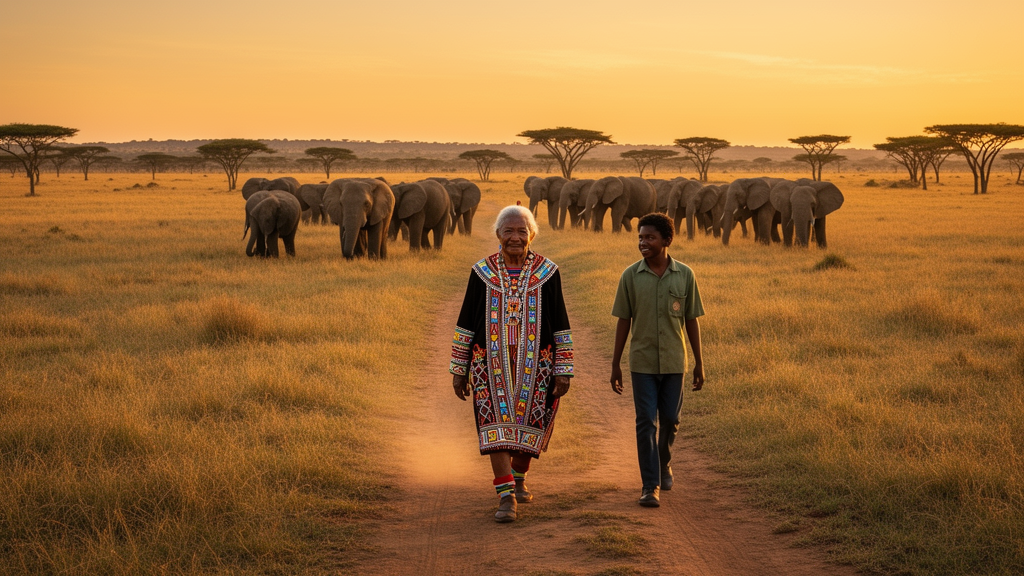
For decades, conservation has been built on a simple premise: separate people from wildlife, and both will be better off. Fortress-style protected areas fenced out Indigenous communities, predators were culled, and wilderness was imagined as a place without humans. A new synthesis published in Ecology and Evolution argues that this premise is not only outdated but actively harmful, and that the real pathway to coexistence runs through the plural, often contradictory values held by Indigenous Peoples and Local Communities (IPLCs) — the very groups that conservation history has repeatedly displaced.
The study, led by Anuradhi Dulangi Jayasinghe of Griffith University with colleagues Georgette Leah Burns and Duan Biggs, deployed a critical interpretive synthesis (CIS), a review method designed to build new conceptual understanding rather than merely summarise data. Unlike a rigid systematic review with fixed inclusion criteria, the CIS allowed the researchers to iteratively browse, screen and analyse literature from Google Scholar and Scopus between March and June 2023, covering publications from 2010 to 2023, alongside grey literature and news-media sources. Purposive sampling guided by theoretical relevance meant sources were selected for their conceptual contribution to value pluralism and coexistence, not for statistical representativeness. Twenty peer-reviewed articles formed the analytical core, spanning case studies from the Amazon to Arctic Finland.
The conceptual engine of the paper is value pluralism: the recognition that multiple fundamental values — autonomy, justice, beauty, kinship, economic security — coexist without being reducible to a single ranking. In biodiversity policy, this challenges the dominance of monetary valuation, which captures only instrumental worth (nature as provider) while missing relational values that emerge from human–nature relationships. The researchers define coexistence, following Mekonen, as a dynamic state in which humans and wildlife co-adapt to shared landscapes under effective institutions — formal and informal governance arrangements that facilitate inclusive decision-making while acknowledging diverse knowledge systems.
From the synthesis, three relationship types emerged: positive, negative and ambivalent. The positive cases are the most striking. The Raramuri people of Mexico practise what Salmon termed kincentric ecology — the belief that all life shares the same breath, that everything which breathes has a soul. Humans, plants and animals are extended family, and reciprocity with the environment is sustained through cultural practice. In Kerala, India, the Kattunayakan, a forest-dwelling Adivasi community in the Wayanad Wildlife Sanctuary, regard wild animals as rational conversing beings, as gods, teachers and equals, and as relatives with shared origins. Sharing food with wildlife and respecting its personal space are treated as best practices of tolerance. The researchers call this deep coexistence: relationships that go beyond adaptation into conscious kinship.
Yet the same value systems can generate negative relationships. The Mishmi communities of Arunachal Pradesh consider tigers brothers from the same mother — and if a tiger becomes dangerous, they may kill it as a last resort, framing the act as dealing with a problematic brother. This practice conflicts with India’s conservation legislation, illustrating how a single community can hold values that produce both profound kinship and lethal outcomes. In North Queensland, when wildlife officers euthanised a saltwater crocodile after a 2023 attack, the Wujal Wujal community responded differently from the media: they argued the incident was avoidable, that wildlife — some of it their totems — deserves respect, and that killing one crocodile would destabilise the entire environmental system.
The ambivalent category is the paper’s most novel contribution. Previous frameworks, such as the conflict-to-coexistence continuum, position attitudes along a single line from extreme negativity to full integration. The authors argue this oversimplifies reality: people may simultaneously value a species’ spiritual significance while suffering economic losses from it — a state that cannot be plotted on a line. Swedish farmers, for instance, acknowledge that lynx kill livestock as painlessly as possible for survival, yet brand wolves as cruel hunters who kill for pleasure. Finnish herders say wolverines sometimes kill reindeer for fun. These mixed, contradictory and context-dependent responses arise when multiple values are invoked at once, and the researchers insist they are not merely a midpoint between positive and negative but a distinct relational mode.
Ambivalence also surfaces in the collision between traditional knowledge and modern conditions. Sámi reindeer herders historically developed coping strategies to coexist with predators, but rapid environmental change pushes them into territories where generational knowledge is limited. Snowmobiles, tourism and unpredictable weather erode what herders call grazing peace — the undisturbed winter feeding that traditional knowledge protects. In Finland, increased depredation forces herding practices toward predator control and monitoring, decreasing autonomy and straining the social relationships embedded in traditional herding. The Xeni Gwet’in First Nation in British Columbia, meanwhile, treat animals and land as active agents in co-management decisions — a perspective implying that human control of ecological relations is either non-existent or unknowable, making uncertainty itself something kincentric management must embrace.
The resulting conceptual framework is deliberately fluid. Positive relationships emerge from reciprocity, belongingness and kincentric values; negative relationships can paradoxically also emerge from strong kinship ties, as with the Mishmi; ambivalent relationships arise from trust and reciprocity colliding with modern governance. Crucially, the three categories are connected by two-way arrows rather than sealed boxes, and coexistence is possible across all of them. The same act — killing a dangerous tiger — is a positive relationship from the community’s perspective and a negative one from the state’s. Value pluralism, the authors argue, is the foundation that makes these multiple legitimate perspectives visible, defying simple quantitative categorisation.
The political stakes are considerable. The fortress conservation model has been associated with violence against Indigenous communities — what Luoma termed conservation violence — displacing peoples and destroying cultures in the name of wilderness. Dawson and colleagues suggest the primary pathway to long-term biodiversity conservation lies in governance quality and reinforcing the role of IPLCs. The IPBES value assessment similarly emphasises that human–nature relationships are shaped by diverse, overlapping values and knowledge systems. In Sagalla, Kenya, where community participation in elephant management is limited, coexistence was perceived as coercion, breeding resistance and retaliatory killing. Ignoring community values, the synthesis warns, produces an information deficit that undermines the social sustainability of conservation.
The authors conclude that acknowledging value pluralism — and the positive, negative and ambivalent relationships it begets — must be respected and accommodated to ensure effective governance of human–wildlife interactions. Their framework is offered as a conceptual tool for conservation decision-making, reflecting IPLC values beyond the reductive binaries of conflict and coexistence. Implementation, they caution, depends on institutional capacity, political will, financial resources and sustained stakeholder engagement, which vary across contexts and scales. But the longer action is delayed, the more likely traditional and local knowledge will be lost and conflicts will deepen. In a world where elephants are culled in South Africa while Adivasi communities share food with wild animals in Kerala, the message is clear: coexistence is not a single state but a plural one, and conservation policy that cannot see that plurality will keep failing the people and wildlife it claims to protect.
Subject of Research: Exploring Human‐Wildlife Coexistence Through the Lens of Value Pluralism Among Indigenous Peoples and Local Communities (IPLCs)
Article Title: Exploring Human‐Wildlife Coexistence Through the Lens of Value Pluralism Among Indigenous Peoples and Local Communities (IPLCs)
Article References: Jayasinghe, A. D., Burns, G. L., & Biggs, D. (2026). Exploring Human‐Wildlife Coexistence Through the Lens of Value Pluralism Among Indigenous Peoples and Local Communities ( IPLCs ). Ecology and Evolution, 16(10), Article e74507. https://doi.org/10.1002/ece3.74507
Image Credits: AI Generated
DOI: 10.1002/ece3.74507
Keywords: human-wildlife coexistence, value pluralism, Indigenous Peoples and Local Communities, IPLCs, conservation governance, kincentric ecology, biodiversity conservation, critical interpretive synthesis, human-wildlife conflict, Ecology and Evolution, Exploring, Human
Cite Scienmag News
Margaret Porter. (October 17, 2026). Why Indigenous Communities Hold the Key to Living With Wildlife. Scienmag. https://scienmag.com/why-indigenous-communities-hold-the-key-to-living-with-wildlife/
Margaret Porter. "Why Indigenous Communities Hold the Key to Living With Wildlife." Scienmag, 17 October 2026, https://scienmag.com/why-indigenous-communities-hold-the-key-to-living-with-wildlife/. Accessed 17 October 2026.
Margaret Porter. "Why Indigenous Communities Hold the Key to Living With Wildlife." Scienmag. October 17, 2026. https://scienmag.com/why-indigenous-communities-hold-the-key-to-living-with-wildlife/


