


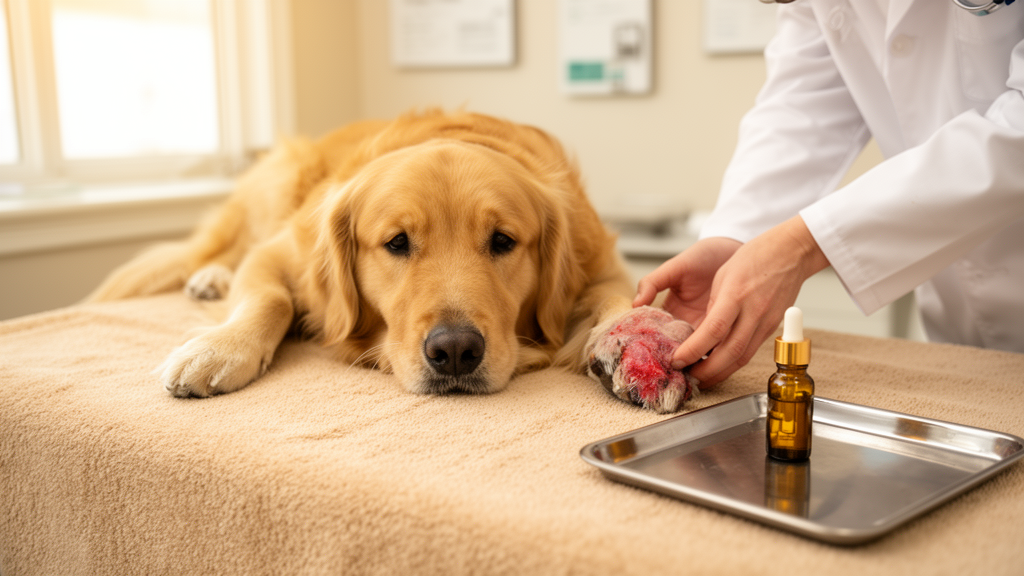
Canine atopic dermatitis is one of the most stubborn chronic skin diseases in veterinary medicine, a genetically rooted inflammatory syndrome that demands lifelong, multimodal therapy. Now a team of Brazilian researchers has reported that a full-spectrum Cannabis oil, given alongside the standard drug oclacitinib, was associated with significantly lower itch scores in atopic dogs — and, remarkably, that itch control held steady even when the oclacitinib dose was cut in half. The study, published in Frontiers in Allergy, offers the first prospective clinical observations of this drug combination and hints at a potential oclacitinib-sparing effect that could reshape how veterinarians manage the disease.
The research, led by Carollina Mariga and colleagues at the Federal University of Santa Maria in Rio Grande do Sul, Brazil, set out to answer two questions at once: whether adjunctive Cannabis oil could improve control of recurrent clinical signs in dogs whose oclacitinib treatment had been unsatisfactory, and whether the cannabinoid supplement could allow a structured reduction of the conventional drug without clinical relapse. Sixteen dogs with a confirmed diagnosis of atopic dermatitis were enrolled, each previously treated with oclacitinib without satisfactory improvement. Food allergy had been excluded through an 8-to-12-week hypoallergenic elimination diet, and flea bite dermatitis was ruled out, following established diagnostic criteria.
The study design was a prospective, placebo-controlled, repeated-measures protocol in which every dog moved through the same fixed sequence of four stages. At T0, the animals received oclacitinib alone at individualized doses ranging from 0.2 to 1.1 mg/kg once daily, deliberately adjusted to leave a clinically detectable level of pruritus so that owners could perceive any treatment-related change. During the next 30 days, T30, the dogs received an oral placebo of mineral oil — tinted with artificial yellow food coloring to mimic the appearance of Cannabis oil — alongside full-dose oclacitinib. At T60, the placebo was replaced by Cannabis oil delivering 2.0 mg/kg of cannabidiol twice daily, still combined with full-dose oclacitinib. Finally, at T90, the cannabinoid oil was maintained while the oclacitinib dose was reduced by 50 percent. Because each animal served as its own control across all phases, the design reduced the interindividual biological variability that plagues cannabinoid research, where endocannabinoid tone differs markedly between individuals and tissues.
Assessment relied on two blinded instruments. A veterinary dermatologist scored skin lesions using the Canine Atopic Dermatitis Extent and Severity Index, CADESI-4, adapted to include the ventral cervical region, while owners rated itching on a simple zero-to-five behavioral scale at every visit. Crucially, both the dermatologist and the owners were unaware of whether the animal was receiving placebo or Cannabis oil at any given phase, and the dermatologist was not informed of the study design or treatment sequence. Fourteen of the sixteen dogs completed all stages through T90; two were withdrawn before the final month because of deep secondary skin infections requiring systemic therapy, diagnosed clinically and by cytology.
The statistical picture was nuanced. CADESI-4 scores, analyzed with generalized linear mixed models, showed no statistically significant effect of time, with estimated marginal means of 4.65 at baseline, 5.13 during placebo, 2.74 during Cannabis treatment, and 3.59 after the oclacitinib reduction. The primary planned contrast between the placebo and Cannabis phases did not reach significance, and after Holm adjustment no pairwise comparison was significant. Pruritus, however, told a different story. A cumulative link mixed model accounting for the ordinal nature of the itch scale and the repeated measurements found a significant effect of time, with mean scores falling from 3.44 at baseline to 3.00 during placebo, 2.31 during Cannabis treatment, and 2.42 after the dose reduction. The direct placebo-versus-Cannabis comparison again fell short of significance, but the comparisons against baseline were striking: itch odds were significantly lower at T60 (p = 0.0013) and at T90 (p = 0.0065) than at T0, indicating lower cumulative odds of being in higher pruritus categories once cannabinoid therapy began.
Perhaps the most clinically intriguing finding emerged at the end of the protocol. When Cannabis oil was interrupted after T90 while the dogs remained on half their original oclacitinib dose, nine of the fourteen animals resumed scratching within a week — four on the second day, two on the third, one on the fourth, and two on the seventh. The remaining five dogs stayed stable for the full seven days without cannabinoid supplementation. Nine owners, or 56.25 percent, chose to continue Cannabis treatment after the study concluded. Together with the maintained pruritus scores during the 50 percent oclacitinib taper, these observations support the hypothesis that adjunctive cannabinoids may exert a drug-sparing effect, allowing meaningful dose reductions of an expensive targeted therapy without loss of itch control.
The biological plausibility of an antipruritic effect rests on the endocannabinoid system, a homeostatic regulator expressed throughout the layers of the skin and in immune cells. Cannabinoid receptor type 1 and type 2 expression is increased in the skin cells of atopic dogs, and experimental work in genetically modified mice shows that deleting CB1 receptors in primary sensory neurons exacerbates inflammation and pruritus, promoting substance P production and mast cell accumulation in the dermis, while CB2 deletion worsens psoriasiform dermatitis and itch. Cannabidiol itself demonstrates broad immunosuppressive potential by downregulating the Janus kinase/signal transducer and activator of transcription pathway — the very pathway oclacitinib targets — and inhibiting key activating cytokines including interleukin-6, interleukin-2, interferon-gamma, and tumor necrosis factor, while also disrupting interconnected cascades such as PI3K-Akt and MAPK.
The formulation used was a full-spectrum, CBD-rich oil containing 73.7 percent CBD by relative proportion of total cannabinoid mass, along with 2.11 percent delta-9-tetrahydrocannabinol, 2.05 percent cannabichromene, 1.85 percent cannabigerol, and smaller amounts of cannabidivarin, cannabigerolic acid, and cannabinol, plus terpenes such as caryophyllene, humulene, nerolidol, guaiol, and bisabolol. The authors argue that this chemical complexity — the so-called entourage effect — may enable multitarget action on inflammatory pathways including MAPK, NF-kB, the NLRP3 inflammasome, and JAK1/STAT6 signaling in skin cells. In vitro studies suggest that cannabichromene downregulates master inflammatory signaling by inhibiting NF-kB and MAPK and suppressing TNF-alpha, interleukin-1 beta, and inducible nitric oxide synthase, while cannabigerol provides immunomodulation through CB2 receptor engagement, PPAR-gamma and Nrf2 activation, and direct inhibition of COX-1, COX-2, and iNOS. The oil underwent laboratory analysis confirming its cannabinoid and terpene profile and the absence of contaminants such as heavy metals, mycotoxins, pesticides, and solvent residues.
The results align closely with a prior prospective, randomized, double-blinded, placebo-controlled study by Loewinger and colleagues, in which 32 atopic dogs treated with a CBD/CBDA mixture showed a significant reduction in pruritus that nonetheless failed to reach significance against placebo, and no improvement in CADESI-4 lesion scores. A retrospective report by Mogi and colleagues, in contrast, described improvements in both itch and lesions in eight dogs treated with CBD-rich oil, though without a control group and with gradually escalating doses. The authors also note that their cohort presented with considerably lower baseline lesion scores than in their own earlier pre-study, reflecting a deliberate choice to include dogs across the full clinical spectrum seen in routine practice — a decision that may have reduced the sensitivity of CADESI-4 to detect treatment-related improvement, since several animals had low or null baseline scores.
Safety findings were reassuring but instructive. During the placebo month, 62.5 percent of dogs experienced at least one adverse clinical sign, including drowsiness, soft stools, and vomiting; during the Cannabis introduction month, 68.75 percent did, with drowsiness the most frequent complaint; and during the final maintenance month, 35.71 percent. All episodes were mild, transient, and self-limiting. Notably, roughly one in five animals reported drowsiness, vomiting, or soft stools even while receiving only mineral oil and food coloring — a pattern the authors attribute at least partly to the caregiver placebo effect, in which owners attribute expected adverse effects to treatment after being informed of study procedures, though spontaneous gastrointestinal signs or effects of the placebo formulation itself remain possible. No relevant behavioral alterations were identified during cannabinoid therapy, consistent with previous work showing that CBD administration does not affect daily voluntary activity in healthy dogs.
The authors are candid about the limitations. The sequential design confounds treatment with time, so observed changes cannot be cleanly separated from natural disease fluctuations, regression to the mean, or observer expectation bias. Pruritus was measured with a simple owner-reported scale rather than the validated Pruritus Visual Analog Scale, the sample was small, and seasonal variation in pruritus was not formally investigated. The CBD-rich formulation, constrained by Brazilian regulations limiting THC content in marketed products to 0.3 percent, prevents evaluation of the potential contribution of higher THC levels and other minor cannabinoids. Still, the study is, to the authors’ knowledge, the first to report the combination of Cannabis oil and oclacitinib in dogs with atopic dermatitis and to provide preliminary observations of a potential oclacitinib-sparing effect. The findings do not support recommending Cannabis as a first-line treatment, but they raise an exploratory hypothesis that earlier introduction of cannabinoid therapy may offer clinical benefits before chronic inflammatory changes become fully established — a question that now demands randomized controlled trials to establish the specific contribution of Cannabis oil to clinical improvement and to consolidate its place in multimodal therapy for this lifelong disease.
Subject of Research: Clinical observations during adjunctive Cannabis treatment and subsequent oclacitinib dose reduction in dogs with atopic dermatitis
Article Title: Clinical observations during adjunctive Cannabis treatment and subsequent oclacitinib dose reduction in dogs with atopic dermatitis
Article References: Mariga, C., Silva, F. C. D., Schiefler, O. H. D. M., Amazonas, E., Mateus, A. L. S. S., Schmidt, C., & Filho, S. T. L. P. (2026). Clinical observations during adjunctive Cannabis treatment and subsequent oclacitinib dose reduction in dogs with atopic dermatitis. Frontiers in Allergy, 7, Article 1852631. https://doi.org/10.3389/falgy.2026.1852631
Image Credits: AI Generated
DOI: 10.3389/falgy.2026.1852631
Keywords: canine atopic dermatitis, cannabidiol, oclacitinib, endocannabinoid system, veterinary dermatology, pruritus, cannabis oil, multimodal therapy, CADESI-4, drug-sparing effect, Clinical, observations
Cite Scienmag News
William Thompson. (October 17, 2026). Cannabis Oil Shows Pruritus Relief in Dogs With Atopic Dermatitis. Scienmag. https://scienmag.com/cannabis-oil-shows-pruritus-relief-in-dogs-with-atopic-dermatitis/
William Thompson. "Cannabis Oil Shows Pruritus Relief in Dogs With Atopic Dermatitis." Scienmag, 17 October 2026, https://scienmag.com/cannabis-oil-shows-pruritus-relief-in-dogs-with-atopic-dermatitis/. Accessed 17 October 2026.
William Thompson. "Cannabis Oil Shows Pruritus Relief in Dogs With Atopic Dermatitis." Scienmag. October 17, 2026. https://scienmag.com/cannabis-oil-shows-pruritus-relief-in-dogs-with-atopic-dermatitis/


