


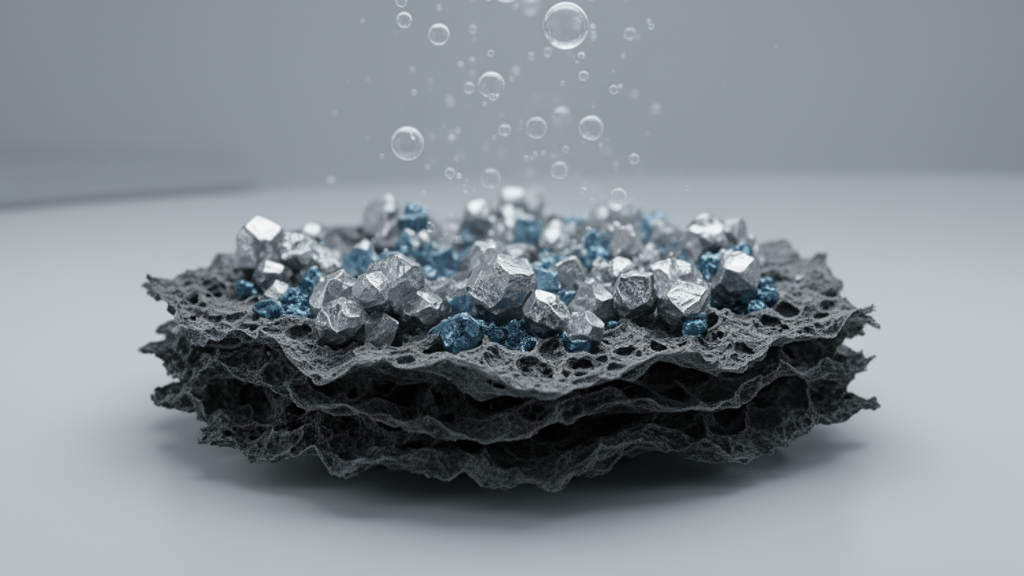
Researchers have unveiled a hybrid electrode material that pulls double duty in the clean-energy economy, storing impressive amounts of charge in a supercapacitor while simultaneously catalyzing the production of hydrogen fuel from water. The composite, described in the Journal of Materials Science, combines nickel cobalt oxide and cadmium oxide nanoparticles anchored onto reduced graphene oxide, a carbon scaffold prized for its exceptional electrical conductivity. The team, led by Summaira Khan and Muhammad Ashraf of Riphah International University in Lahore, Pakistan, together with Sohail Mumtaz of Gachon University in the Republic of Korea, synthesized the material through a hydrothermal approach, a low-cost and environmentally friendly route in which reactions proceed in water inside a sealed vessel at elevated temperature.
The appeal of the new material lies in its bifunctionality. Electrode materials for supercapacitors and catalysts for the hydrogen evolution reaction typically demand different, sometimes conflicting, properties: fast and reversible redox activity for charge storage, and efficient adsorption of hydrogen intermediates for water splitting. By embedding nickel cobalt oxide, a spinel oxide celebrated for its rich redox chemistry, and cadmium oxide, which contributes additional electroactive sites, onto reduced graphene oxide, the researchers created a hierarchical architecture in which each component compensates for the limitations of the others. The result is a single electrode that performs credibly in both roles, a design philosophy that could simplify the materials toolkit for integrated energy devices.
The numbers reported for charge storage are striking. At a current density of 2 amperes per gram, the composite delivered a specific capacity of 2700 coulombs per gram, a metric that quantifies the total charge an electrode can store per unit mass and one that translates into substantial energy density when paired with an appropriate counter-electrode in a full device. The hybrid also achieved an energy density of 71.2 watt-hours per kilogram alongside a power density of 1600 watts per kilogram, a combination that matters because supercapacitors have long been criticized for storing less energy than batteries even though they can deliver and absorb charge far more rapidly. Pushing both figures upward simultaneously is the central engineering challenge of the field.
Durability, the quiet killer of promising electrode materials, also fared well. The composite retained a coulombic efficiency of 89.87 percent over 1000 charge-discharge cycles, indicating that the redox reactions remained reversible and that the material resisted the structural degradation, dissolution, and detachment that plague many metal oxide electrodes as they swell and contract during repeated cycling. The researchers attribute this resilience to the reduced graphene oxide matrix, which substantially enhances charge-transport pathways, preserves the hierarchical structure, and exposes abundant electroactive sites while physically supporting the oxide nanoparticles.
Reduced graphene oxide deserves particular attention in explaining the composite’s performance. Derived from graphite oxide by partial chemical reduction, it retains functional oxygen groups that serve as nucleation points for anchoring metal oxide nanoparticles, preventing them from clumping into larger particles with diminished surface area. Its conductive carbon network then acts as a highway for electrons, funneling charge from the current collector to the dispersed oxide particles and back. Without this scaffold, electrons moving through a thick film of semiconducting oxides encounter resistance at every grain boundary; with it, the effective resistance drops and the redox activity of the oxides can be exploited at high rates. The synergistic effect from embedding the two oxides onto the carbon matrix facilitates efficient electron transfer, redox activity, and durability, the authors write.
Nickel cobalt oxide itself is a spinel structure in which nickel and cobalt cations occupy defined sites within a cubic oxide framework. Its electrochemical activity stems from the multiple oxidation states accessible to both metals, allowing rich and reversible Faradaic reactions in which charge is stored through electron transfer at the electrode surface rather than through the purely electrostatic adsorption seen in carbon-based double-layer capacitors. Cobalt’s involvement raises the electrical conductivity relative to pure nickel oxide, while nickel contributes additional redox capacity. Cadmium oxide, a well-known transparent conducting oxide, adds a second population of electroactive nanoparticles and may improve the overall electronic character of the composite, though the researchers emphasize the cooperative interaction among all three solid phases rather than the contribution of any single component.
The hydrogen evolution results add a catalytic dimension to the work. When tested as an electrocatalyst for splitting water, the composite required an overpotential of 190.22 millivolts to reach a current density of 10 milliamperes per square centimeter, with a Tafel slope of 67.22 millivolts per decade. The overpotential measures the extra voltage beyond the thermodynamic requirement that must be applied to drive hydrogen production at a practical rate; lower values mean less wasted energy. The Tafel slope, obtained from the relationship between overpotential and the logarithm of current density, offers insight into the reaction mechanism and the kinetics of the catalytic process, with shallower slopes indicating faster kinetics. Achieving both metrics in a material designed primarily for charge storage suggests that the same surface features that promote fast redox reactions also assist the adsorption and recombination steps of hydrogen generation.
The bifunctional design carries practical weight for the emerging hydrogen economy. Green hydrogen, produced by electrolyzing water with renewable electricity, depends on electrocatalysts that are active, stable, and cheap. Precious-metal catalysts based on platinum and iridium set the performance benchmark but remain expensive and scarce, motivating intense research into transition-metal oxides, sulfides, and phosphides as alternatives. A hydrothermally synthesized composite of abundant metals on a carbon scaffold fits squarely within this search, and the fact that the same electrode can be repurposed for energy storage hints at integrated systems in which a single material platform serves supercapacitors, water splitters, and possibly regenerative fuel cells.
The study, published on 16 October 2026, suggests an auspicious approach for designing efficient hybrid electrode systems for electrochemical energy storage applications and next-generation supercapacitors, according to the authors. The fabrication and design of advanced electrode materials via low-cost and environmentally friendly approaches have attracted great interest, they note, positioning the hydrothermal route as a scalable pathway for industry. The work also reflects a broad international collaboration, with contributors from Princess Nourah bint Abdulrahman University and Taif University in Saudi Arabia, the University of Chemistry and Technology Prague in the Czech Republic, Urgench State University in Uzbekistan, and the University of Hafr Al Batin and Prince Sattam bin Abdulaziz University in Saudi Arabia, supported by the Princess Nourah bint Abdulrahman University Researchers Supporting Project.
Challenges remain before such composites reach commercial devices. Cycle life beyond 1000 cycles, full-cell performance with realistic mass loadings, and long-term stability under industrially relevant current densities all require further demonstration, and cadmium’s toxicity raises environmental questions that researchers will need to address through encapsulation or substitution. Yet the underlying design logic, dispersing redox-active oxides across a conductive carbon network to harvest the strengths of both, continues to spread through the energy materials community. As the demand for rapid-charging storage and low-cost hydrogen production grows in parallel, materials that serve both missions at once may prove among the most consequential innovations of the decade.
Subject of Research: Nickel cobalt oxide-cadmium oxide anchored on reduced graphene oxide (NiCo2O4–CdO@rGO) as a bifunctional electrode material for energy storage devices and hydrogen evolution reaction
Article Title: Nickel cobalt oxide-cadmium oxide anchored on reduced graphene oxide (NiCo2O4–CdO@rGO) as a bifunctional electrode material for energy storage devices and hydrogen evolution reaction
Article References: Khan, S., Ashraf, M., Zahid, T., Ahsan, U., Fakhraddin, M., Alotaibi, M. T., Maati, L. A. E., Tawfik, S. G., Alrubayyi, A., Alrobei, H., & Mumtaz, S. (2026). Nickel cobalt oxide-cadmium oxide anchored on reduced graphene oxide (NiCo2O4–CdO@rGO) as a bifunctional electrode material for energy storage devices and hydrogen evolution reaction. Journal of Materials Science. https://doi.org/10.1007/s10853-026-13909-z
Image Credits: AI Generated
DOI: 10.1007/s10853-026-13909-z
Keywords: supercapacitors, hydrogen evolution reaction, reduced graphene oxide, nickel cobalt oxide, cadmium oxide, bifunctional electrode, energy storage, electrocatalysis, Nickel, cobalt, oxide-cadmium, oxide
Cite Scienmag News
Bethany Barker. (October 17, 2026). Graphene-backed nickel cobalt oxide composite doubles as supercapacitor electrode and hydrogen catalyst. Scienmag. https://scienmag.com/graphene-backed-nickel-cobalt-oxide-composite-doubles-as-supercapacitor-electrode-and-hydrogen-catalyst/
Bethany Barker. "Graphene-backed nickel cobalt oxide composite doubles as supercapacitor electrode and hydrogen catalyst." Scienmag, 17 October 2026, https://scienmag.com/graphene-backed-nickel-cobalt-oxide-composite-doubles-as-supercapacitor-electrode-and-hydrogen-catalyst/. Accessed 17 October 2026.
Bethany Barker. "Graphene-backed nickel cobalt oxide composite doubles as supercapacitor electrode and hydrogen catalyst." Scienmag. October 17, 2026. https://scienmag.com/graphene-backed-nickel-cobalt-oxide-composite-doubles-as-supercapacitor-electrode-and-hydrogen-catalyst/


