


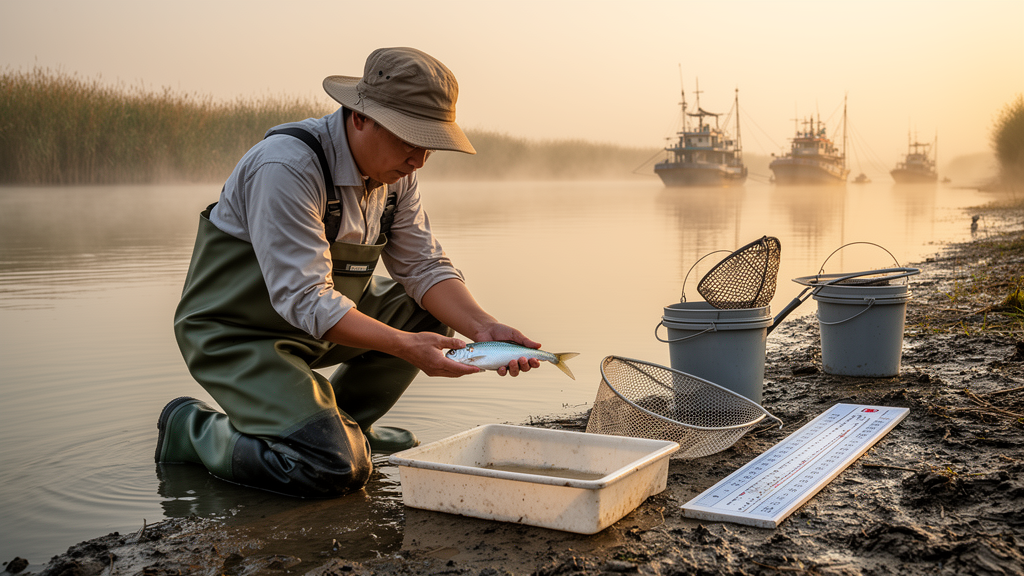
Deep in the Yangtze River, one of the world’s most remarkable migratory fish is quietly telling scientists whether a historic fishing ban is working. The Japanese grenadier anchovy, Coilia nasus, an Endangered species celebrated for its delicate flavor and epic upstream journey, has become the subject of a new study that goes beyond simple catch counts to reveal the reproductive condition of the fish themselves. Researchers from Shanghai Ocean University and the Chinese Academy of Fishery Sciences have established a detailed reproductive status baseline for this species across four distinct sections of the Yangtze during the fishing moratorium, offering a technical but vital window into how the population is recovering.
The study, published in Environmental Monitoring and Assessment, tackled a fundamental limitation of conventional monitoring. Catch-based indicators, such as the number of fish caught per event, are widely used to track the effects of the Yangtze fishing ban, but they say nothing about whether the fish are actually ready to spawn. A river can teem with fish that never reach reproductive maturity, and such a population would be far from recovered. To address this gap, the research team designed a survey that combined catch data with laboratory measurements of gonadal development, age structure, and the gonadosomatic index, a key metric that expresses gonad weight as a proportion of total body weight.
Between May and June 2024, the team deployed drift gill nets with 40-millimetre mesh at four river sections spanning estuarine, mainstream, and river–lake junction habitats. The sections were Chongming near the Yangtze Estuary in Shanghai, Taizhou in Jiangsu Province, Anqing in Anhui Province, and Hukou in Jiangxi Province, near the junction with Poyang Lake. The survey yielded an impressive 9,455 fish, which the researchers summarized in calendar 10-day intervals to capture seasonal patterns. A laboratory series of 1,119 fish, collected from 30 May to 4 June, provided the detailed reproductive measurements that form the technical core of the study.
The results revealed a striking spatial contrast in reproductive condition. Anqing recorded the highest mean catch per event at 129.5 fish, yet the lowest proportion of mature fish at just 8.9 percent. Chongming, by comparison, yielded fewer fish per event at 95.3, but a far higher proportion of mature fish at 54.2 percent, and 18.4 percent of the laboratory series at Chongming were at gonadal stage V, the most advanced macroscopic stage. Even more dramatically, stage-V fish rose to 44.8 percent of the late June catch at Chongming, suggesting that fully ripe spawners were concentrated downstream near the estuary as the migration season progressed.
Statistical models that clustered events by sampling occasion estimated approximately tenfold higher odds of maturity at Chongming than at Anqing. The contrast persisted even when the analysis was restricted to a six-day common sampling window, ruling out seasonal timing as the sole explanation. At Anqing, the gonadal composition shifted seasonally from stage II toward stage III, but few fish reached the advanced stages IV and V. Hukou was dominated by stage-III and stage-IV fish, occupying an intermediate position in the reproductive gradient. These patterns suggest that fish at the two upstream sections were larger but in lower body condition than those downstream, consistent with a contribution from long-distance migrants that mature later in the season.
The age structure of the laboratory series added another layer of technical insight. Ages 2 and 3 accounted for 90.3 percent of the 1,119 fish examined, indicating that the population sampled during the migration season is dominated by young adults. The gonadosomatic index increased consistently across macroscopic gonadal stages, validating the use of the index as a quantitative companion to visual staging. Fish at macroscopic gonadal stages IV and V were classified as mature, with stage V analyzed separately to distinguish fully ripe spawners from those approaching maturity.
The spatial patterns carry important implications for understanding the migratory ecology of this anadromous species. Coilia nasus migrates from marine and estuarine waters into freshwater reaches of the Yangtze to spawn, and previous research has documented diverse migration patterns and spawning ground distributions using otolith microchemistry. The current study’s finding that downstream fish are smaller but in better condition and more reproductively advanced suggests that short-distance migrants near the estuary may mature earlier, while long-distance migrants traveling upstream to sections like Anqing and Hukou invest energy in the journey itself and mature later. This state-dependent spawning migration echoes patterns documented in other migratory fish, such as Norwegian spring-spawning herring, where reproductive state shapes the timing and extent of migration.
The study also highlights the value of joint monitoring of catch rate and reproductive condition through the migration season. By combining these two dimensions, the researchers provide a seasonal baseline for this Endangered species across estuarine, mainstream, and river–lake junction habitats. Such baselines are essential for evaluating the effectiveness of the Yangtze fishing ban, a sweeping conservation measure that has halted seven decades of biodiversity decline in the river according to recent research published in Science. The ban, which began in 2020 and is designed to last ten years, has created an unprecedented opportunity for fish populations to recover, but recovery must be measured not just in numbers but in the reproductive health of the population.
The technical approach of the study reflects best practices in fish reproductive monitoring. The use of a standardized macroscopic staging system, aligned with internationally recognized terminology for describing reproductive development in fishes, allows comparison with other studies. The gonadosomatic index, measured in the laboratory series, provides a continuous quantitative measure that complements the categorical staging. The statistical models, which clustered events by sampling occasion, account for the temporal structure of the survey and provide robust estimates of the spatial contrast in maturity odds. The full survey and laboratory datasets and the R scripts used for the analyses are available in Figshare, supporting transparency and reproducibility.
As the Yangtze fishing ban enters its later years, studies like this one offer a template for monitoring recovery in other Endangered migratory fish. The Japanese grenadier anchovy, with its complex life history spanning marine, estuarine, and freshwater habitats, serves as a sentinel species whose reproductive condition reflects the health of the entire river ecosystem. The seasonal baseline established by this research provides a reference point against which future surveys can be compared, and the finding that reproductive maturity varies dramatically across river sections underscores the need for spatially explicit monitoring. The recovery of this iconic species will depend not just on the absence of fishing but on the presence of fish that are ready to spawn, and this study provides the technical foundation for measuring exactly that.
Subject of Research: Conservation Biology
Article Title: Reproductive status monitoring of Coilia nasus across four Yangtze River sections during the fishing ban period
Article References: Guo, H., Zhang, X., Tang, W., & Liu, K. (2026). Reproductive status monitoring of Coilia nasus across four Yangtze River sections during the fishing ban period. Environmental Monitoring and Assessment, 198(11), Article 1205. https://doi.org/10.1007/s10661-026-16060-z
Image Credits: AI Generated
DOI: 10.1007/s10661-026-16060-z
Keywords: Coilia nasus, Yangtze River, fishing ban, reproductive monitoring, anadromous fish, gonadosomatic index, Reproductive, status, monitoring, Coilia, nasus, across
Cite Scienmag News
Margaret Porter. (October 17, 2026). Endangered anchovy reveals hidden reproductive clues along the Yangtze during fishing ban. Scienmag. https://scienmag.com/endangered-anchovy-reveals-hidden-reproductive-clues-along-the-yangtze-during-fishing-ban/
Margaret Porter. "Endangered anchovy reveals hidden reproductive clues along the Yangtze during fishing ban." Scienmag, 17 October 2026, https://scienmag.com/endangered-anchovy-reveals-hidden-reproductive-clues-along-the-yangtze-during-fishing-ban/. Accessed 17 October 2026.
Margaret Porter. "Endangered anchovy reveals hidden reproductive clues along the Yangtze during fishing ban." Scienmag. October 17, 2026. https://scienmag.com/endangered-anchovy-reveals-hidden-reproductive-clues-along-the-yangtze-during-fishing-ban/


