


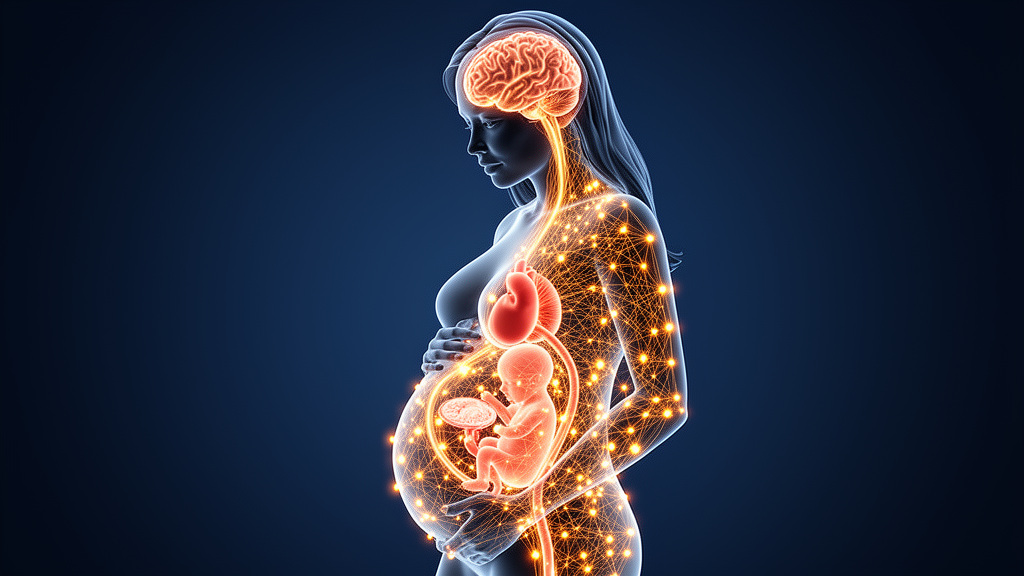
For decades, medicine has treated pregnancy as a dialogue between two separate organisms: the mother and the fetus, connected but distinct. A new scoping review published in Frontiers in Network Physiology argues that this framing is fundamentally incomplete. Drawing on 38 studies spanning psychology, immunology, genetics, and cardiovascular physiology, Igor V. Lakhno of Kharkiv National Medical University proposes that the mother, placenta, and fetus operate as a single, adaptive, multiscale network—a system he calls the maternal-fetal “communicatome.” When this network synchronizes, pregnancy thrives. When it decouples, the result may be pre-eclampsia, fetal growth restriction, or preterm birth, detectable weeks before symptoms appear.
The central pillar of the communicatome is the coupling of maternal and fetal heart rate variability, or HRV. HRV reflects the beat-to-beat fluctuations of the heart governed by the autonomic nervous system, and in pregnancy the two cardiac systems do not beat in isolation. Analytical tools such as partial directed coherence and bivariate phase-rectified signal averaging reveal that the coupling is nonlinear and time-varying: early in gestation, fetal-to-maternal influence often dominates, but by mid-to-late pregnancy the drive shifts toward the maternal side. This synchronization offers a non-invasive window into the maturation of the fetal brain and autonomic nervous system.
One of the review’s most striking technical findings concerns the umbilical vein, which has no innervation of its own and therefore cannot generate rhythms independently. Instead, it acts as a physiological “mirror.” Spectral analysis of umbilical venous blood flow reveals a characteristic frequency peak at roughly 0.5 hertz—within the 0.45 to 0.55 hertz range—that corresponds directly to maternal respiratory sinus arrhythmia, the natural speeding and slowing of the heart with each breath. Maternal breathing at approximately 30 breaths per minute during paced respiration propagates across the placental barrier and modulates fetal circulation. Remarkably, the fetus generates its own episodic breathing movements at 30 to 60 breaths per minute, creating a bidirectional mechanical feedback loop in which rhythmic pressure waves travel through the umbilical vein back toward the placenta and can influence maternal heart rate variability itself.
That mirror breaks in disease. In pre-eclampsia and fetal growth restriction, the 0.5 hertz peak is absent or significantly diminished, signaling a collapse in network connectivity. In severe pre-eclampsia, previous work by the review’s author indicates that a hypokinetic pattern of combined maternal-fetal hemodynamics is associated with a marked reduction in respiratory sinus arrhythmia, and the fetal cardiovascular system becomes functionally dissociated from the maternal organism—confirmed by the loss of significant correlations between maternal and fetal HRV parameters such as total power and the root mean square of successive differences. The review proposes that this decoupling is not merely a symptom but a presumable pathogenetic mechanism of fetal distress.
The clinical stakes are quantifiable. Fetal HRV metrics such as short-term variation, the standard deviation of normal-to-normal intervals, and RMSSD normally increase with gestational age as the fetal autonomic nervous system matures from sympathetic dominance toward vagal control. Growth-restricted fetuses show markedly reduced variability, elevated stress indices, and delayed maturation as measured by the fetal Autonomic Brain Age Score, or fABAS—a metric that can flag developmental vulnerability weeks before clinical symptoms. A meta-analysis of seven studies covering 780 singleton pregnancies found that antepartum short-term variation predicted fetal acidemia at birth with a pooled sensitivity of 0.57 and specificity of 0.81, meaning low STV flags risk but a normal value helps rule it out. Longer term, a landmark longitudinal study of roughly 700 fetuses found that higher fetal HRV and steeper developmental trajectories after 28 weeks predicted better mental and psychomotor outcomes on the Bayley Scales at age two.
Beneath these biosignals lies a dense molecular scaffolding. The placenta secretes hormones, growth factors, and anti-angiogenic factors into both circulations, and it uses the mTOR signaling pathway as a nutrient sensor that prioritizes maternal resource stability over fetal demand to ensure mutual survival. Extracellular vesicles—lipid-membrane-bound particles ranging from tiny exosomes to giant syncytial nuclear aggregates larger than 20 micrometers—carry proteins such as endothelial nitric oxide synthase, which promotes maternal vasodilation, and apolipoprotein-E, which modulates maternal lipid metabolism. In pre-eclampsia, EV-bound eNOS activity is significantly impaired. The vesicles also transport mRNA and DNA that can “cross-dress” fetal antigen-presenting cells with maternal MHC molecules, inducing a state of split tolerance in which the fetal immune system learns to accept maternal antigens.
The immune dialogue is equally active. Fetal trophoblasts do not hide from the maternal immune system; they actively “educate” it, coaxing decidual natural killer cells and macrophages into tolerant, anti-inflammatory M2 phenotypes. Regulatory T cells are essential to this arrangement—their absence leads to uniform rejection of the semi-allogeneic fetus. Meanwhile, the genetic domain reveals an evolutionary tug-of-war: paternally expressed genes such as IGF-2 push fetal growth, while maternally expressed receptors such as IGF-2R restrain it, and the review interprets pre-eclampsia and gestational diabetes as possible manifestations of this ongoing genetic negotiation.
Perhaps the most enduring legacy of pregnancy is microchimerism. Fetal cells cross into the mother and maternal cells into the fetus, engrafting in tissues including the brain, heart, lungs, thymus, and thyroid. The foundational work cited in the review identified male fetal progenitor cells in maternal blood as long as 27 years after delivery—a maximum observed persistence rather than a universal constant, but evidence that pregnancy leaves a cellular imprint lasting decades. In mouse models, maternal microchimeric cells actively shape offspring neurodevelopment, suppressing microglial activation and altering synaptic pruning, though the functional implications in humans remain largely inferred from these animal studies.
Stress enters the network through a specific molecular gate: the enzyme O-GlcNAc transferase, or OGT, which sits on the X chromosome and escapes X-inactivation in placental tissue. Maternal stress hormones activate glucocorticoid receptors that reduce placental OGT, destabilizing the histone methyltransferase EZH2 and eroding the repressive H3K27me3 chromatin mark. Because female placentas naturally express higher OGT levels, male fetuses—with lower baseline OGT—may fall below a “threshold of vulnerability” under early-gestation stress, making them more susceptible to growth restriction and neurodevelopmental impairment. OGT also regulates extracellular vesicle secretion by modifying annexin A1, a protein essential for vesicle packaging. The review is careful to note that these mechanisms derive largely from rodent models and require validation in human longitudinal cohorts.
The communicatome extends even to psychology and microbes. Prenatal attachment strengthens with gestational age and the perception of fetal movements, and paternal-fetal attachment is shaped less by childhood experiences of care than by the quality of the current parental relationship—a “funnel” through which ancestral parenting patterns are transmitted to the next generation. Maternal gut microbiota produce short-chain fatty acids that cross the placenta to program the fetal gut-brain axis, and microbiota depletion during pregnancy has been linked to deficient thalamocortical neurodevelopment. Pregnancy itself remodels the maternal brain, with gray matter changes in the default mode network that enhance theory-of-mind and infant-cue responsiveness. The review’s practical vision is personalized, predictive obstetrics: integrated biosignal analysis combining fetal ECG, Doppler spectra, and fABAS monitoring to detect network decoupling early, intervene intrauterinely, and prevent the adult diseases—hypertension, diabetes, and neuropsychiatric vulnerability—that the Developmental Origins of Health and Disease paradigm traces back to the womb.
Subject of Research: Network physiology of maternal-fetal communication and its role in pregnancy health and fetal programming
Article Title: The maternal–fetal communicatome: a scoping review and network physiology perspective on a unified, adaptive, and multiscale interaction network
Article References: Lakhno, I. V. (2026). The maternal–fetal communicatome: a scoping review and network physiology perspective on a unified, adaptive, and multiscale interaction network. Frontiers in Network Physiology, 6, Article 1864981. https://doi.org/10.3389/fnetp.2026.1864981
Image Credits: AI Generated
DOI: 10.3389/fnetp.2026.1864981
Keywords: maternal-fetal communication, network physiology, heart rate variability, placenta, pre-eclampsia, fetal growth restriction, preterm birth, microchimerism, extracellular vesicles, DOHaD, fetal neurodevelopment, gut-brain axis
Cite Scienmag News
Harold Sullivan. (October 17, 2026). The Maternal-Fetal Communicatome: How Pregnancy Acts as One Unified Physiological Network. Scienmag. https://scienmag.com/the-maternal-fetal-communicatome-how-pregnancy-acts-as-one-unified-physiological-network/
Harold Sullivan. "The Maternal-Fetal Communicatome: How Pregnancy Acts as One Unified Physiological Network." Scienmag, 17 October 2026, https://scienmag.com/the-maternal-fetal-communicatome-how-pregnancy-acts-as-one-unified-physiological-network/. Accessed 17 October 2026.
Harold Sullivan. "The Maternal-Fetal Communicatome: How Pregnancy Acts as One Unified Physiological Network." Scienmag. October 17, 2026. https://scienmag.com/the-maternal-fetal-communicatome-how-pregnancy-acts-as-one-unified-physiological-network/


