


Every year, millions of people survive an ischemic stroke only to face a long and uncertain road of rehabilitation. Some recover their speech, movement, and memory with remarkable speed; others plateau despite months of therapy. For decades, neuroscientists have known that the brain’s intrinsic functional networks—the large-scale circuits that hum with coordinated activity even when we are at rest—correlate with how well patients recover. But correlation is not causation, and this distinction has long frustrated the field. Now, a study published in Experimental Biology and Medicine offers some of the strongest genetic evidence yet that specific brain networks may actively drive recovery after a mild, nondisabling ischemic stroke, and that cholesterol may shape cognitive outcomes partly through these very circuits.
The research team, led by investigators from hospitals in Guangdong and Zhejiang, China, turned to a technique called Mendelian randomization, a statistical framework that exploits the random shuffle of genes at conception as a natural experiment. Because genetic variants are fixed at birth and cannot be altered by disease or environment, they can serve as proxies for exposures in ways that conventional observational studies cannot. If people who inherit variants associated with stronger functional connectivity in a given brain network also tend to recover better after stroke, the argument for a causal contribution becomes far more compelling than any correlational finding.
To build this genetic case, the researchers drew on a genome-wide association study of 34,691 UK Biobank participants, from which they extracted instruments for 191 resting-state functional magnetic resonance imaging phenotypes. These phenotypes, derived from spontaneous low-frequency fluctuations of the blood oxygen level–dependent, or BOLD, signal, capture two fundamental properties of brain organization: the amplitude of neural activity within individual nodes, and the temporal correlation between pairs of regions, known as pairwise functional connectivity. On the outcome side, they used genetic data from 1,270 patients with nondisabling ischemic stroke enrolled in the Vitamin Intervention for Stroke Prevention trial, whose motor, cognitive, and global impairments were tracked with National Institutes of Health Stroke Scale subscales every three months over two years.
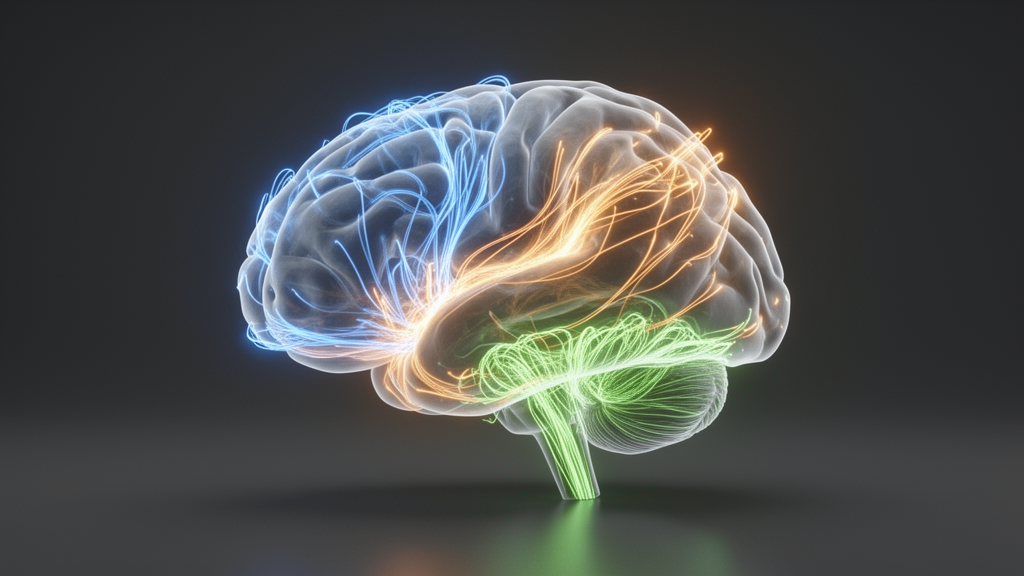
The headline finding centers on what neuroscientists call the triple network: the default mode network, the central executive network, and the salience network. The salience network, anchored in the anterior insula and dorsal anterior cingulate cortex, detects behaviorally relevant stimuli and orchestrates dynamic switching between the internally oriented default mode network and the externally oriented central executive network. The central executive network supports working memory, performance monitoring, and error correction, while the default mode network contributes to memory-based prediction and self-referential processing. The study found that people who inherited variants predicting stronger connectivity within this triple network—specifically between the default mode and central executive networks, and between the central executive and salience networks—showed significantly greater motor improvement after stroke, with an effect estimate of 0.399 and a p-value of 8.33 × 10⁻¹⁶, one of the most statistically robust associations in the entire analysis.
Remarkably, the same triple-network connectivity phenotype was also associated with better cognitive recovery, alongside two additional network features. Stronger connectivity between parietal and frontal regions, part of the frontoparietal network that underpins attention and working memory, predicted better cognitive outcomes. Resting frontal BOLD signal features linking the central executive network with the salience and default mode networks were likewise tied to greater cognitive improvement. Within the limbic network, higher genetically predicted BOLD fluctuation amplitude in the orbitofrontal region was associated with better motor recovery, hinting that emotional and motivational circuits may play an underappreciated role in physical rehabilitation. Notably, no network phenotype survived multiple-testing correction for global recovery, suggesting that the causal architecture of recovery is genuinely domain-specific rather than a single general-purpose property of the brain.
The technical rigor of the analysis deserves emphasis. The primary method was the multiplicative random-effects inverse-variance weighted approach, supplemented by weighted median, MR-Egger, constrained maximum likelihood, debiased inverse-variance weighted, and Bayesian weighted Mendelian randomization estimators, with MR-Pleiotropy Residual Sum and Outlier used to flag problematic variants. A causal relationship was declared only if all methods agreed in direction and the inverse-variance weighted p-value passed a stringent Bonferroni threshold of 8.73 × 10⁻⁵, correcting for 191 phenotypes and three outcomes. Sensitivity analyses found no evidence of heterogeneity among instruments, no single variant driving the results in leave-one-out plots, no statistical signal of horizontal pleiotropy, and no reverse causation when the analyses were run backward. The team even adjusted for collider bias—the distortion that can arise from conditioning on stroke survivors—using corrected weighted least squares based on GIGASTROKE consortium data, and the associations held firm.
Perhaps the most provocative result involves cholesterol. Low-density lipoprotein cholesterol is a well-established risk factor for ischemic stroke, but its role in recovery has been murky, partly because post-stroke lipid levels are heavily influenced by medication and clinical circumstances. Using genetic instruments for lipid traits from a circulating metabolite genome-wide association study of 136,016 participants, the researchers found that genetically proxied higher LDL-C was associated with poorer cognitive recovery, while triglycerides and HDL-C showed no such link. Digging into LDL subfractions, they discovered that total cholesterol in large, medium, and small LDL particles was associated with the triple-network connectivity phenotype itself.
This set the stage for a two-step mediation analysis. The logic is elegant: if lipids influence the brain network, and the brain network influences recovery, then the network may sit on the causal pathway between cholesterol and cognitive outcome. The product-of-coefficients method, with standard errors from the delta method, suggested that triple-network connectivity partially mediates the association between LDL-C liability and cognitive recovery, accounting for roughly 14 to 15 percent of the total effect. The mediation estimates were modest in absolute terms—around −0.008 to −0.009—but their confidence intervals excluded zero, and Steiger directionality tests supported the inferred causal order. The authors propose plausible mechanisms, including neuroinflammation, endothelial dysfunction, altered cerebral perfusion, impaired neurovascular coupling, and even amyloidogenic pathways, all of which are known targets of atherogenic lipids.
Important caveats temper these findings. The BOLD signal reflects not only neural communication but also the vascular and metabolic systems that support it, so the imaging phenotypes may capture variation in neurovascular health as much as in network organization—particularly relevant when the exposure is cholesterol, which directly affects blood vessels. The outcome cohort was predominantly of European ancestry and modest in size, the NIHSS subscales are relatively coarse measures of impairment, and the summary-level design could not account for lesion location, even though strokes situated within or adjacent to key networks would themselves alter measured connectivity. Moreover, the genetic instruments were derived from healthy UK Biobank participants, meaning the results reflect lifelong liability to network properties rather than the possibility that modifying connectivity after a stroke would improve recovery.
Even with these limitations, the study opens genuinely new territory. It provides hypothesis-generating evidence that the triple network is not merely a correlate of recovery but a potential causal scaffold—one that supports motor relearning through attention, error correction, and compensatory strategy selection, and cognitive rehabilitation through executive control and self-monitoring. It also raises the tantalizing question of whether lipid management could preserve intrinsic network function and protect cognitive recovery, a testable proposition for prospective clinical studies. And it points toward interventions such as noninvasive brain stimulation, which could in principle modulate the connectivity patterns identified here. For a field that has long relied on correlational imaging studies, the arrival of genetically informed causal evidence marks a meaningful step toward understanding why some brains recover better than others—and what might be done to help those that do not.
Subject of Research: Neuroscience
Article Title: Genetic evidence for causal relationships between brain functional networks and domain-specific recovery after nondisabling ischemic stroke
Article References: Cai, H., Huang, Z., Liang, J., Zhang, H., & Liu, Z. (2026). Genetic evidence for causal relationships between brain functional networks and domain-specific recovery after nondisabling ischemic stroke. Experimental Biology and Medicine, 251, Article 10948. https://doi.org/10.3389/ebm.2026.10948
Image Credits: AI Generated
Keywords: stroke recovery, Mendelian randomization, functional connectivity, triple network, LDL cholesterol, brain networks, neuroplasticity, resting-state fMRI, Genetic, evidence, causal, relationships
Cite Scienmag News
Cassandra Pierce. (October 17, 2026). Genetic Evidence Points to Brain’s Triple Network as a Driver of Stroke Recovery. Scienmag. https://scienmag.com/genetic-evidence-points-to-brains-triple-network-as-a-driver-of-stroke-recovery/
Cassandra Pierce. "Genetic Evidence Points to Brain’s Triple Network as a Driver of Stroke Recovery." Scienmag, 17 October 2026, https://scienmag.com/genetic-evidence-points-to-brains-triple-network-as-a-driver-of-stroke-recovery/. Accessed 17 October 2026.
Cassandra Pierce. "Genetic Evidence Points to Brain’s Triple Network as a Driver of Stroke Recovery." Scienmag. October 17, 2026. https://scienmag.com/genetic-evidence-points-to-brains-triple-network-as-a-driver-of-stroke-recovery/


