


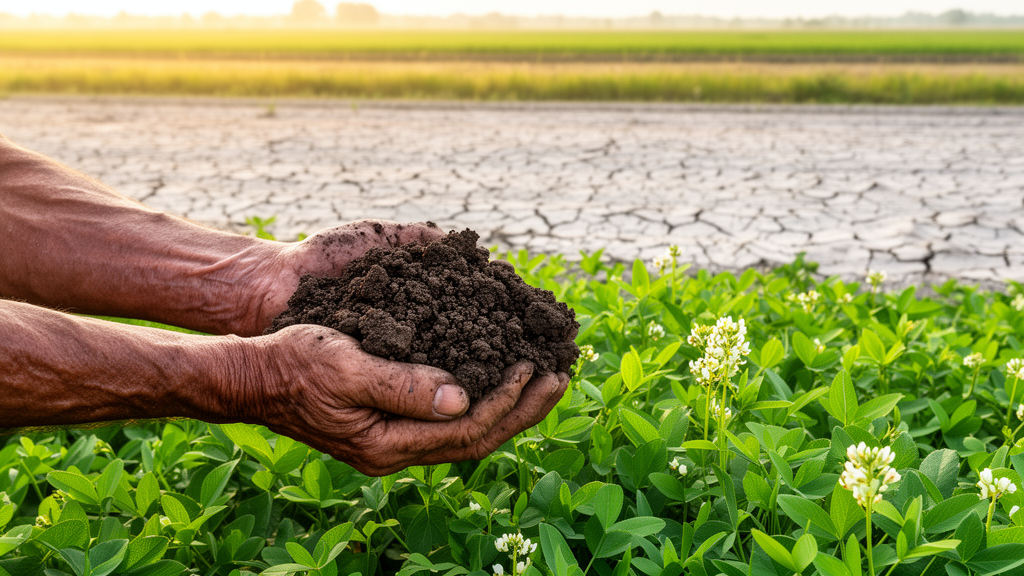
Deep in the rice-growing heartland of subtropical India, a quiet revolution in soil science is underway. Researchers from Indira Gandhi Krishi Vishwavidyalaya in Raipur, working with colleagues at ICAR-National Bureau of Soil Survey and Land Use Planning and Bihar Agricultural University, have spent years crisscrossing the Balod district of Chhattisgarh, collecting 140 geo-tagged soil samples from farmers’ fields that have been under the same rice-based cropping systems continuously since 2000. Their findings, published in Frontiers in Soil Science, deliver a technical but strikingly practical message: the crops farmers choose to grow after rice are quietly deciding the fate of their soil, and legumes are winning that contest decisively.
The study is the first of its kind to develop separate minimum data set (MDS) indicators and critical limits for two contrasting soil orders, Vertisols and Inceptisols, under identical long-term rice-based agroecosystems in real farmers’ fields rather than experimental plots. The research team evaluated four rice-based systems: rice-wheat (RW), rice-chickpea (RC), rice-lathyrus (RL), and rice-fallow (RF). Soil samples from the 0-15 cm surface layer, the effective root zone of the crops, were analyzed for 32 physical, chemical, and biological attributes, from bulk density and aggregate stability to microbial biomass carbon and enzyme activities. Principal component analysis (PCA) was then employed to distill this mountain of data into a handful of key indicators, which were scored, weighted, and integrated to calculate a soil quality index (SQI) for each system and soil type.
The results reveal a clear hierarchy. In Vertisols, the deep, clay-rich soils dominated by smectite minerals, the highest SQI was recorded under rice-chickpea (0.85), followed by rice-lathyrus (0.81), while the lowest was recorded under rice-wheat (0.73). In Inceptisols, the lighter-textured soils, rice-lathyrus topped the ranking (0.78), followed by rice-fallow (0.71), with rice-wheat again trailing at 0.64. Overall, Vertisols sustained better soil quality (0.79) than Inceptisols (0.71). The pattern is unambiguous: wherever a legume followed rice, the soil was healthier, more biologically active, and better structured than where wheat was intensively cultivated or fields were left fallow.
The technical explanation lies in the complementary effects of legume inclusion on soil processes. Chickpea, with its higher root biomass and root diameter density, alleviated the post-puddling compaction that plagues rice systems and enhanced aggregate stability, moderating the swell-shrink behavior of smectitic clays. Lathyrus, grown in a relay system using residual soil moisture, contributed to improved soil aggregation through root-induced structural stabilization. Chemically, legume inclusion increased biological nitrogen fixation, while the rapid decomposition of crop residues with a narrow carbon-to-nitrogen ratio enhanced organic carbon stocks and the availability of nitrogen and phosphorus through rhizosphere-mediated nutrient mobilization. Biologically, continuous inputs of labile carbon from legume roots and residues stimulated microbial biomass and enzyme activities, accelerating nutrient mineralization.
In contrast, the rice-wheat system, the workhorse of South Asian agriculture, experienced higher compaction and nutrient mining, while rice-fallow lacked the post-rice organic carbon inputs that sustain soil quality. The physical data tell the story vividly. In Vertisols, bulk density was highest under rice-wheat (1.40 Mg m-3) and lowest under rice-chickpea (1.35 Mg m-3), while mean weight diameter, a measure of aggregate stability, was highest under rice-chickpea (0.86 mm) and lowest under rice-wheat (0.71 mm). Water-holding capacity followed the same trend, peaking at 51.86 percent under rice-chickpea. In Inceptisols, rice-lathyrus recorded the highest organic carbon (4.89 g kg-1), cation exchange capacity (34.97 cmol(p+) kg-1), and hydraulic conductivity (0.98 cm h-1), while rice-wheat recorded the lowest values across nearly every chemical attribute.
The biological indicators proved especially revealing. Dehydrogenase activity (DHA), a measure of the oxidative metabolism of living soil organisms, contributed the most (48 percent) to the SQI in Vertisols, followed by bulk density (20 percent), mean weight diameter (12 percent), organic carbon (7 percent), available phosphorus (7 percent), and zinc (6 percent). In Inceptisols, organic carbon contributed the most (26 percent), followed by cation exchange capacity (23 percent), alkaline phosphatase activity (18 percent), DHA (14 percent), hydraulic conductivity (11 percent), and zinc (6 percent). The dominance of DHA in Vertisols reflects its high sensitivity to the seasonal alternation between anaerobic and aerobic soil conditions that defines rice-based systems, making it a robust indicator of soil biological functioning.
Perhaps the most valuable contribution of the study is the establishment of critical limits for each key indicator, threshold ranges necessary to ensure optimal soil functioning and sustain long-term crop productivity. Using regression analyses between relative yield and individual MDS indicators, with relative yield values of 40 percent and 80 percent selected to identify lower and upper critical limits, the researchers defined precise boundaries for each soil type. In Vertisols, DHA levels of 25 and 42.5 µg triphenyl formazan g-1 d-1 were required to attain 40 percent and 80 percent of potential maximum yield, respectively, while bulk density exhibited limits of 1.33 and 1.44 Mg m-3, mean weight diameter 0.62 and 0.84 mm, organic carbon 4.2 and 5.8 g kg-1, available phosphorus 14.5 and 22.2 kg ha-1, and zinc 0.34 and 0.78 mg kg-1. In Inceptisols, the corresponding limits were organic carbon 3.6 and 5.25 g kg-1, cation exchange capacity 26 and 42 cmol(p+) kg-1, alkaline phosphatase activity 238 and 290 µg p-nitrophenol g-1 d-1, DHA 20 and 36 µg TPF g-1 d-1, hydraulic conductivity 0.80 and 0.97 cm h-1, and zinc 0.68 and 1.28 mg kg-1.
The critical limits of the SQI itself tell an equally important story. To achieve 40 percent and 80 percent relative yield, the lower and upper critical limits of SQI were 0.72 and 0.86 for Vertisols, and 0.66 and 0.78 for Inceptisols. This indicates that achieving 80 percent relative yield requires comparatively higher SQI values in Vertisols than in Inceptisols, consistent with the higher yield potential of these clay-rich soils. The strong and significant relationships between SQI and relative yield in Vertisols (R² = 0.90) and Inceptisols (R² = 0.89) indicate that the index strongly influenced crop productivity across both soil types. The slopes of the relationships suggest that a 0.1-unit increase in SQI results in approximate increases of 30.4 percent and 29.7 percent in relative yield under Vertisols and Inceptisols, respectively.
The study also validated the SQI against rice-equivalent yield, computed using 20 years of yield data under farmers’ field conditions and minimum support prices for 2025-2026. In Vertisols, the SQI showed a strong and significant correlation with rice-equivalent yield under the rice-chickpea system (R² = 0.91), followed by rice-lathyrus (R² = 0.89), rice-fallow (R² = 0.88), and rice-wheat (R² = 0.82). In Inceptisols, the strongest correlation was observed under rice-lathyrus (R² = 0.89), followed by rice-wheat (R² = 0.86) and rice-fallow (R² = 0.85). These validation results confirm that the soil quality index is not merely an academic construct but a reliable predictor of system productivity under real farming conditions.
The identification of distinct MDS indicators for the two soil types reflects their inherent differences in pedogenic characteristics, mineralogy, and nutrient dynamics. In Vertisols, soil quality was primarily governed by structural stability and biological activity, whereas in Inceptisols, nutrient retention and fertility-related properties played a greater role. This finding demonstrates that soil quality is governed by different controlling factors depending on soil order, and therefore a universal set of indicators may not adequately capture soil quality across contrasting soils. The researchers note that OC, DHA, and zinc emerged as key indicators in both soil types, reflecting that they are less influenced by soil type and more responsive to management-induced changes, making them reliable indicators for soil functioning across contrasting soils. A comprehensive review of 876 studies on MDS selection similarly found that organic carbon was the most widely selected indicator, followed by zinc and DHA across a wide range of soils and cropping systems worldwide.
The implications for farmers and policymakers are substantial. The study recommends the adoption of the rice-chickpea cropping system in Vertisols, followed by the rice-lathyrus system, while noting that the rice-fallow system maintained comparatively better soil quality than the intensive rice-wheat system. The establishment of lower and upper limits for key soil indicators and SQI for rice-based agroecosystems across both soil types will help develop soil-specific optimum management strategies to sustain soil quality and long-term productivity under farmers’ field conditions. The researchers acknowledge certain limitations, including the 0-15 cm sampling depth, single-time sampling, and the need to validate critical limits under varied agro-ecological conditions. Future research involving deeper soil profile studies, seasonal sampling, and participatory approaches involving farmers and extension agencies may enhance the robustness of these findings and translate them into actionable soil health management strategies.
Beyond the technical achievements, the study carries broader significance for global food security and environmental sustainability. The researchers note that the outcomes support progress toward the Sustainable Development Goals, with particular relevance to SDG 2 (Zero Hunger) through enhanced sustainability and SDG 15 (Life on Land) through improved soil resource management. As rice-based agroecosystems dominate the subtropical regions of South Asia and play a vital role in maintaining soil health and ensuring long-term crop productivity, the finding that legumes sustain better soil quality than intensive rice-wheat rotations offers a practical, low-cost pathway for millions of farmers. The message is clear: the humble chickpea and the unassuming lathyrus, crops often dismissed as marginal, are quietly performing ecosystem services that no amount of fertilizer can replicate.
Subject of Research: Soil Science
Article Title: Soil quality indices and critical limits of indicators under long-term rice-based agroecosystems in subtropical India
Article References: Kumar, U., Bachkaiya, V., Kumar, N., Nayak, V., Pandey, P., Srivastava, L. K., Ingle, S. N., Kumar, H., & Mishra, V. N. (2026). Soil quality indices and critical limits of indicators under long-term rice-based agroecosystems in subtropical India. Frontiers in Soil Science, 6, 1918756. https://doi.org/10.3389/fsoil.2026.1918756
Image Credits: AI Generated
DOI: 10.3389/fsoil.2026.1918756
Keywords: soil quality index, rice-based agroecosystems, legumes, Vertisols, Inceptisols, critical limits, minimum data set, dehydrogenase activity, organic carbon, subtropical India, Soil, quality
Cite Scienmag News
Alan Morgan. (October 17, 2026). Legumes quietly outperform intensive rice-wheat rotations in landmark soil health study. Scienmag. https://scienmag.com/legumes-quietly-outperform-intensive-rice-wheat-rotations-in-landmark-soil-health-study/
Alan Morgan. "Legumes quietly outperform intensive rice-wheat rotations in landmark soil health study." Scienmag, 17 October 2026, https://scienmag.com/legumes-quietly-outperform-intensive-rice-wheat-rotations-in-landmark-soil-health-study/. Accessed 17 October 2026.
Alan Morgan. "Legumes quietly outperform intensive rice-wheat rotations in landmark soil health study." Scienmag. October 17, 2026. https://scienmag.com/legumes-quietly-outperform-intensive-rice-wheat-rotations-in-landmark-soil-health-study/


