


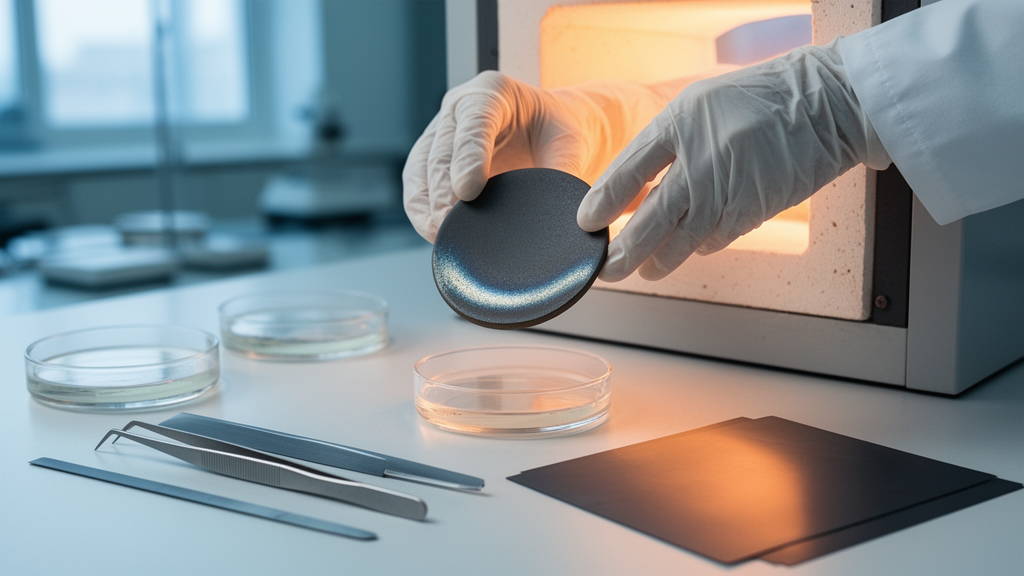
Graphene has long been hailed as a wonder material for energy storage, but turning it into practical supercapacitor electrodes has always involved a frustrating trade-off: the processing methods that maximize performance often produce bulky, low-density electrodes that waste precious space. Now, a team of researchers from Hubei Minzu University in China has cracked this problem with an approach borrowed from an unexpected source—pottery. By treating graphene oxide like clay and using a clever solvent trick, they have created dense, high-performance graphene electrodes that could reshape how we build compact energy storage devices.
The innovation, detailed in Frontiers in Chemistry, centers on a refined version of what the researchers call a graphene oxide (GO) “clay” process. In their earlier work, the team pioneered the idea of processing graphene oxide—the oxidized, water-friendly form of graphene—much like traditional pottery clay, kneading and shaping it into various forms before thermal treatment converts it into porous graphene monoliths. But that original method had a critical flaw: it relied on hexane, a volatile solvent that evaporated rapidly during processing, causing the GO clay to lose its workability and making precise, scalable electrode fabrication extremely difficult.
To solve this, the researchers turned to diethylene glycol dimethyl ether, or DEGDE, a high-boiling-point organic solvent with a boiling point of 162°C—far higher than hexane’s. This seemingly simple substitution proved transformative. Because DEGDE evaporates slowly, it preserves the plasticity and uniformity of the GO clay throughout the calendering and thermal reduction stages. The result is a smooth, cohesive clay mud that can be rolled into sheets, punched into precise circular discs, and thermally reduced into dense, self-supporting reduced graphene oxide (rGO) electrode sheets—all without needing binders, conductive additives, or extensive purification steps.
The technical details reveal just how elegant this approach is. The team synthesized graphene oxide from graphite powder using a modified Hummers’ method, then kneaded the resulting GO clay powder with DEGDE and a small amount of water into a homogeneous clay mud. After aging for four hours to ensure uniformity, they rolled the mud into sheets using a manual roller press, punched out 1-centimeter discs, and thermally reduced them at 180°C for six hours. Cross-sectional scanning electron microscopy showed the resulting electrodes had a compact, crack-free internal structure with densely packed rGO layers approximately 120 micrometers thick—exactly the kind of high-packing-density architecture needed for strong volumetric performance.
Chemical analysis confirmed the thermal reduction worked effectively. X-ray photoelectron spectroscopy showed the carbon-to-oxygen ratio of the GO backbone increased from roughly 3.1:1 to 9.4:1 after treatment, indicating successful removal of oxygen-containing functional groups. Raman spectroscopy revealed an increase in the D-to-G band intensity ratio, a signature of the structural rearrangement that occurs during thermal reduction. Manganese and sulfur impurities from the synthesis process were effectively washed away, leaving a clean carbon framework with restored sp² domains—ideal for both electrical conductivity and ion adsorption.
But the real test came from electrochemical measurements. In a symmetric two-electrode configuration using 5 M potassium hydroxide electrolyte, the graphene electrodes delivered a gravimetric specific capacitance of 119.4 ± 4.4 F g⁻¹ and a volumetric specific capacitance of 84.0 ± 3.1 F cm⁻³ at 1 mA cm⁻². Cyclic voltammetry showed quasi-rectangular curves characteristic of ideal electrical double-layer capacitor behavior, while galvanostatic charge-discharge measurements confirmed reversible, capacitive charge storage with nearly symmetric triangular profiles even at the highest tested current of 10 mA cm⁻².
Electrochemical impedance spectroscopy further validated the design. The equivalent series resistance came in at approximately 3.5 ohms, indicating good electrical conductivity, while the low-frequency response matched the de Levie model for porous electrodes—confirming that the compact yet porous architecture allowed favorable ion accessibility throughout the electrode structure. The capacitance retention from 1 to 10 mA cm⁻² was approximately 63 percent, demonstrating solid rate performance for a carbon-based electrical double-layer capacitor electrode.
Here is where the trade-off becomes interesting. The gravimetric capacitance of roughly 119 F g⁻¹ is lower than the approximately 200 F g⁻¹ achieved by the team’s earlier porous graphene monoliths and some low-density graphene aerogels reported in the literature. But this reduction is a direct consequence of deliberate design choices: the calendering step compacts the rGO sheets to achieve high packing density, and the omission of dialysis, centrifugation, and sonication simplifies production at the cost of some surface area. For compact energy storage devices where available volume is limited, this trade-off strongly favors the new approach.
The volumetric capacitance of 84.0 F cm⁻³ compares favorably with many rGO-based electrodes prepared through far more complex methods, yet it was achieved through a process requiring only kneading, rolling, and thermal treatment using commercially available reagents and standard equipment. The relatively small standard deviations across parallel measurements confirm excellent reproducibility of the fabrication protocol—a crucial factor for any scalable manufacturing process.
This work represents a meaningful advance toward practical, cost-effective production of high-density graphene electrodes for supercapacitors. By combining competitive volumetric performance with exceptional processing simplicity, the DEGDE-mediated clay approach positions graphene supercapacitors as a viable technology for compact energy storage applications where every cubic centimeter counts. As the demand for efficient, eco-friendly energy storage continues to grow, innovations like this one demonstrate that sometimes the best solutions come from thinking outside the laboratory—and looking back at humanity’s oldest crafting traditions.
Subject of Research: High-volumetric-capacitance graphene supercapacitors via DEGDE-mediated GO clay process
Article Title: High-volumetric-capacitance graphene supercapacitors via DEGDE-mediated GO clay process
Article References: Wu, J., Cheng, D., Li, Q., Wang, Z., Li, Z., Li, Y., & Li, Y. (2026). High-volumetric-capacitance graphene supercapacitors via DEGDE-mediated GO clay process. Frontiers in Chemistry, 14, Article 1966349. https://doi.org/10.3389/fchem.2026.1966349
Image Credits: AI Generated
DOI: 10.3389/fchem.2026.1966349
Keywords: High-volumetric-capacitance, graphene, supercapacitors, DEGDE-mediated, clay, process, scientific research
Cite Scienmag News
Neil Sanderson. (October 17, 2026). Graphene Supercapacitors Get a Pottery-Inspired Makeover for Compact Energy Storage. Scienmag. https://scienmag.com/graphene-supercapacitors-get-a-pottery-inspired-makeover-for-compact-energy-storage/
Neil Sanderson. "Graphene Supercapacitors Get a Pottery-Inspired Makeover for Compact Energy Storage." Scienmag, 17 October 2026, https://scienmag.com/graphene-supercapacitors-get-a-pottery-inspired-makeover-for-compact-energy-storage/. Accessed 17 October 2026.
Neil Sanderson. "Graphene Supercapacitors Get a Pottery-Inspired Makeover for Compact Energy Storage." Scienmag. October 17, 2026. https://scienmag.com/graphene-supercapacitors-get-a-pottery-inspired-makeover-for-compact-energy-storage/


