


…
…
The concept of the settlement-sphere invites a reconsideration of how coral reef restoration is planned, executed, and evaluated. For decades, restoration practitioners have concentrated on the visible architecture of reefs: the branching complexity of outplanted colonies, the percentage cover of live coral, and the abundance of fish returning to rehabilitated sites. Yet the decisive battles for reef recovery are fought at a scale invisible to the naked eye, in the thin film of water and life that surrounds a microscopic larva as it searches for a place to begin its adult existence. By drawing attention to this hidden dimension, the framework proposed by Romero and colleagues fills a conceptual gap that has quietly undermined many well-intentioned restoration programs around the world.
Coral larvae are remarkable navigators despite their diminutive size. Released during spawning events that can involve millions of gametes, these planula larvae spend days to weeks drifting with currents before becoming competent to settle. During this planktonic phase, they rely on a combination of environmental signals to locate suitable habitat: light gradients that indicate shallow versus deep zones, gravity for orientation, and increasingly, chemical cues emanating from benthic surfaces. As a larva approaches the seafloor, it enters a world dominated by processes that operate over micrometers to centimeters. The boundary layer above a reef surface is not simply diluted seawater; it is a chemically and microbially distinct zone shaped by the metabolic activity of algae, bacteria, fungi, and the structural texture of the substrate itself. Within this zone, concentrations of dissolved oxygen, nutrients, and signaling compounds can differ dramatically from the ambient water column just centimeters away.
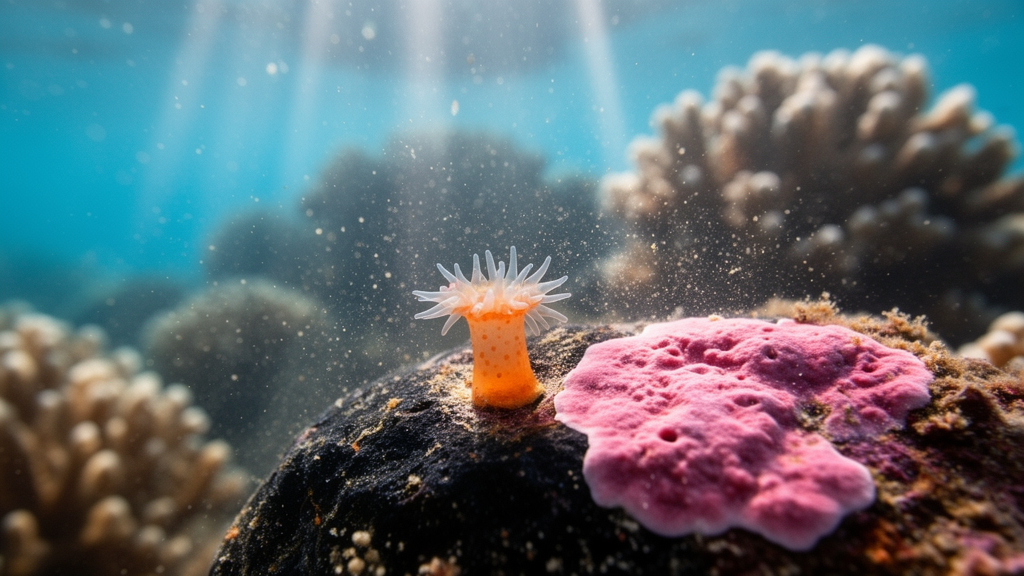
The biochemical dimension of the settlement-sphere is perhaps its most fascinating component. Crustose coralline algae, the pinkish calcified red algae that coat much of the reef substrate, have long been recognized as powerful inducers of coral settlement. Research has identified specific molecules associated with these algae that trigger larval metamorphosis in multiple coral species. Bacterial biofilms on substrate surfaces also produce chemical signals that larvae can detect and respond to, with some bacterial strains promoting settlement while others actively deter it. These microbial communities are not passive background players; they are active architects of the settlement landscape, and their composition shifts in response to environmental degradation. On reefs affected by eutrophication or thermal stress, the balance of microbial communities on benthic surfaces can tip toward taxa that produce deterrent compounds or that compete directly with settling larvae for space.
The physical structure of the settlement-sphere matters equally. Coral larvae preferentially settle in crevices, under overhangs, and within the complex three-dimensional architecture provided by structurally diverse substrates. These microhabitats offer protection from grazers, reduced sedimentation, and moderated light and flow conditions. However, many degraded reefs have lost this structural complexity through the death and erosion of branching corals, the smothering effects of sedimentation, or the physical destruction caused by storms and anchoring. A flat, featureless substrate, even if chemically suitable, may fail to retain settling larvae or protect newly metamorphosed polyps during their most vulnerable weeks. The interplay between physical structure and chemical signaling means that restoration interventions targeting one dimension without considering the other may fall short of their goals.
Hypoxia represents a particularly insidious threat to the settlement-sphere. As organic matter accumulates on degraded reefs, microbial respiration consumes oxygen in the near-surface boundary layer, creating pockets of low oxygen that can be lethal to larvae and early recruits. Unlike large-scale hypoxic events that affect entire bays or lagoons, these microscale oxygen depletions occur within the settlement-sphere itself, invisible to conventional water quality monitoring conducted at meter-scale distances. A larva approaching a seemingly healthy substrate may encounter oxygen concentrations far below those measured in the overlying water column, leading to settlement failure or post-settlement mortality that goes undetected by standard surveys. This disconnect between what monitoring programs measure and what larvae actually experience highlights the need for microenvironmental sensing technologies in restoration assessment.
The framework also carries implications for how restoration practitioners select and prepare substrates for larval deployment. Traditional approaches often involve placing ceramic tiles, concrete structures, or natural rubble on the reef and hoping that larvae will find them. The settlement-sphere concept suggests that the success of these deployments depends not just on their physical placement but on the microbial and chemical conditions that develop on their surfaces over time. A newly deployed substrate may initially lack the biofilms and chemical cues that competent larvae require, making it unattractive for settlement until microbial communities establish. Conversely, substrates placed in areas with high algal cover may quickly develop biofilms dominated by settlement-deterrent bacteria, rendering them ineffective despite their physical suitability.
Advanced materials science offers promising avenues for engineering settlement-spheres that actively promote coral recruitment. Researchers have begun developing surfaces with tailored topography, chemistry, and microbiome composition designed to attract larvae and support early post-settlement survival. Some approaches involve coating substrates with specific bacterial strains known to induce metamorphosis, while others focus on creating microscale surface features that mimic the texture of preferred natural substrates. These engineered settlement-spheres could be deployed as part of larval restoration programs, providing not just a physical platform for attachment but a complete microenvironment optimized for the transition from planktonic larva to benthic juvenile.
The temporal dimension of the settlement-sphere deserves careful consideration as well. The period from larval contact with a surface through metamorphosis and early post-settlement establishment represents a critical bottleneck in coral life history, during which mortality rates can exceed ninety-nine percent under natural conditions. The framework’s emphasis on defining the post-settlement observation period explicitly acknowledges that different processes dominate at different stages of this transition. During the initial hours and days after settlement, chemical cues and microbial interactions are paramount. As the recruit develops calicoblastic tissue and begins building its skeleton, physical protection from grazers and sedimentation becomes increasingly important. By the time a juvenile colony has grown beyond a few millimeters, ecological processes operating at larger scales, including competition with algae and predation by fish, begin to shape survival outcomes more strongly than the immediate microenvironment.
Anthropogenic stressors erode the settlement-sphere through multiple pathways that often operate simultaneously. Ocean acidification alters the carbonate chemistry of boundary layer water, potentially affecting both larval behavior and the availability of suitable mineral substrates for attachment. Warming temperatures shift the composition of microbial biofilms, favoring taxa that may produce deterrent compounds over those that promote settlement. Nutrient enrichment from coastal development fuels algal growth that physically crowds settlement surfaces and alters the chemical environment through allelopathic compounds and oxygen depletion during nighttime respiration. Sedimentation from coastal construction and terrestrial runoff smothers fine-scale substrate features that larvae rely on for attachment and protection. Each of these stressors individually degrades some component of the settlement-sphere, but their combined effects can be multiplicative, creating conditions where even abundant larval supply fails to translate into successful recruitment.
The mismatch between restoration scale and larval scale has practical consequences for how success is measured. Many restoration programs evaluate outcomes by counting the number of outplanted colonies that survive over months or years, a metric that reflects the performance of large, already-established corals rather than the recruitment processes that sustain wild populations over evolutionary timescales. A restoration program that successfully outplants thousands of fragments but fails to support natural recruitment is not building a self-sustaining population; it is maintaining a garden that requires perpetual human intervention. The settlement-sphere framework redirects attention toward the recruitment bottleneck, encouraging practitioners to evaluate whether their interventions create conditions that allow sexually produced larvae to complete their life cycle without ongoing assistance.
Sexual propagation methods, including the collection of spawned gametes and the rearing of larvae in ex situ facilities before deployment to degraded reefs, have demonstrated considerable promise in producing the millions of larvae needed for meaningful restoration at scale. However, the effectiveness of these larval delivery approaches depends critically on what happens after larvae are released onto the reef. If the settlement-sphere at the deployment site is degraded, whether through loss of chemical cues, absence of suitable microhabitat structure, or presence of hostile microbial communities, even massive larval inputs may fail to produce measurable recruitment. This explains why some larval restoration trials have shown encouraging short-term results while others have produced disappointing outcomes despite similar larval densities and deployment methods.
Moving forward, the integration of microenvironmental sensing into restoration monitoring could transform how practitioners understand and respond to recruitment failure. Miniature oxygen sensors, chemical probes capable of detecting signaling compounds, and high-resolution imaging systems that characterize substrate topography and biofilm composition could provide the data needed to diagnose why particular sites fail to support recruitment. Such diagnostic capabilities would allow restoration practitioners to target their interventions more precisely, whether by augmenting chemical cues through substrate conditioning, modifying physical structure to create favorable microhabitats, or managing surrounding biological communities to reduce competitive pressure on settling larvae.
The settlement-sphere concept also bridges disciplines that have historically operated in parallel rather than in concert. Microbial ecologists studying biofilm dynamics, chemical ecologists investigating signaling compounds, physical oceanographers modeling boundary layer flow, and restoration practitioners deploying substrates on degraded reefs all hold pieces of the puzzle. By providing a unifying framework that explicitly connects these perspectives at the scale relevant to coral larvae, the settlement-sphere concept creates a common language for interdisciplinary collaboration. This integration is essential if the field is to move beyond trial-and-error approaches toward evidence-based strategies that reliably enhance recruitment across diverse reef environments and under the challenging conditions of a rapidly changing ocean.
Subject of Research: The coral settlement-sphere: microenvironments that shape reef restoration in the Anthropocene
Article Title: The coral settlement-sphere: microenvironments that shape reef restoration in the Anthropocene
Article References: Romero, S. L., Harrison, P. L., Ordoñez Alvarez, A., Shlesinger, T., Khen, A., Loya, Y., Smith, J. E., & Wangpraseurt, D. (2026). The coral settlement-sphere: microenvironments that shape reef restoration in the Anthropocene. Frontiers in Marine Science, 13, Article 1940282. https://doi.org/10.3389/fmars.2026.1940282
Image Credits: AI Generated
DOI: 10.3389/fmars.2026.1940282
Keywords: coral reefs, restoration, microbiology, ocean acidification, climate change, coral, settlement-sphere, microenvironments, shape, reef, Anthropocene, scientific research
Cite Scienmag News
Violet Maxwell. (October 17, 2026). The invisible world that decides whether baby corals survive. Scienmag. https://scienmag.com/the-invisible-world-that-decides-whether-baby-corals-survive/
Violet Maxwell. "The invisible world that decides whether baby corals survive." Scienmag, 17 October 2026, https://scienmag.com/the-invisible-world-that-decides-whether-baby-corals-survive/. Accessed 17 October 2026.
Violet Maxwell. "The invisible world that decides whether baby corals survive." Scienmag. October 17, 2026. https://scienmag.com/the-invisible-world-that-decides-whether-baby-corals-survive/


