


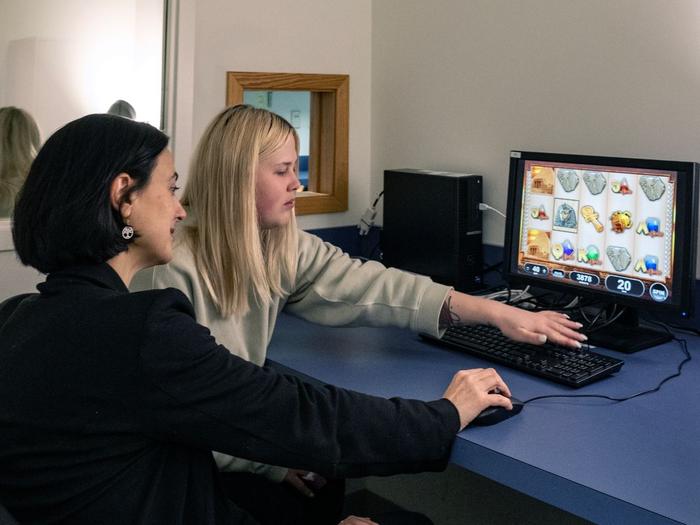
A West Virginia University researcher is studying slot machines to determine what makes them a potentially addictive form of gambling.

Credit: WVU Photo/Brian Persinger
A West Virginia University researcher is studying slot machines to determine what makes them a potentially addictive form of gambling.
Mariya Cherkasova, assistant professor in the Department of Psychology at the WVU Eberly College of Arts and Sciences, will spend the next two years “reverse engineering” certain structural characteristics of slot machines to find out what makes them an immersive product. Her research is supported by the International Center for Responsible Gaming.
In hopes of understanding the addictive nature of the games, Cherkasova will examine the interactions between subjects’ individual characteristics and the slot machines’ structural characteristics. Subjects will play several versions of a highly realistic slot machine simulator that runs in a browser.
“Some versions of the game will include the typical bells and whistles that accompany wins, while others will not,” she said. “This exemplifies the reverse engineering of the sensory feedback — one version has bells and whistles while the other lacks them.”
She will also manipulate how often and how much the players win, known as a reinforcement schedule. Game versions will be engineered to have specific reinforcement ratios and intervals.
In an additional experiment in her laboratory, Cherkasova will track subjects’ eyes during simulator play.
“That part is pretty innovative,” she said. “Because when you’re measuring immersion, it’s mostly been based on self-report, and there’s a bit of a paradox in there — how can you measure immersion without disrupting those states? You either have to measure it retrospectively, or you have to disrupt the state to measure it. Some of our past work suggests that you can study immersion using eye tracking. We hope to validate those indices as tacit measures of immersion that do not involve explicit self-report or interrupting the immersive state.”
A graduate research assistant will run the laboratory study and collect data in the second year of the two-year study.
Studies have shown slot machines are associated with harms more than other gambling modalities like the lottery.
“From a public health perspective, there’s a continuum of gambling,” Cherkasova said. “Some products are associated with very few harms. Few people develop problematic gambling patterns buying lottery tickets. Slot machines are still ‘king’ in terms of how many people play them. And they still account for the lion’s portion of gambling revenue and are on the other end of the harm continuum.”
Some slot machine gamblers become highly immersed and absorbed in the game, a state sometimes referred to as the “zone.” Similar states may be experienced while playing video games or binge watching a show. However, those states may be especially harmful during slot machine play because they can lead to a person losing significant sums of money.
“The person loses track of time,” she said. “They forget everything around them and just keep playing and playing the slot machine. This is something that’s associated with compulsive gameplay and very significant losses.”
In past work, Cherkasova and other researchers found higher levels of depression and lower levels of dispositional mindfulness are both strongly correlated with immersion. However, just as a biological predisposition may lead to gambling problems, gambling products and environments also bring out these same tendencies.
“For that reason, it’s as important to study the characteristics of gambling products as it is to study individual characteristics of the players that may be liabilities,” she said.
While the gambling industry doesn’t share information about the characteristics of slot machines, a kind of natural selection process guides which models stay on the floor or online — those that make the most money tend to remain in use.
In future research, Cherkasova would like to study what happens in a player’s brain when they enter a flow state, like “the zone,” when playing a slot machine. A small number of studies have focused on players’ flow states during video gameplay, but none have looked at gambling or slot machine use.
“Frankly, we really don’t know what goes on in the brain,” Cherkasova said.
She said she believes her work will help researchers understand why slot machines are one of the most harmful gambling modalities and how slot machine design interacts with players’ individual vulnerabilities to cause harm.
“Diagnosable gambling disorders are rare,” she said. “But just like drinking alcohol, there’s really no completely safe level of gambling.”
Cite Scienmag News
Drew Townsend. (April 8, 2024). WVU psychologist ‘reverse engineers’ slot machines to better understand compulsive gambling. Scienmag. https://scienmag.com/wvu-psychologist-reverse-engineers-slot-machines-to-better-understand-compulsive-gambling/
Drew Townsend. "WVU psychologist ‘reverse engineers’ slot machines to better understand compulsive gambling." Scienmag, 8 April 2024, https://scienmag.com/wvu-psychologist-reverse-engineers-slot-machines-to-better-understand-compulsive-gambling/. Accessed 3 September 2026.
Drew Townsend. "WVU psychologist ‘reverse engineers’ slot machines to better understand compulsive gambling." Scienmag. April 8, 2024. https://scienmag.com/wvu-psychologist-reverse-engineers-slot-machines-to-better-understand-compulsive-gambling/

