


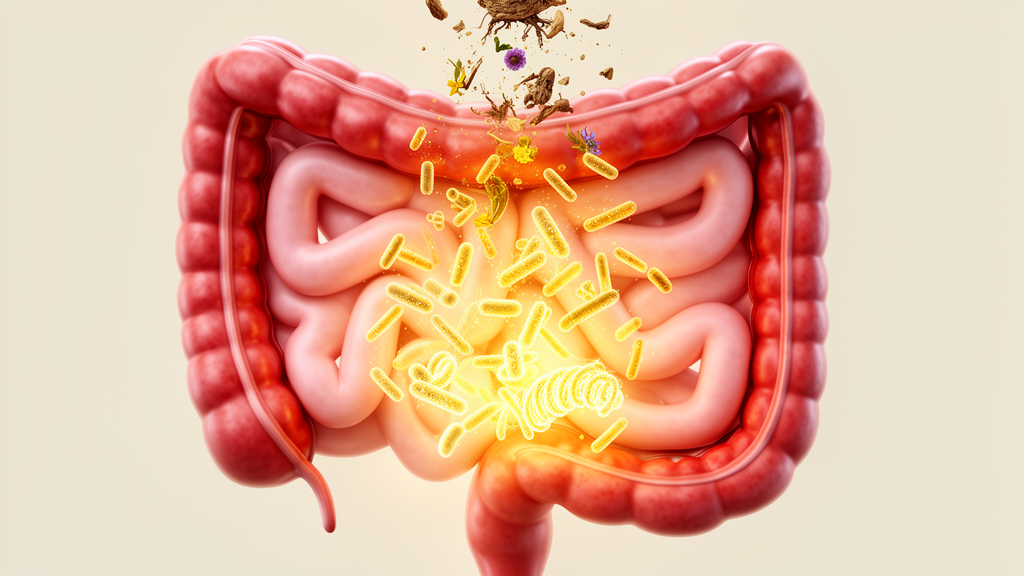
Ulcerative colitis is one of the most stubborn forms of inflammatory bowel disease, a condition the World Health Organization classifies as a contemporary, treatment-resistant disorder. It begins as inflammation of the rectal mucosa and spreads proximally through the colon, producing abdominal pain, diarrhea, and bloody stools. Current mainstay drugs, including 5-aminosalicylic acid, glucocorticoids, and immunosuppressants, frequently cause adverse reactions with prolonged use, driving researchers to seek alternatives with fewer side effects. Now, a team at Gansu Agricultural University has traced how a 1,800-year-old Chinese herbal formula, Baitouweng Tang, fights this disease, and the answer lies not in the herbs themselves but in the gut microbes they cultivate.
Baitouweng Tang originates from Zhang Zhongjing’s Shanghan Lun, a classical medical text, and combines four herbs: Pulsatilla chinensis (Bai Tou Weng), Phellodendron chinense (Huang Bai), Coptis chinensis (Huang Lian), and Fraxinus chinensis (Qin Pi). The formula is traditionally used to cool the blood and stop diarrhea, and it remains a representative treatment for febrile dysentery and various gastrointestinal disorders. Despite its long clinical history, the precise pharmacodynamic pathways remained incompletely characterized. The new study, published in Food Science & Nutrition, set out to determine whether the formula works by regulating intestinal microbiota and related tryptophan metabolism to activate the aryl hydrocarbon receptor, a key signaling molecule in gut immunity.
The researchers prepared the formula by refluxing the four herbs in distilled water in a 4:3:2:4 ratio, then analyzed its chemical constituents using UHPLC-HRMS. The analysis identified alkaloids, phenylpropanoids, sugars and glycosides, terpenoids, and organic acids, with alkaloids, phenylpropanoids, and terpenoids as the main categories. Among the more abundant components were Pulsatilla saponin D, Pulchinenoside B, 23-hydroxybetulinic acid, oleanolic acid, berberine, oxyberberine, 8-oxocoptisine, obacunone, esculin, esculetin, and fraxetin, each characterized by retention time, molecular formula, and fragment ions.
To test the formula’s effects, the team induced acute colitis in C57BL/6 mice with 2.5% dextran sulfate sodium and administered Baitouweng Tang at high, medium, and low doses of 8.1, 5.4, and 2.7 g/kg, alongside a salazosulfapyridine positive control. The colitis mice lost weight, showed elevated disease activity index scores, and had shortened colons. Treatment with the formula and the positive drug inhibited weight loss, reduced DAI scores, and curbed colon shortening to varying degrees. Molecular analysis revealed that colitis elevated Ifn-γ and Il-6 mRNA levels in colon tissue, while the formula and positive drug diminished these inflammatory markers and differentially elevated Il-22 mRNA expression, indicating a fine protective effect on colitis mice.
Sequencing of the V3-V4 variable region of the 16S rRNA gene showed that colitis markedly shifted the gut microbiota, with the model group diverging from controls in both alpha and beta diversity. At the phylum level, colitis increased Bacteroidetes, Proteobacteria, and Desulfobacterota while Firmicutes declined, a pattern the formula efficiently reversed. At the genus level, the model group showed notable increases in Bacteroides, norank_f_Desulfovibrionaceae, and Alistipes, while Bifidobacterium and Dubosiella declined. The formula boosted Bifidobacterium, Turicibacter, Dubosiella, and Alistipes, suggesting a global regulation of the entire intestinal microecosystem rather than a single-taxon effect.
The critical experiment came next: the researchers depleted the gut microbiota with a mixture of vancomycin, ampicillin, metronidazole, and neomycin sulfate for ten consecutive days, creating a pseudo-germ-free mouse model. Sequencing confirmed that antibiotic treatment collapsed alpha diversity and left only Proteobacteria at the phylum level, with only Enterobacter and Escherichia-Shigella at the genus level. When colitis was induced in these microbe-depleted mice, the beneficial effect of Baitouweng Tang was almost completely attenuated, and tryptophan metabolism was blocked, severely inhibiting AhR signaling activation. This demonstrated that the formula depends on intestinal microbes to exert its anti-colitis effect.
To confirm the microbial contribution, the team performed fecal microbiota transplantation from formula-treated donors into antibiotic-depleted recipient mice. Transplantation partially restored the protective effects, improving body weight and DAI scores, reducing inflammatory infiltration and mucosal damage, restoring colon tissue structure and goblet cell numbers, and suppressing Ifn-γ and Il-6 mRNA while upregulating Il-22. The partial restoration suggests that the gut microbiota contributes substantially to, but does not fully account for, the therapeutic effects of the formula.
Targeted metabolomics using LC-MS/MS with an isotope internal standard revealed that colitis reduced fecal levels of 5-hydroxyindole-3-acetic acid, indole-3-acetic acid, 3-hydroxy-DL-kynurenine, 3-indoleacetonitrile, nicotinic acid, kynurenic acid, and xanthurenic acid. The formula increased indole, indole-3-lactic acid, 5-hydroxyindole-3-acetic acid, 5-hydroxytryptophan, 3-hydroxy-DL-kynurenine, nicotinic acid, N-acetyl-serotonin, L-tryptophan, kynurenic acid, and serotonin, with significant differences in indole, indole-3-lactic acid, 3-hydroxy-DL-kynurenine, and serotonin. Spearman’s rank correlation analysis linked indole-3-lactic acid positively with Turicibacter and Romboutsia, and indole-3-acetic acid positively with Dubosiella, Monoglobus, Alistipes, Erysipelatoclostridium, and Faecalitalea, connecting specific microbial genera to specific metabolites.
The aryl hydrocarbon receptor normally remains dormant in the cytoplasm, bound in a complex with HSP90, XAP2, and p23. Upon ligand binding, the receptor translocates to the nucleus and initiates transcriptional regulation of downstream target genes such as CYP1A1, CYP1B1, and IL-22, maintaining intestinal homeostasis. In colitis mice, protein and mRNA levels of AhR, Cyp1a1, and Cyp1b1 decreased, while the formula significantly increased their expression. After antibiotic treatment, this effect was severely weakened, and fecal microbiota transplantation from formula-treated donors partially restored AhR expression in colon tissue, confirming the microbe-dependent mechanism.
In vitro experiments on HT-29 intestinal epithelial cells clarified the indirect nature of the activation. Within safe concentrations, the formula itself did not affect AhR protein expression or its target proteins CYP1A1 and CYP1B1. However, the tryptophan metabolite indole-3-lactic acid significantly promoted AhR expression. When the researchers modeled inflammation by stimulating HT-29 cells with 5 μg/mL lipoteichoic acid for 6 hours, treatment with 5 μM indole-3-lactic acid markedly reduced mRNA levels of IL-8, TNF-α, and IL-1β, and restored mRNA and protein levels of AhR, CYP1A1, and CYP1B1. The findings establish a microbiota-ILA-AhR axis as an important mechanism by which Baitouweng Tang alleviates colitis, providing a mechanistic foundation for clinical application and opening new avenues for microbiota-targeted or metabolite-based therapeutics for ulcerative colitis.
Subject of Research: Gut microbiota-dependent tryptophan metabolism and AhR signaling in the therapeutic effects of Baitouweng Tang on ulcerative colitis
Article Title: Gut Microbiota‐Dependent Tryptophan Metabolism Drives the Therapeutic Effects of Baitouweng Tang in Colitis via the AhR Pathway
Article References: Niu, C., Hua, Y., Kang, J., Li, F., Chen, B., Guo, R., & Wei, Y. (2026). Gut Microbiota‐Dependent Tryptophan Metabolism Drives the Therapeutic Effects of Baitouweng Tang in Colitis via the AhR Pathway. Food Science & Nutrition, 14(10), Article e72434. https://doi.org/10.1002/fsn3.72434
Image Credits: AI Generated
DOI: 10.1002/fsn3.72434
Keywords: Baitouweng Tang, ulcerative colitis, gut microbiota, tryptophan metabolism, indole-3-lactic acid, aryl hydrocarbon receptor, AhR pathway, traditional Chinese medicine, microbiota-targeted therapy, intestinal barrier, inflammatory bowel disease, DSS colitis model
Cite Scienmag News
Morgan Morrow. (October 17, 2026). Ancient Four-Herb Formula Heals Colitis by Feeding Gut Microbes That Activate AhR. Scienmag. https://scienmag.com/ancient-four-herb-formula-heals-colitis-by-feeding-gut-microbes-that-activate-ahr/
Morgan Morrow. "Ancient Four-Herb Formula Heals Colitis by Feeding Gut Microbes That Activate AhR." Scienmag, 17 October 2026, https://scienmag.com/ancient-four-herb-formula-heals-colitis-by-feeding-gut-microbes-that-activate-ahr/. Accessed 17 October 2026.
Morgan Morrow. "Ancient Four-Herb Formula Heals Colitis by Feeding Gut Microbes That Activate AhR." Scienmag. October 17, 2026. https://scienmag.com/ancient-four-herb-formula-heals-colitis-by-feeding-gut-microbes-that-activate-ahr/


