


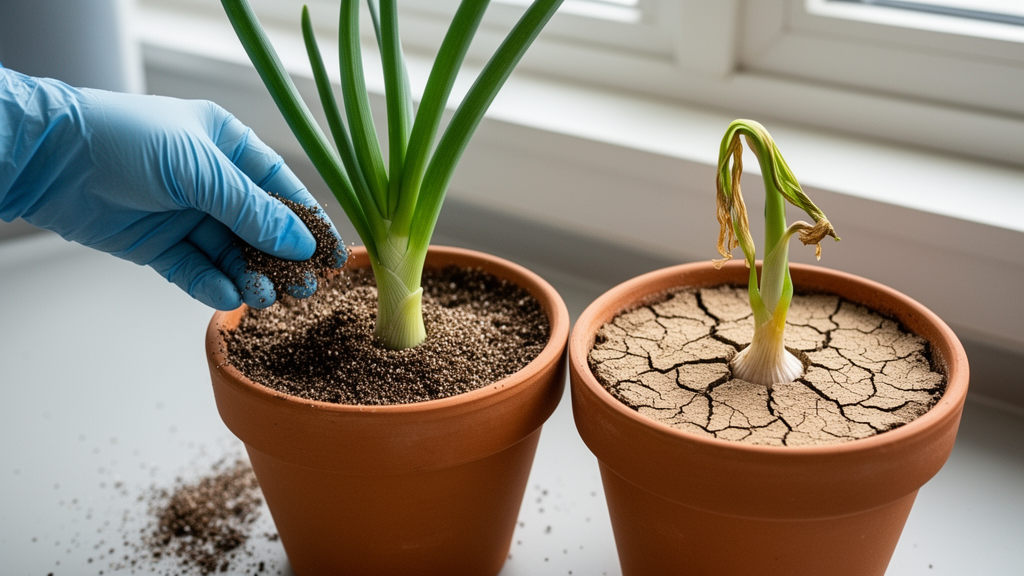
When drought strikes a garlic field, the damage begins at a scale invisible to the naked eye. Cell walls thin, membranes destabilize, chloroplasts and other organelles deform, and the tightly choreographed traffic of lipids and proteins inside each cell falls into disarray. A new study published in BMC Plant Biology shows that a single soil bacterium can reverse much of that microscopic devastation, and it maps in unprecedented detail how the microbe rewires the plant’s lipid and protein machinery to do so.
The research, led by Yiwei Yan, Qizhang Wang, Bernard R. Glick, and Jie Tian, focused on a strain called Pseudomonas sp. UW4, a well-characterized plant growth-promoting bacterium. Using ‘Ledu Purple Garlic’ as the experimental crop, the team set out to answer a question that has long frustrated agricultural scientists: while beneficial bacteria are known to alleviate drought stress in many crops, the underlying lipid and protein regulatory associations that make this possible have remained poorly understood.
To probe those mechanisms, the researchers combined three complementary approaches. They examined the microstructure and ultrastructure of garlic roots and leaves under the microscope, they profiled the full lipidome of stressed and unstressed tissues, and they catalogued the proteome, the complete set of proteins expressed under each condition. Integrating these datasets allowed them to connect physical damage, metabolic disruption, and molecular response within a single analytical framework.
The microscopic results were striking. Drought stress inflicted severe morphological and structural damage on tissues and organelles in both roots and leaves, distorting the architecture that garlic plants depend on to transport water and carry out photosynthesis. When the plants were inoculated with strain UW4, however, the bacterium substantially repaired the injured cells and preserved the structural integrity of stomata, the adjustable pores that regulate gas exchange, as well as vascular bundles, the conduits that move water and nutrients through the plant, and the intracellular organelles that house its metabolic machinery.
Lipidomic profiling revealed what was happening at the biochemical level. Drought stress drastically repressed the accumulation of triacylglycerols, the energy-dense storage lipids that plants draw on when water is scarce, and it reshaped the global lipid metabolic profile in ways that signaled deep metabolic distress. Inoculation with UW4 reversed this stress-induced disorder across three lipid classes simultaneously: the triacylglycerol reserves, the membrane lipids that form the physical barriers of every cell, and the signaling lipids that carry molecular messages between cellular compartments. Together, these effects restored lipid metabolic homeostasis, the balanced steady state that healthy cells maintain.
The proteomic analysis added a second layer of insight. Drought triggered a large set of drought-responsive differentially expressed proteins, and among these, four key players stood out because strain UW4 significantly upregulated them all: CESA5, CALS9, WRKY14, and HSP70-14. Each performs a distinct but complementary role. CESA5 participates in cellulose synthesis, CALS9 in callose deposition, both central to cell wall biosynthesis, which determines how well cells resist collapse under water deficit. WRKY14 functions as a transcriptional regulator in stress signal transduction, relaying drought alarms to the genes that must respond. HSP70-14, a member of the heat shock protein family, acts as a molecular chaperone that stabilizes other proteins, preserving their folded structure when stress would otherwise cause them to misfold or degrade.
By modulating cell wall biosynthesis, stress signal transduction, and protein stability, these proteins sustain basal cellular metabolism and redox balance, the equilibrium between oxidative and reductive reactions that keeps reactive oxygen species in check. The study’s authors conclude that this coordinated protein response ultimately mitigates the oxidative damage that drought triggers, damage that would otherwise cascade through membranes, organelles, and DNA.
The most novel contribution of the work lies in its multi-omics integration. By overlaying lipid and protein data, the researchers validated that strain UW4 is associated with the remodeling of a lipid-protein association network, a web of functional relationships in which triacylglycerols and HSP70-14 emerge as highly connected nodes, hubs through which much of the network’s regulatory traffic flows. The analysis also indicated that WRKY14 may be involved in lipid metabolic signaling, suggesting a direct line of communication between the plant’s stress-sensing transcription machinery and its lipid metabolism, a link that had not been clearly established in Allium crops before.
Taken together, the study describes a three-part mechanism by which UW4 confers enhanced drought tolerance in garlic: it repairs structural damage at the tissue and organelle level, it reconstructs lipid metabolic homeostasis, and it orchestrates synergistic modulation between lipids and proteins. This work elucidates the molecular mechanism underlying plant growth-promoting bacteria-mediated stress tolerance in Allium crops and provides theoretical support for deploying microbial inoculants in arid agricultural ecosystems, where garlic and related crops face increasingly unpredictable water supplies.
The implications extend beyond garlic. As climate change intensifies drought pressure on agriculture worldwide, microbial inoculants offer a low-input alternative to irrigation expansion and genetic modification, working with the plant’s own biology rather than replacing it. The identification of specific hubs such as TAGs and HSP70-14 within a lipid-protein association network gives breeders and microbiologists concrete molecular targets to screen for, potentially accelerating the development of drought-resilient cropping systems across the Tibetan Plateau region where this research was conducted and far beyond it.
Subject of Research: Pseudomonas sp. UW4 enhances drought tolerance in garlic by repairing tissue structure, restoring lipid metabolic homeostasis, and remodeling a lipid-protein association network.
Article Title: Pseudomonas sp. UW4 enhances drought tolerance in garlic via lipid-protein association network and repairing tissue structure
Article References: Yan, Y., Wang, Q., Glick, B. R., & Tian, J. (2026). Pseudomonas sp. UW4 enhances drought tolerance in garlic via lipid-protein association network and repairing tissue structure. BMC Plant Biology. https://doi.org/10.1186/s12870-026-10122-7
Image Credits: AI Generated
DOI: 10.1186/s12870-026-10122-7
Keywords: Pseudomonas sp. UW4, garlic, drought stress, plant growth-promoting bacteria, lipidomics, proteomics, triacylglycerol, HSP70-14, WRKY14, cell wall biosynthesis, lipid-protein interaction, microbial inoculants
Cite Scienmag News
Morgan Morrow. (October 17, 2026). Soil bacterium Pseudomonas sp. UW4 shields garlic from drought by rebuilding lipids and proteins. Scienmag. https://scienmag.com/soil-bacterium-pseudomonas-sp-uw4-shields-garlic-from-drought-by-rebuilding-lipids-and-proteins/
Morgan Morrow. "Soil bacterium Pseudomonas sp. UW4 shields garlic from drought by rebuilding lipids and proteins." Scienmag, 17 October 2026, https://scienmag.com/soil-bacterium-pseudomonas-sp-uw4-shields-garlic-from-drought-by-rebuilding-lipids-and-proteins/. Accessed 17 October 2026.
Morgan Morrow. "Soil bacterium Pseudomonas sp. UW4 shields garlic from drought by rebuilding lipids and proteins." Scienmag. October 17, 2026. https://scienmag.com/soil-bacterium-pseudomonas-sp-uw4-shields-garlic-from-drought-by-rebuilding-lipids-and-proteins/


