


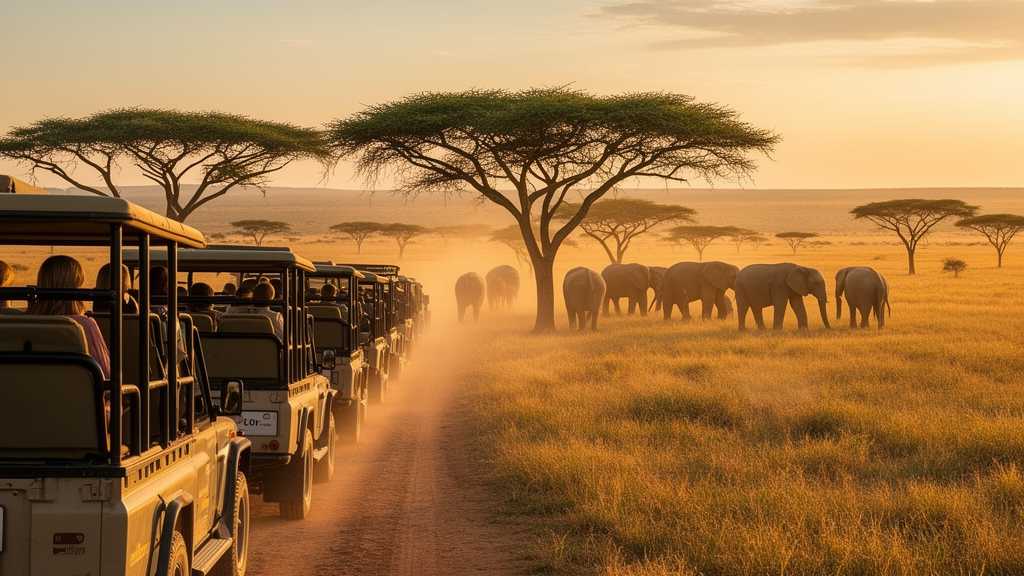
Nature-based tourism has long been celebrated as Africa’s conservation success story, generating revenue that funds protected area management, incentivizes wildlife protection, and creates livelihoods for communities surrounding national parks. But a sweeping new review published in Frontiers in Sustainable Resource Management argues that this celebrated industry is also a pervasive yet under-recognized pressure on the continent’s ecosystems, one that operates not through dramatic single events but through the slow, cumulative accumulation of disturbance that reshapes wildlife behavior, degrades habitats, and reorganizes entire ecological communities over time.
The review, led by Chiedza Ngonidzashe Mutanga of the Okavango Research Institute at the University of Botswana, together with Edson Gandiwa of the Zimbabwe Parks and Wildlife Management Authority and Reniko Gondo, synthesizes literature published between 2000 and 2026, drawing primarily on savanna and forest ecosystems across the continent. Using a social-ecological systems and resilience lens, the authors screened roughly 429 publications down to approximately 93 studies, examining how repeated tourism activities including wildlife viewing, off-road vehicle use, trekking, and boating alter biodiversity through interconnected mechanisms that intensify over time, particularly in high-use areas where congestion and overuse have been documented in places such as Kruger National Park in South Africa and the Chobe National Park riverfront in Botswana.
The review identifies three primary pathways through which tourism drives biodiversity change: wildlife behavioral change, habitat degradation, and altered species interactions. At the behavioral level, encounters with tourists, vehicles, and associated infrastructure elicit avoidance, increased vigilance, displacement, aggression, and in some cases habituation. These responses consistently modify patterns of movement, activity, and habitat use, with implications for how wildlife utilize space and resources. In Etosha National Park in Namibia, large mammals modify their diel activity patterns in response to disturbance around waterholes and road networks, with some species increasing nocturnal activity during periods of high human presence. African lions and spotted hyenas in the same system also select areas associated with lower disturbance.
Behavioral responses to tourism are closely linked to physiological stress. In Madikwe Game Reserve in South Africa, elephants exposed to high tourist pressure exhibit increased vigilance, aggression, and displacement, together with elevated glucocorticoid levels during peak tourism periods. Similar patterns are reported in other tourism contexts, including increased stress hormone levels during human interaction in South Africa and behavioral and movement changes linked to tourism activities in Botswana. These findings indicate that repeated tourism exposure can function as a chronic stressor with implications for individual fitness, and that apparent habituation may mask underlying stress or the displacement of more sensitive individuals, meaning that tolerance to human presence does not necessarily imply negligible ecological impact.
Habitat degradation represents the second major pathway. Activities such as off-road driving, repeated vehicle movement, trampling, and infrastructure development alter vegetation structure, compact soils, and accelerate erosion, leading to a gradual decline in habitat quality. These impacts are amplified in ecologically sensitive areas where visitor pressure is high, with consequences for vegetation productivity, soil stability, and associated ecological processes. Tourism-related pollution, including waste accumulation, wastewater discharge, and emissions, further degrades environmental conditions, affecting soil and water quality and extending impacts beyond visibly disturbed sites. In Chobe National Park, persistent congestion along the Riverfront at major viewing points has been documented, while tourism use in Kruger National Park is structured around road networks and focal attractions, concentrating disturbance in specific locations and redistributing ecological processes across the landscape.
Tourism infrastructure reinforces these processes by reshaping both habitat structure and access. Road networks extend the spatial reach of disturbance by enabling repeated use of previously less-disturbed areas. In Katavi National Park in Tanzania, road upgrading involved extensive clearing of woody vegetation, altering woodland structure, while in Kibale National Park in Uganda, road presence contributes to habitat fragmentation and sustained ecological pressure. Increased accessibility also facilitates more frequent human activity across the landscape, as reflected in Kenya where repeated game driving contributes to soil compaction and vegetation damage. Beyond physical disturbance, tourism development often entails the extraction and overuse of natural resources, including water, land, and vegetation, which further alters habitat structure and ecosystem conditions.
The third pathway involves altered species interactions. Tourism-related disturbance modifies patterns of movement, activity, and space use, thereby influencing how species encounter one another. Shifts toward nocturnality alter temporal relationships among species, modifying predator access to prey and hunting success, as reflected in Kruger National Park where leopard activity responds to vehicle presence, and in the Serengeti where tourism reduces carnivore hunting success in the presence of vehicles. Roads and tourism activity concentrate disturbance in high-use areas, leading to avoidance and shifts in habitat use. In Zimbabwe, elephant distribution in Zambezi National Park is structured by vehicle density, while in Kruger National Park animals avoid heavily used roads. Changes in predator space use and activity can influence encounter rates, competition over carcasses, and access to shared resources, with implications for survival, reproductive success, and guild structure.
Tourism-induced behavioral changes also reshape within-species and group-level interactions. In Ghana, primate groups exposed to high tourism activity show increased aggression, reduced home range size, and altered spatial organization, while in Zanzibar, tourism influences activity budgets in red colobus monkeys. In Central African forest systems, gorilla habituation alters movement and group behavior, influencing resource use and interactions within and between groups, including processes such as seed dispersal and forest regeneration. Changes in the distribution of ecosystem engineers further extend these interaction effects. In Madikwe Game Reserve, tourism alters elephant movement and space use, and because elephants play a central role in shaping vegetation structure, nutrient redistribution, and habitat heterogeneity, changes in their movement patterns influence ecosystem processes across spatial scales. In the Amboseli ecosystem, sustained pressure on elephant populations has contributed to the conversion of woodland into grass-dominated habitats through intensive browsing.
Beyond the ecological mechanisms, the review examines the social trade-offs that emerge from tourism-based conservation. Tourism generates substantial revenue and is widely promoted as a mechanism for financing conservation, yet evidence across protected areas shows that only a limited share reaches local populations, and where it does, distribution is often inconsistent and poorly aligned with local expectations. Weak institutional arrangements, including unclear benefit-sharing mechanisms, limited transparency, and weak accountability, undermine distribution systems and contribute to persistent dissatisfaction among communities. Power asymmetries shape access to resources, control over revenue, and participation in decision-making, often resulting in elite capture or external appropriation of benefits. At the same time, conservation imposes tangible costs on communities, including restricted access to land and resources, human-wildlife conflict, and livelihood trade-offs associated with conservation restrictions, creating a mismatch between those who benefit from tourism and those who bear its costs.
Formal inclusion of communities in conservation governance does not necessarily translate into meaningful influence over decision-making. While participation is widely promoted as a mechanism for improving conservation and livelihood outcomes, evidence across African contexts shows that it is often constrained, resulting in limited influence over key decisions. In many cases, decentralization remains partial, with authority over tourism development, revenue allocation, and regulatory enforcement continuing to be centralized within state institutions or shaped by external actors. Structural constraints, including limited access to information, weak technical capacity, and unequal bargaining power, further limit meaningful participation and reinforce existing inequalities, creating a persistent gap between the design of participatory governance frameworks and their implementation in practice.
The shift from state-led conservation to multi-actor governance has increased the diversity of actors involved in tourism-based conservation, including government agencies, community institutions, private operators, non-governmental organizations, and donors. Government agencies typically retain primary responsibility for policy development, regulation, licensing, and enforcement, while private tourism operators influence conservation outcomes through investment and tourism operations. Community institutions contribute to local stewardship and benefit-sharing, although their influence over strategic decision-making often remains constrained. NGOs and donor organizations commonly support conservation through funding, technical expertise, research, and capacity building. Consequently, the influence of these stakeholder groups is not evenly distributed, with government agencies and private operators generally exercising greater authority over tourism planning and resource allocation than local communities, complicating coordination, accountability, and the alignment of interests across actors.
Tourism-based conservation systems also operate within broader environmental and socio-economic contexts that shape how trade-offs emerge and are managed. Climate variability and change, including rising temperatures, rainfall variability, and extreme events, are reshaping ecosystems, influencing wildlife distributions, and affecting tourism infrastructure and operations. These changes interact with tourism pressures, amplifying ecological impacts and increasing the complexity of governance responses. At the same time, conservation areas are embedded within wider land-use systems characterized by agriculture, settlement expansion, and population growth, which intensify pressure on ecological resources. Governance systems must therefore respond not only to tourism-related pressures but also to external drivers operating across scales, yet limited financial and technical capacity, weak institutional coordination, and competing development priorities constrain effective responses, reflecting a broader problem of institutional fit where governance arrangements do not necessarily correspond to the scale and complexity of the ecological and social processes being managed.
The synthesis across the reviewed literature indicates that tourism-related change in conservation systems is best understood not as a series of discrete ecological and social impacts, but as an interconnected process through which pressures accumulate and propagate across the social-ecological system. Three recurring characteristics emerge from the evidence. First, tourism pressure is frequently spatially concentrated and repetitive, particularly around wildlife-viewing sites, road networks, tourism infrastructure and other high-use areas. Second, ecological change is closely connected to social and economic outcomes, as tourism generates revenue, employment and conservation incentives while simultaneously producing uneven costs through restricted access, human-wildlife interactions, congestion and unequal benefit distribution. Third, governance emerges as the principal mechanism through which these interacting pressures and trade-offs are mediated, with adaptive, spatially responsive and participatory measures such as zoning, visitor limits, regulated access, benefit-sharing and co-management able to modify tourism pressures and their consequences, while weak coordination, limited local influence, fragmented institutional responsibilities and reactive management can allow localized pressures to accumulate into broader ecological and social effects.
The review identifies a set of adaptive and context-specific strategies aimed at reducing biodiversity loss while sustaining ecosystem services, including spatial planning and zoning, wildlife-sensitive operations, community-based natural resource management, strengthened governance frameworks, and learning-oriented approaches such as citizen science and environmental education. Where management is adaptive, spatially responsive and participatory, measures such as zoning, vehicle limits, rotation systems, temporal access controls, distance limits, operator regulation, transparent distribution systems, participatory governance, co-management, density caps, transparent licensing, equity models, visitor caps, licensing limits, adaptive thresholds, integrated planning, corridor protection and adaptive governance can modify tourism pressures and their consequences. Conversely, enforcement gaps, expansion of informal tracks, weak benefit-sharing design, low transparency, limited local influence, opaque licensing, external influence, weak land-use integration, absence of growth limits, reactive governance, fragmented governance and weak cross-scale coordination can allow localized pressures to accumulate into broader ecological and social effects.
The review also highlights important gaps in the current evidence base on tourism-biodiversity interactions in Africa. Empirical studies remain unevenly distributed across the continent, with a strong concentration in a relatively small number of well-studied conservation areas, limiting the extent to which existing findings can be applied across the diversity of ecological settings, governance arrangements, and tourism models that characterize conservation systems in Africa. Much of the literature focuses on short-term or site-specific impacts, providing limited insight into cumulative, long-term, and cross-scale processes, and research remains fragmented across ecological, social, and governance domains. The current evidence base is also shaped by a strong focus on high-visibility species and locations, particularly large mammals in flagship protected areas, which risks overlooking less visible ecological processes and tourism impacts in other ecosystem types, including wetlands and marine environments. These gaps point to the need for more systematic, comparative, and longitudinal approaches to research on tourism-biodiversity interactions in Africa, with greater attention to underrepresented regions, longer timeframes, and cross-scale interactions.
Ultimately, the review concludes that the sustainability of nature-based tourism in African conservation systems depends less on tourism presence or growth in itself than on the conditions under which tourism operates and is governed. From a social-ecological systems perspective, sustaining tourism’s contribution to conservation requires attention to the relationships among ecological limits, social and economic outcomes, and governance responses, rather than managing these dimensions separately. This requires management that is capable of responding to cumulative and cross-scale change while recognizing the interconnected nature of tourism and conservation systems, particularly where tourism pressures interact with climate variability, land-use change and population pressure. As tourism continues to expand across the continent, advancing a more integrated and context-sensitive evidence base will be essential for both academic insight and policy relevance.
Subject of Research: A review of how nature-based tourism gradually drives biodiversity change and social trade-offs in African conservation systems, and the adaptive governance responses needed.
Article Title: Tourism and biodiversity dynamics in African conservation systems: gradual ecological change, social trade-offs and adaptive governance
Article References: Mutanga, C. N., Gandiwa, E., & Gondo, R. (2026). Tourism and biodiversity dynamics in African conservation systems: gradual ecological change, social trade-offs and adaptive governance. Frontiers in Sustainable Resource Management, 5, Article 1861347. https://doi.org/10.3389/fsrma.2026.1861347
Image Credits: AI Generated
DOI: 10.3389/fsrma.2026.1861347
Keywords: nature-based tourism, biodiversity, African conservation, social-ecological systems, adaptive governance, wildlife behavior, habitat degradation, ecosystem services, protected areas, community-based conservation, climate variability, resilience
Cite Scienmag News
Margaret Porter. (October 17, 2026). Safari tourism quietly reshapes Africa’s ecosystems, review warns. Scienmag. https://scienmag.com/safari-tourism-quietly-reshapes-africas-ecosystems-review-warns/
Margaret Porter. "Safari tourism quietly reshapes Africa’s ecosystems, review warns." Scienmag, 17 October 2026, https://scienmag.com/safari-tourism-quietly-reshapes-africas-ecosystems-review-warns/. Accessed 17 October 2026.
Margaret Porter. "Safari tourism quietly reshapes Africa’s ecosystems, review warns." Scienmag. October 17, 2026. https://scienmag.com/safari-tourism-quietly-reshapes-africas-ecosystems-review-warns/


