


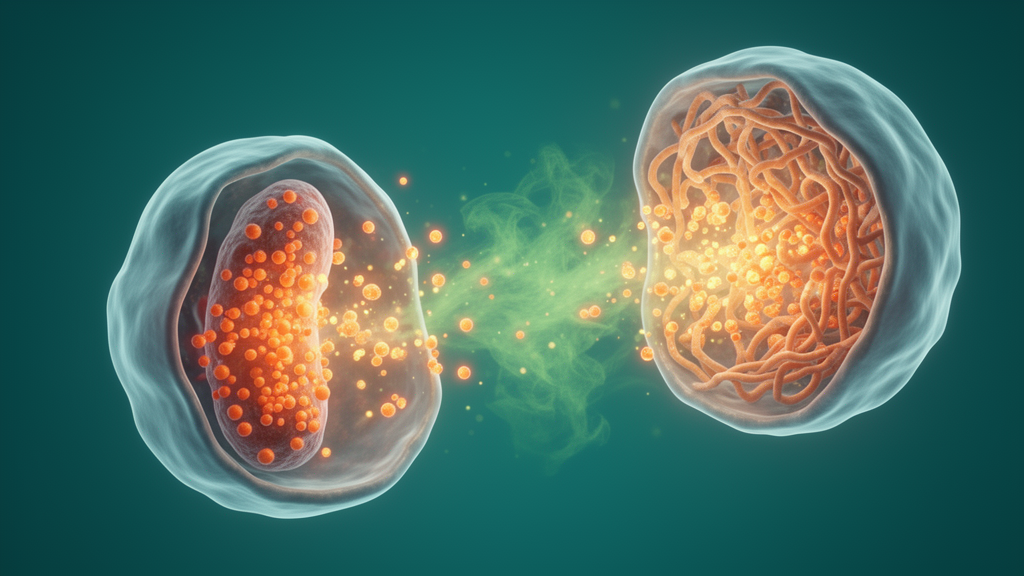
Deep inside every pancreatic beta cell, two molecular languages are spoken simultaneously. One is written in calcium ions, the other in reactive oxygen species. For decades, researchers studied each in isolation, but a comprehensive review now argues that the real story of insulin secretion—and its collapse in type 2 diabetes—lies in the organelle-specific dialogue between these two signaling systems. The analysis, published in Frontiers in Network Physiology, assembles evidence that calcium and redox signals are not parallel streams but a tightly interwoven network spanning the endoplasmic reticulum, mitochondria, NADPH oxidase enzymes, and the islet’s multicellular architecture.
Calcium is the undisputed trigger of insulin release. Extracellular ionized calcium sits at roughly 1.1 to 1.3 millimolar, about ten thousand times higher than the cytosolic concentration near 100 nanomolar, and beta cells exploit this steep gradient with exquisite precision. When blood glucose rises, glucose enters the cell through transporters—GLUT2 in rodents, the higher-affinity GLUT1 in humans—and is funneled almost entirely into mitochondrial oxidation rather than lactate production. The resulting surge in the ATP-to-ADP ratio closes ATP-sensitive potassium channels, depolarizes the plasma membrane, and opens voltage-gated calcium channels. The incoming calcium binds synaptotagmin on secretory granules, engaging the SNARE fusion machinery and driving insulin exocytosis in the characteristic biphasic pattern seen in both humans and rodents.
The channels themselves form a layered hierarchy. L-type channels dominate: in mice, beta-cell-specific deletion of CaV1.2 nearly abolishes first-phase insulin secretion and causes glucose intolerance, while CaV1.3 contributes to electrical activity initiation and, notably, may be expressed tenfold higher than CaV1.2 in human beta cells, where its genetic variants associate with type 2 diabetes. Transient receptor potential channels such as TRPM2, which is activated by hydrogen peroxide and intracellular calcium, and TRPM5 and TRPV2, act as amplifiers and fine-tuners rather than primary triggers. Equally critical are the extrusion systems—the plasma membrane calcium ATPase and the sodium-calcium exchanger—which clear cytosolic calcium and, when heterozygously deleted in mice, paradoxically enhance glucose-stimulated insulin secretion by expanding intracellular stores.
Inside the cell, two organelles dominate calcium storage. The endoplasmic reticulum combines high capacity with high affinity, holding calcium at roughly 200 to 500 micromolar through the SERCA pumps, with SERCA2b and SERCA3 predominant in beta cells. Release occurs through inositol trisphosphate receptors, activated by PLC-generated IP3 from G protein-coupled receptor signaling, and through ryanodine receptors, which mediate calcium-induced calcium release. Mitochondria, by contrast, take up calcium with low affinity but enormous capacity, relying on the mitochondrial calcium uniporter and the high local calcium concentrations generated at mitochondria-associated membranes, the contact sites where IP3 receptors, the chaperone Grp75, and the channel VDAC1 assemble into a functional transfer complex. Matrix calcium activates TCA cycle dehydrogenases, boosting NADH and FADH2 production and ATP synthesis—the metabolic signal that completes stimulus-secretion coupling. Efflux through the NCLX exchanger is equally essential: its silencing in mouse models causes mitochondrial calcium accumulation and delayed, impaired insulin secretion.
Reactive oxygen species speak a different but equally structured language. Superoxide anions, generated as byproducts of the mitochondrial electron transport chain or deliberately by NADPH oxidase enzymes, are dismutated by SOD1 and SOD2 into hydrogen peroxide, the most signaling-competent member of the family. Hydrogen peroxide is stable enough to diffuse through peroxiporin aquaporins such as AQP8 yet reactive enough to oxidize cysteine residues on target proteins reversibly, forming sulfenic acid. In beta cells, this chemistry directly touches the secretory machinery: oxidation of the KATP channel’s SUR1 regulatory subunit enhances channel closure, reinforcing depolarization and calcium influx. Pharmacological or genetic suppression of NOX enzymes reduces glucose-stimulated insulin secretion in rat islets and human islets alike, and NOX4, which constitutively produces hydrogen peroxide coupled to glucose metabolism, has emerged as a required signal—its deletion abolishes first-phase secretion in mouse islets and INS-1E cells.
Recent subcellular mapping in rat INS-1E beta cells reveals that NOX isoforms are not randomly distributed. NOX1 and DUOX1 concentrate in the endoplasmic reticulum, DUOX2 localizes to insulin-containing vesicles, and NOX2 and NOX4 span vesicles, ER, and the plasma membrane. This compartmentalization creates spatially restricted redox microdomains in which hydrogen peroxide selectively modifies nearby targets—ER luminal redox balance for protein folding, granule-associated proteins for insulin processing, and ion channels at the membrane for excitability—rather than flooding the cell with indiscriminate oxidation. Pro-inflammatory cytokines remodel this landscape in a temporally coordinated fashion, suggesting a shift from controlled signaling toward sustained oxidative conditions during beta-cell stress.
The deepest integration occurs at mitochondria-associated membranes. There, calcium released from the ER through IP3 receptors generates localized hotspots that drive mitochondrial calcium uptake via the uniporter, stimulating oxidative phosphorylation and, consequently, mitochondrial ROS production. The crosstalk is bidirectional: IP3 receptors and VDAC are themselves redox-sensitive, with moderate oxidation enhancing channel activity while excessive oxidation impairs function and disrupts calcium homeostasis. Tethering proteins such as mitofusin 2 maintain the physical proximity that makes these microdomains possible. In beta cells, whose antioxidant profile includes robust peroxiredoxin and thioredoxin systems but relatively low catalase and glutathione peroxidase, this architecture allows efficient handling of transient physiological ROS while leaving limited reserve for chronic stress.
Type 2 diabetes progressively dismantles this coordination. In obesity and insulin resistance, beta cells initially compensate with enhanced calcium signaling and insulin output, but the compensation is fragile. High-fat diet feeding eventually uncouples voltage-gated calcium entry from the exocytotic machinery, and loss of calcium coordination between individual beta cells precedes overt dysfunction. Palmitate exposure depletes ER calcium through reduced SERCA2b expression, elevates cytosolic and mitochondrial calcium, and generates ER stress. Human islets from donors with type 2 diabetes show reduced ER-mitochondria contacts and impaired calcium transfer, while chronic glucotoxicity disrupts ER-mitochondrial calcium exchange even as organelle interactions increase. Mitochondrial ROS overproduction, driven by electron transport chain dysfunction and amplified by calcium overload, feeds forward into further calcium dysregulation through redox-sensitive TRPM2 channels and impaired IP3 receptor and ryanodine receptor function.
The redox side of the disease is equally layered. Sustained glucolipotoxicity and inflammation elevate ROS from mitochondria, NOX1 and NOX2, peroxisomes, and the ER simultaneously. NOX1 expression rises in islets from individuals with type 2 diabetes, and its cytokine-driven activation abolishes glucose-stimulated insulin secretion—an effect prevented by NOX1 inhibition. NOX2-derived hydrogen peroxide mediates palmitate-induced lipotoxicity, and ER stress can precede NOX2 activation, suggesting a temporal hierarchy in which ER dysfunction triggers ROS amplification. Antioxidant defenses, dependent on NADPH availability through the pentose phosphate pathway and anaplerotic metabolism, become overwhelmed: chronic high glucose reduces glucose-6-phosphate dehydrogenase, weakening NADPH supply, while overexpression of G6PD or ER-resident glutathione peroxidases restores function under stress. Emerging evidence even implicates sustained ROS in basal insulin hypersecretion before overt secretory failure, depleting insulin stores and accelerating beta-cell exhaustion.
Beyond individual cells, the islet operates as a coordinated network. Gap junctions composed of connexin 36 synchronize calcium oscillations across beta cells, and their disruption abolishes pulsatile insulin secretion. Specialized hub cells and wave-initiator cells organize propagation, and paracrine signals from glucagon, somatostatin, and urocortin 3 fine-tune the network. Redox signaling participates in this coordination too: hydrogen peroxide can diffuse between cells, and connexin 36 itself is sensitive to cysteine oxidation, meaning local redox tone may shape calcium wave propagation. In type 2 diabetes, calcium wave propagation, functional connectivity, and global synchronization all decline. The review’s authors argue that future progress demands genetically encoded biosensors for calcium and hydrogen peroxide targeted to specific organelles, applied to human islets, to resolve the temporal sequence linking ROS generation and calcium dysregulation. Understanding this multi-organellar dialogue, they contend, may unlock pharmacological strategies to protect beta-cell function or promote functional recovery before irreversible failure sets in.
Subject of Research: Organelle-specific crosstalk between calcium and redox signaling in pancreatic beta cells in physiology and type 2 diabetes
Article Title: Organelle-specific crosstalk between calcium and redox signaling in pancreatic β-cells in physiology and type 2 diabetes
Article References: Camara, L. R. P., & Vilas-Boas, E. A. (2026). Organelle-specific crosstalk between calcium and redox signaling in pancreatic β-cells in physiology and type 2 diabetes. Frontiers in Network Physiology, 6, Article 1864821. https://doi.org/10.3389/fnetp.2026.1864821
Image Credits: AI Generated
DOI: 10.3389/fnetp.2026.1864821
Keywords: pancreatic beta cells, calcium signaling, reactive oxygen species, type 2 diabetes, mitochondria, endoplasmic reticulum, NADPH oxidase, insulin secretion, mitochondria-associated membranes, oxidative stress, islet network, redox signaling
Cite Scienmag News
Drew Townsend. (October 17, 2026). Calcium and ROS: The Organelle-Level Dialogue That Decides the Fate of Insulin-Secreting Cells. Scienmag. https://scienmag.com/calcium-and-ros-the-organelle-level-dialogue-that-decides-the-fate-of-insulin-secreting-cells/
Drew Townsend. "Calcium and ROS: The Organelle-Level Dialogue That Decides the Fate of Insulin-Secreting Cells." Scienmag, 17 October 2026, https://scienmag.com/calcium-and-ros-the-organelle-level-dialogue-that-decides-the-fate-of-insulin-secreting-cells/. Accessed 17 October 2026.
Drew Townsend. "Calcium and ROS: The Organelle-Level Dialogue That Decides the Fate of Insulin-Secreting Cells." Scienmag. October 17, 2026. https://scienmag.com/calcium-and-ros-the-organelle-level-dialogue-that-decides-the-fate-of-insulin-secreting-cells/


