


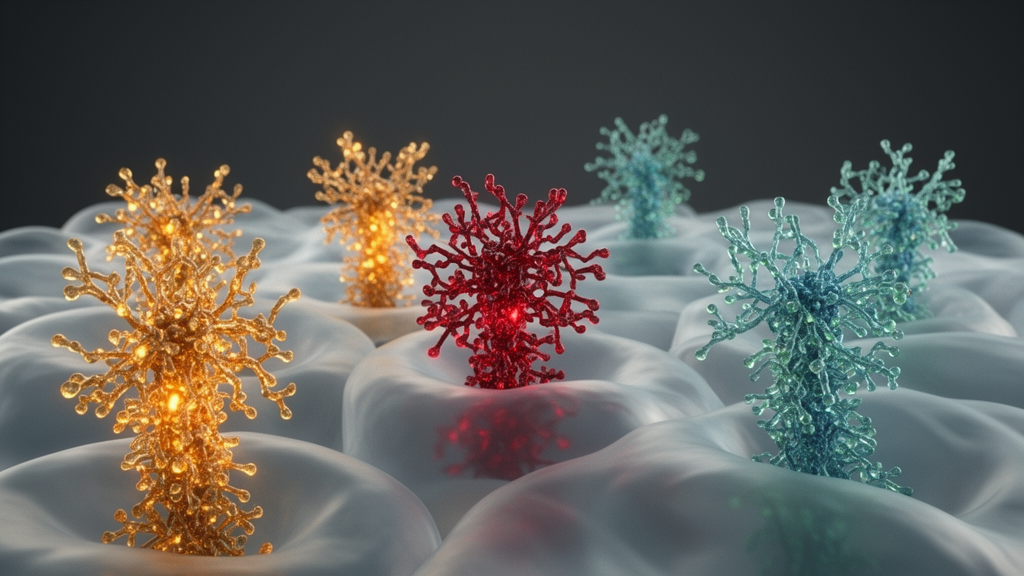
Every cell in the human body carries a sugar code. Long before a cell decides whether to live, die, or turn malignant, intricate carbohydrate chains attached to its surface receptors quietly shape the conversation between the cell and its environment. A new review published in Frontiers in Cell Death by researchers at Otto von Guericke University Magdeburg now brings this hidden layer of regulation into sharp focus, arguing that the sugars decorating so-called death receptors are not decorative afterthoughts but powerful molecular checkpoints that can tip the balance between life and death.
Death receptors are specialized proteins on the cell surface that belong to the tumor necrosis factor receptor superfamily. When activated by their cognate death ligands, they can trigger apoptosis, the tightly controlled process of programmed cell death that eliminates damaged, infected, or surplus cells. The three most studied members of this family are CD95, also known as Fas or APO-1, the TRAIL receptors DR4 and DR5, and TNFR1, the receptor for tumor necrosis factor alpha. Upon ligand binding, these receptors assemble macromolecular signaling platforms such as the death-inducing signaling complex, or DISC, which recruits and activates caspase-8, the enzyme that ignites the apoptotic cascade. Yet the same receptors can also drive inflammatory survival pathways, regulated necrosis, or even proliferation, depending on which protein complexes form downstream. Understanding what determines these divergent outcomes has become one of the central questions in cell death research.
The Magdeburg team, led by Inna Lavrik together with Kamil Seyrek, Johannes Espe, Corinna König, and Fabian Wohlfromm, argues that a crucial and long-underappreciated part of the answer lies in glycosylation, the enzymatic attachment of sugar moieties to proteins. Glycosylation occurs predominantly in the endoplasmic reticulum and the Golgi apparatus and comes in several chemically distinct flavors. N-linked glycosylation attaches branched oligosaccharides to asparagine residues, beginning with a fourteen-sugar precursor that is transferred en bloc onto nascent proteins entering the ER lumen. O-linked glycosylation, by contrast, starts with a single N-acetylgalactosamine residue appended to serine or threonine in the Golgi, which is then progressively elongated. A third, reversible modification called O-GlcNAcylation adds just a single N-acetylglucosamine to serine or threonine residues, often on intracellular proteins, and can dynamically compete with phosphorylation to modulate signaling.
What makes glycosylation such a potent regulatory mechanism is its staggering structural diversity. Because different cell types express different repertoires of glycosyltransferases, the same receptor can carry strikingly different sugar coats in different tissues or disease states. The authors emphasize that these glycans form a kind of glyco-code, a language of carbohydrate signatures that cells use to fine-tune receptor conformation, ligand recognition, and signal transduction. Without the correct sugar modifications, death receptors simply cannot transmit the apoptotic signal properly. Even small variations in glycan subtypes can measurably alter the strength or direction of a death signal, which helps explain why some cells are exquisitely sensitive to death ligands while their neighbors remain stubbornly resistant.
CD95 offers perhaps the clearest illustration of this principle. The mature receptor runs between 45 and 54 kilodaltons in molecular weight, a range attributable largely to post-translational glycosylation. Two well-defined N-glycosylation sites at asparagines 118 and 136 in the extracellular domain are essential for CD95 ligand recognition and binding. When researchers mutated both sites in leukemia cells, CD95-mediated apoptosis dropped dramatically, underscoring how indispensable these sugars are for the receptor to function. Additional predicted glycosylation sites within the intracellular death domain hint that sugar modifications may also influence the cytoplasmic face of the receptor, where the DISC assembles.
Even more striking is what happens when CD95 becomes oversialylated. Sialic acid residues, nine-carbon sugars that typically cap the outer ends of N-glycan chains, add substantial negative charge and bulk. Hypersialylation of CD95 can increase its apparent molecular weight by up to 8 kilodaltons and has been shown to prevent receptor oligomerization and DISC formation. The enzyme ST6Gal1, which resides in the Golgi and appends alpha2,6-linked sialic acid to subterminal galactose residues, suppresses CD95-mediated apoptosis when overactive. Conversely, stripping sialic acid from CD95 with neuraminidases in B-lymphocytic cells heightens sensitivity to apoptosis. Because sialylated glycans are frequently elevated in cancer, and because the oncogenic Ras protein is known to boost ST6Gal1 expression, the authors suggest that malignant cells may deliberately decorate their death receptors with bulky, negatively charged sugars to shield themselves from apoptotic attack.
The galectin-3 story adds another layer of complexity. This galactose-binding lectin behaves in a remarkably context-dependent manner. Outside the cell, exogenously added galectin-3 potentiates chemotherapy-induced cytotoxicity, presumably by cross-linking surface glycoproteins and promoting apoptotic signaling. But when cancer cells overexpress the truncated O-glycan known as sialyl-Tn, galectin-3 loses its surface binding sites and accumulates inside the cell. There, its unique NWGR amino acid motif allows it to bind and inhibit the pro-apoptotic protein Bax, blocking mitochondrial pore formation and thereby protecting tumor cells from both intrinsic and death receptor-driven apoptosis. Knocking down the sialyltransferase responsible for sialyl-Tn synthesis restores galectin-3 binding sites and resensitizes malignant cells to chemotherapeutic drugs, a finding with obvious translational implications.
For the TRAIL receptors DR4 and DR5, glycosylation plays out differently on each paralog. DR4 carries an N-glycan at asparagine 156 that promotes receptor clustering, DISC formation, and caspase-8 activation, whereas DR5 lacks a consensus N-glycosylation sequence altogether. Fucosylation, the attachment of fucose residues to N-glycans, further enhances ligand-independent receptor association and DISC assembly. When the enzyme GDP-mannose-4,6-dehydratase, which is required for fucose biosynthesis, is defective in colon cancer cells, the cells become resistant to TRAIL-induced apoptosis and can escape natural killer cell-mediated tumor surveillance. Restoring the enzyme reverses this phenotype and dramatically reduces tumor growth in experimental models. Intriguingly, certain Lewis glycans carried not on the receptors themselves but on adjacent glycosphingolipids can also potentiate TRAIL signaling by promoting the formation of complex II, the secondary cytoplasmic platform where caspase-8 becomes activated. Some of these Lewis structures, notably sialyl-Lewis a and sialyl-Lewis x, are already used clinically as tumor markers, highlighting how closely glycan biology and cancer diagnostics are intertwined.
O-glycans add yet another dimension. The enzyme GALNT14 initiates O-glycosylation on DR5 and is critical for ligand-dependent receptor clustering, but its abnormal expression is also associated with tumor progression. Fully elongated core 1 O-glycans on DR5 promote clustering and apoptosis, whereas truncated Tn and sialyl-Tn antigens impair receptor oligomerization and stability, and can even drive hetero-oligomerization with the decoy receptor DcR2, dampening the death signal. Because mutations in Cosmc, the chaperone required for proper T-synthase folding, are common in pancreatic and cervical cancers, truncated O-glycans frequently accumulate on tumor cells and may confer a genuine survival advantage.
Perhaps the most surprising chapter concerns O-GlcNAcylation, the single-sugar modification that acts deep inside the cell. Upon TRAIL stimulation, DR4 becomes O-GlcNAcylated at serine 424 in its death domain, which drives the receptor into lipid rafts and enables efficient DISC assembly. Strikingly, even TRAIL-resistant cancer cells can be killed when this modification is enforced. DR5, by contrast, appears to be inhibited by O-GlcNAcylation, which blocks its oligomerization, revealing an unexpected asymmetry between the two TRAIL receptors. Bacterial pathogens have exploited this same regulatory axis: effectors such as NleB and SseK1 from enteropathogenic bacteria attach GlcNAc to conserved arginine residues in the death domains of FADD, TRADD, RIPK1, and the receptors themselves, thereby shutting down host apoptosis during infection. Even caspases themselves can be O-GlcNAcylated near their cleavage sites, preventing their activation. Taken together, the Magdeburg review makes a compelling case that glycans on and around death receptors function as a multilayered checkpoint system, one that normal cells use to prevent spontaneous apoptosis and that cancer cells exploit to evade it. Deciphering this glyco-code in full, the authors argue, could open entirely new therapeutic avenues for diseases in which the death receptor network has gone awry.
Subject of Research: Glycosylation of death receptors as a regulatory checkpoint in apoptotic signaling
Article Title: Glycans on death receptors as sweet markers and signaling checkpoints
Article References: Seyrek, K., Espe, J., König, C., Wohlfromm, F., & Lavrik, I. N. (2025). Glycans on death receptors as sweet markers and signaling checkpoints. Frontiers in Cell Death, 4, Article 1585989. https://doi.org/10.3389/fceld.2025.1585989
Image Credits: AI Generated
DOI: 10.3389/fceld.2025.1585989
Keywords: death receptors, glycosylation, apoptosis, CD95, TRAIL, TNFR1, O-GlcNAcylation, sialylation, cancer, DISC, galectin-3, glyco-code
Cite Scienmag News
Drew Townsend. (October 17, 2026). Sugar Coats on Death Receptors Act as Molecular Switches Deciding Cell Fate. Scienmag. https://scienmag.com/sugar-coats-on-death-receptors-act-as-molecular-switches-deciding-cell-fate/
Drew Townsend. "Sugar Coats on Death Receptors Act as Molecular Switches Deciding Cell Fate." Scienmag, 17 October 2026, https://scienmag.com/sugar-coats-on-death-receptors-act-as-molecular-switches-deciding-cell-fate/. Accessed 17 October 2026.
Drew Townsend. "Sugar Coats on Death Receptors Act as Molecular Switches Deciding Cell Fate." Scienmag. October 17, 2026. https://scienmag.com/sugar-coats-on-death-receptors-act-as-molecular-switches-deciding-cell-fate/


