


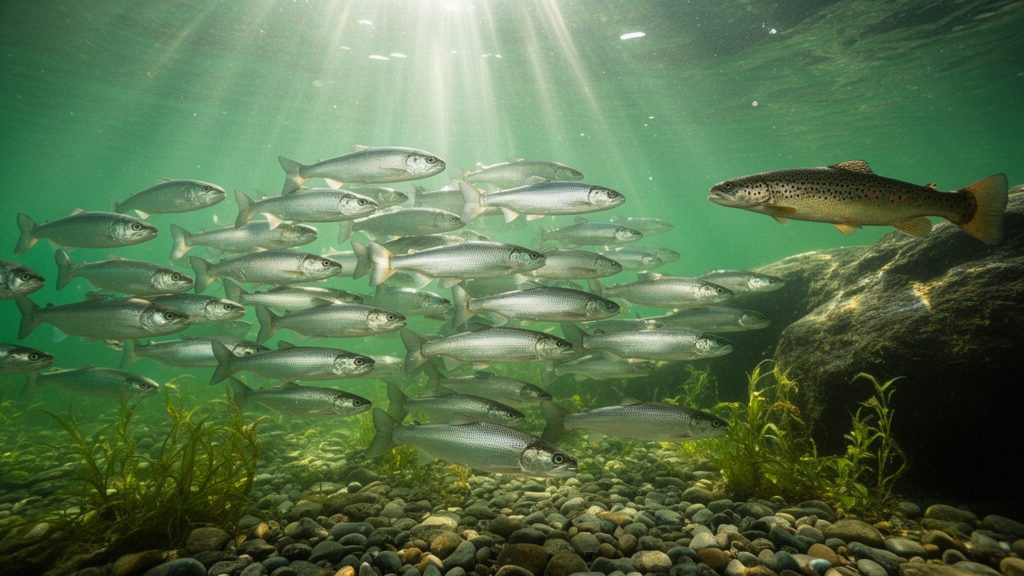
In the turquoise waters of Croatia’s Krka River, a quiet transformation has been unfolding for two decades. A comprehensive new study published in the journal NeoBiota has documented a striking shift in the river’s fish communities: native species that once dominated these waters are declining, while non-native and translocated fish are spreading rapidly through the river’s slower-moving sections. The research, spanning 20 years of sampling data, offers one of the most detailed pictures yet of how biological invasions reshape a Mediterranean biodiversity hotspot.
The Krka River, located in northern Dalmatia on Croatia’s Adriatic coast, flows 72.5 kilometers through one of Europe’s most remarkable karst landscapes. Nearly 49 kilometers of the river have been protected as a national park since 1985, and its course is punctuated by seven tufa waterfalls with a combined drop of 224 meters, forming the largest tufa barrier system on the continent. These travertine barriers, along with dams and hydroelectric plants, divide the river into distinct segments with very different hydrological characters, from fast-flowing headwaters to the 13-kilometer-long lake-like stretch of Visovac Lake.
This structural complexity makes the Krka an ideal natural laboratory for studying how fish communities change along a river’s length and over time. The Dalmatian region is considered an ichthyological biodiversity hotspot, home to 36 endemic species in Croatia’s Adriatic drainage alone. The Krka itself historically supported 33 freshwater fish species, including nine endemics found nowhere else. Yet decades of unregulated stocking, dam construction, pollution, water extraction and climate pressures have raised concerns about the fate of these unique fish communities, and until now, no comprehensive analysis of the river’s fish fauna had ever been conducted.
The research team assembled sampling data collected between 2004 and 2008 and again between 2020 and 2024, dividing the river into four longitudinal segments separated by major waterfalls. Using standardized electrofishing along 150- to 300-meter transects and multi-mesh gillnets set overnight in lentic sections, the researchers documented fish abundance across 15 mainstream locations. In total, 25 sampling campaigns took place in the earlier period and 39 in the recent one, each spanning 17 sampling days. All captured fish were identified to species level, and the team supplemented field data with records from BioAtlas, iNaturalist, GBIF, the IUCN Red List and FishBase.
The results reveal a community in transition. In the past period, 15 species were recorded, 10 of them native, four non-native and one translocated from the Danube Basin. By the recent period, species richness had risen to 22, but the composition had changed dramatically: 11 native species, seven non-native and four translocated. Eight species appeared for the first time in the recent dataset, including the newly described Krka minnow Phoxinus krkae, three non-native arrivals from North America and Asia, the black bullhead Ameiurus melas, the pumpkinseed Lepomis gibbosus and the grass carp Ctenopharyngodon idella, and three translocated Danube species, northern pike, common carp and perch. Only the European eel, recorded in the past, was absent from recent catches.
Statistical analyses confirmed that these changes were not sampling artifacts. Permutational multivariate analysis of variance showed highly significant differences in community composition both between river segments and between time periods, and non-metric multidimensional scaling produced a clear visual separation of the two eras. Native species such as the Illyrian chub Squalius illyricus and the Dalmatian barbelgudgeon Aulopyge huegelii anchored one end of the ordination, while non-native species like pike, pumpkinseed and perch clustered at the other. Similarity percentage analysis identified the native chubs and the freshwater blenny as the main drivers of temporal dissimilarity, having been far more abundant in the past.
The functional profile of the community shifted as much as its taxonomic composition. Non-native phytolithophilic species, which spawn on vegetation, such as black bullhead, pike, perch and the topmouth gudgeon Pseudorasbora parva, became abundant and widespread in the recent period. Meanwhile, native lithophilic species that spawn on gravel and stone, including Aulopyge huegelii and both Illyrian and common chubs, dominated the past period but were absent from recent samples. Feeding guilds told a similar story: omnivores and invertivores, represented largely by non-native fish, became increasingly prevalent, particularly in the downstream segments.
Space mattered as much as time. The fast-flowing headwater segment remained a stronghold for rheophilic trout species, with the native Adriatic trout Salmo farioides and the non-native rainbow trout both serving as significant indicators. But the slower, lake-like segments B, C and D showed a pronounced invasion of non-native and translocated fish, especially segment C, which contains the artificially dammed Carigradska Draga backwater. There, seven of the eight recorded species were not native to the Krka. The researchers attribute this pattern to the way damming and hydroelectric operations have transformed the river’s hydrology, creating the calm, vegetated habitats that generalist invaders favor, while the cold, oxygen-rich, fast-flowing upstream reaches remain hostile to them.
The ecological consequences could be severe. Ten of the 11 non-native species recorded in the recent period are assessed as having a high risk of invasiveness, and the topmouth gudgeon carries a very high risk. Omnivorous and invertivorous invaders can deplete native insects and zooplankton, triggering algal blooms, eutrophication and cascading food-web disruption. Predatory translocated species pose a different threat: northern pike is known to exert considerable predatory pressure outside its native range and has shown a dietary preference for native cyprinids elsewhere, while high perch abundance in Brljan Lake echoes findings from Turkish lakes where perch disrupts predator-prey dynamics and restructures entire communities. Many Mediterranean endemics evolved without native piscivorous fish, leaving them particularly vulnerable.
The study also points to the likely origins of the invasion. Historical records show that carp and tench were introduced to the Šarena Lakes near the river’s source as early as 1947, and a trout farm operating since 1948 introduced rainbow trout in 1965. Sport fishing and aquaculture remain major vectors of translocation between Croatian watersheds, and unintentional introductions of species like pumpkinseed and topmouth gudgeon during stocking operations are well documented. Because the Krka’s karst hydrology isolates it underground from neighboring rivers, natural dispersal is considered unlikely for most arrivals. The researchers also note that the extreme drought of 2011 to 2012, which brought historical low water levels, may have stressed native species while favoring hardy non-native generalists, a scenario that could foreshadow the future of other Mediterranean karst rivers under climate change.
Perhaps the most sobering finding concerns the endemic soft-mouth trout, Salmo obtusirostris, a keystone species now considered locally extinct in the Krka. The Dalmatian barbelgudgeon, a Croatian endemic, suffered a dramatic decline of more than 99 percent in mainstream catches between the two sampling periods, though it persists in the Čikola tributary. The authors conclude that 20 years is sufficient time for a fundamental restructuring of a karst river’s fish community, involving not just species turnover but functional homogenization, as specialized native species are replaced by generalist invaders. Complete eradication of non-native species from the river appears impossible, but targeted interventions, such as removing the artificial dam at Carigradska Draga, could restore favorable habitat. The researchers argue that upstream tributaries and colder refuges represent the best hope for the Krka’s endemic fish, and that these areas should become priorities for monitoring and management before the invasion advances further.
Subject of Research: Temporal and spatial changes in freshwater fish communities caused by non-native species invasion in a Croatian karst river
Article Title: A biodiversity hotspot at risk: Fish communities reveal a spread of non-native species in a karst river
Article References: Škugor, T., Marčić, Z., Ćaleta, M., Mustafić, P., Mrakovčić, M., Goreta, G., Renić, N., Pleše, S., Dianežević, D., Horvatić, S., & Zanella, D. (2026). A biodiversity hotspot at risk: Fish communities reveal a spread of non-native species in a karst river. NeoBiota, 108, 231-250. https://doi.org/10.3897/neobiota.108.188169
Image Credits: AI Generated
DOI: 10.3897/neobiota.108.188169
Keywords: Krka River, non-native species, freshwater fish, biodiversity hotspot, karst river, Dalmatia, invasive species, fish communities, Croatia, endemic species, ecological guilds, NeoBiota
Cite Scienmag News
Margaret Porter. (October 17, 2026). Invasive fish are quietly taking over Croatia’s Krka River, 20-year study reveals. Scienmag. https://scienmag.com/invasive-fish-are-quietly-taking-over-croatias-krka-river-20-year-study-reveals/
Margaret Porter. "Invasive fish are quietly taking over Croatia’s Krka River, 20-year study reveals." Scienmag, 17 October 2026, https://scienmag.com/invasive-fish-are-quietly-taking-over-croatias-krka-river-20-year-study-reveals/. Accessed 17 October 2026.
Margaret Porter. "Invasive fish are quietly taking over Croatia’s Krka River, 20-year study reveals." Scienmag. October 17, 2026. https://scienmag.com/invasive-fish-are-quietly-taking-over-croatias-krka-river-20-year-study-reveals/


