


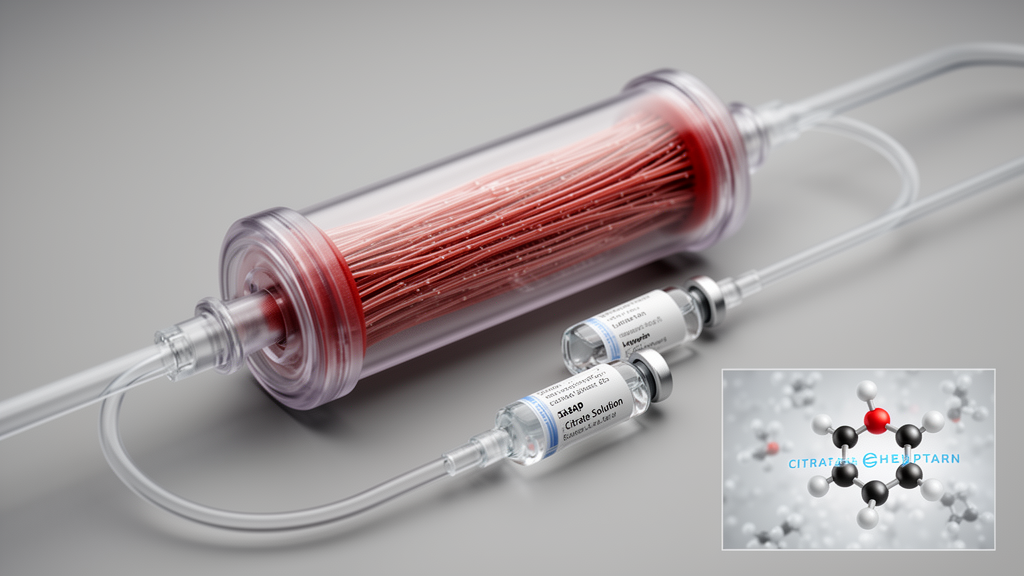
For critically ill patients whose kidneys suddenly fail, continuous renal replacement therapy (CRRT) is a lifeline: a machine quietly filtering the blood around the clock when the body can no longer do it alone. But a new randomized pilot study from Spain suggests that this therapy may be doing far more than replacing renal function. The choice of anticoagulation strategy used to keep the dialysis circuit running — regional citrate or systemic heparin — may leave distinct biological fingerprints across different pathophysiological domains, from oxidative stress to neutrophil activation, hinting that extracorporeal therapies are not biologically neutral.
The study, led by Fernando Sánchez-Morán of the General University Hospital of Castellón and Jaume I University, together with colleagues at the University of Valencia, was published in Frontiers in Nephrology. The team hypothesized that regional citrate anticoagulation (RCA), which works by chelating ionized calcium within the extracorporeal circuit, profoundly modifies the physicochemical environment to which circulating blood is exposed — and that these changes could influence the biology of blood before it returns to the patient. Systemic unfractionated heparin, the other widely used strategy, operates through an entirely different mechanism, offering a natural comparison point.
To test this, the investigators conducted a prospective randomized pilot trial between June 2018 and May 2022 in the intensive care units of two Spanish hospitals. Twenty critically ill adults with acute kidney injury (AKI) requiring CRRT were randomized equally to citrate or heparin anticoagulation. Serial blood samples were drawn before CRRT initiation, at one hour, and at 24 hours, with paired pre-filter and post-filter sampling at the later two timepoints to track what happened to each biomarker as blood traversed the artificial circuit. Eight healthy reference participants established physiological reference values for interpretation.
The biomarker panel was deliberately designed to span four complementary pathophysiological domains. Redox homeostasis was assessed through reduced glutathione (GSH), oxidized glutathione (GSSG), and their ratio, quantified by liquid chromatography–tandem mass spectrometry. Neutrophil activation was represented by plasma myeloperoxidase (MPO) activity, measured spectrophotometrically through the peroxidase-catalysed oxidation of tetramethylbenzidine. Cellular injury was tracked via cell-free DNA (cfDNA) quantified by fluorometry with SYTOX Green, and systemic inflammation was assessed by C-reactive protein (CRP) using a standard immunoturbidimetric assay. Laboratory personnel performing the analyses were blinded to treatment allocation throughout.
The results revealed a strikingly selective pattern rather than a uniform biological response. Among the six biomarkers, only MPO — the neutrophil activation marker — showed a significant time-by-anticoagulation interaction in the longitudinal mixed-effects model (P = .008), with the treatment-by-time coefficient growing larger at 24 hours than at one hour (β = 49.46 vs 33.14), suggesting a cumulative rather than acute divergence between strategies. However, when the investigators applied baseline-adjusted sensitivity analyses, the between-group difference was no longer statistically significant, illustrating how inference in this small pilot cohort depended on the analytical framework applied.
Meanwhile, GSH and cfDNA concentrations changed significantly over time irrespective of anticoagulation strategy (both P = .016), while the GSSG/GSH ratio — the most informative indicator of systemic redox balance — approached a treatment-level difference (P = .067). In a baseline-adjusted analysis extending the approach used for MPO to all six biomarkers, the GSSG/GSH ratio actually showed a significant between-group difference at 24 hours (P = .017). Taken together, the authors argue, more than one biological domain may carry an exploratory signal in this cohort, depending on the analytic approach — which is precisely why they treated all six biomarker comparisons as exploratory and hypothesis-generating rather than prioritizing any single domain as confirmed.
The paired pre- and post-filter sampling added another layer of insight into what happens inside the extracorporeal circuit itself. CRP increased significantly from pre-filter to post-filter at both timepoints (P < .001 at one hour; P = .018 at 24 hours), irrespective of anticoagulation strategy. Because CRP cannot be synthesized within the circuit, this pattern is compatible with haemoconcentration from plasma water removal, or with non-selective release of CRP previously retained within the membrane’s secondary protein layer through competitive protein displacement. A companion analysis showed that CRP was the only biomarker detectable in the ultrafiltrate effluent, supporting — but not proving — selective trans-membrane transport. MPO also increased post-filter at one hour, and GSH showed an anticoagulation-dependent pre-to-post change at the same timepoint, suggesting that at least part of the biological modulation may originate within the circuit itself.
The investigators were careful to account for flow-related artefacts. The estimated filtration fraction was small (median 4.5%), corresponding to a post-filter haemoconcentration factor of only about 1.05 — too small to explain the marker-specific behaviour observed, since uniform haemoconcentration would have raised all analytes by a similar modest proportion. Similarly, correcting citrate-group MPO concentrations for the expected pre-filter dilution (about 3.6%) did not materially alter the principal finding (P = .006 vs P = .008 uncorrected), indicating that citrate-induced haemodilution is unlikely to explain the neutrophil activation signal.
No significant differences emerged in secondary clinical outcomes. Duration of CRRT, ICU and hospital length of stay, renal recovery, and mortality were comparable between groups, and no bleeding complications, citrate accumulation, or heparin-induced thrombocytopenia were recorded. The authors contextualize these null clinical findings against the broader trial literature: large randomized trials including the RICH trial (n = 596) and a meta-analysis pooling 14 trials (n = 1134) with trial sequential analysis have found no mortality difference between citrate and heparin, suggesting the absence of an overall survival effect is unlikely to be explained simply by inadequate sample size.
Yet the absence of a mortality signal does not rule out domain-specific biological modulation. Using the observed effect sizes, the team projected the sample sizes needed to confirm interactions of the magnitude seen here: GSH and cfDNA would require prohibitively large cohorts (n > 600–1400), whereas GSSG, the GSSG/GSH ratio, and CRP at one hour showed achievable requirements (approximately 85–470 patients) for a multicentre confirmatory trial. The authors propose a translational research strategy: first identifying which pathophysiological domains are consistently modified, then determining the biological subphenotypes in which these changes matter most, and finally evaluating whether targeted modulation translates into clinical benefit. If confirmed in adequately powered prospective studies, the findings could open a path toward precision extracorporeal medicine — where the anticoagulation strategy is chosen not only for circuit patency, but for its biological effects on the patient.
Subject of Research: Critical Care Nephrology
Article Title: Beyond renal support: biological modulation across pathophysiological domains during continuous renal replacement therapy — a randomized pilot study
Article References: Sánchez-Morán, F., Pérez, S., Sastre-Belloch, J., & Mateu-Campos, M. L. (2026). Beyond renal support: biological modulation across pathophysiological domains during continuous renal replacement therapy — a randomized pilot study. Frontiers in Nephrology, 6, Article 1932419. https://doi.org/10.3389/fneph.2026.1932419
Image Credits: AI Generated
DOI: 10.3389/fneph.2026.1932419
Keywords: CRRT, acute kidney injury, regional citrate anticoagulation, heparin, biomarkers, neutrophil activation, oxidative stress, extracorporeal therapy, critical care, pilot trial, Beyond, renal
Cite Scienmag News
Jerry Hayes. (October 17, 2026). Citrate or Heparin? Dialysis Anticoagulation May Shape Biology Beyond the Kidney. Scienmag. https://scienmag.com/citrate-or-heparin-dialysis-anticoagulation-may-shape-biology-beyond-the-kidney/
Jerry Hayes. "Citrate or Heparin? Dialysis Anticoagulation May Shape Biology Beyond the Kidney." Scienmag, 17 October 2026, https://scienmag.com/citrate-or-heparin-dialysis-anticoagulation-may-shape-biology-beyond-the-kidney/. Accessed 17 October 2026.
Jerry Hayes. "Citrate or Heparin? Dialysis Anticoagulation May Shape Biology Beyond the Kidney." Scienmag. October 17, 2026. https://scienmag.com/citrate-or-heparin-dialysis-anticoagulation-may-shape-biology-beyond-the-kidney/


