


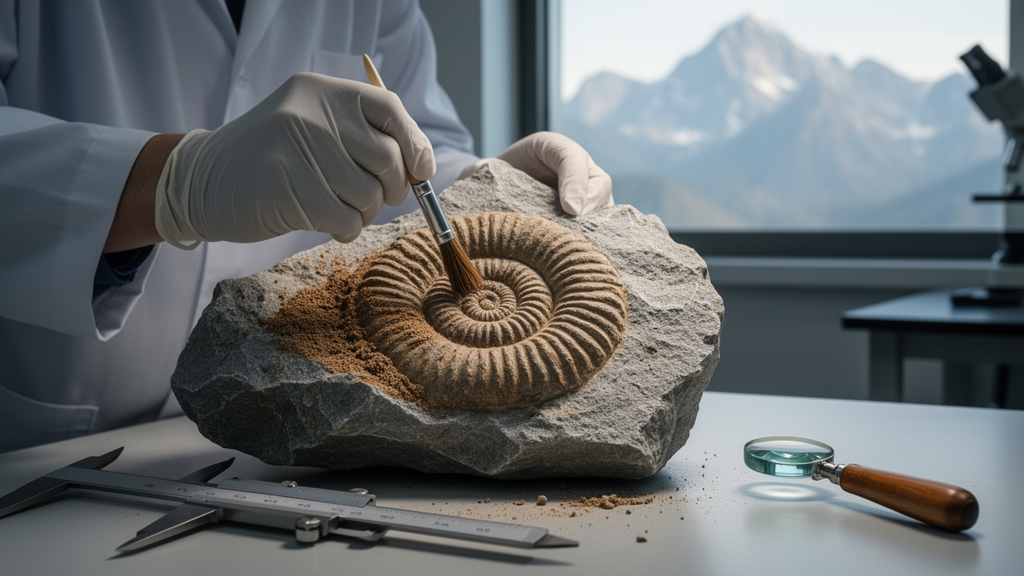
High in the Alpstein mountains of north-eastern Switzerland, a single fragment of fossilized shell has rewritten the known history of one of the ocean’s most enduring lineages. Researchers reporting in the Swiss Journal of Palaeontology describe an internal mould of a nautilid cephalopod collected at the Semelenberg locality, identifying it as Pseudocenoceras archiacianum, a species first described from nineteenth-century material. The find is doubly remarkable: it represents the first record of the genus Pseudocenoceras anywhere in Switzerland, and, to the authors’ knowledge, the first time this particular species has ever been documented from the Albian stage of the Cretaceous period, roughly 113 to 100 million years ago.
Nautilids are the surviving cousins of the famously spiral-shelled ammonites, and unlike the ammonites, which vanished entirely at the end of the Cretaceous, a handful of nautilid lineages persists to this day in the deep waters of the Indo-Pacific. Fossil nautilids, however, are notoriously hard to classify. Their shells are conservative in form, changing little over tens of millions of years, and the features that palaeontologists traditionally use to separate species, such as the shape of the whorl section, the width of the umbilicus and the sinuosity of the suture lines where septa meet the shell wall, often overlap between genera. The new Swiss specimen, catalogued at the Naturmuseum St. Gallen under the inventory number NMSG Coll. PK. 7B.46.47, exemplifies both the value and the frustration of working with this group.
The story begins with more than a decade of intensive collecting in the Alpstein, a limestone massif whose Cretaceous strata have proved extraordinarily rich in marine fossils. Previous work has documented an astonishing cephalopod fauna from these rocks, dominated by ammonites: over 100 ammonite species belonging to 54 genera have been listed from the region, making them among the most diverse and abundant macrofossil groups in the local record. Nautilids, by contrast, have remained elusive. Only a handful of genera had been reported, and within the Albian specifically, a single genus, Eutrephoceras, accounted for the entire known nautilid record of the Alpstein until now.
The Semelenberg locality, documented in earlier studies as Semelenberg Nord II, sits within the Garschella Formation, a sedimentary unit spanning the lower Aptian to the lowermost Cenomanian stages. The outcrop’s age is pinned down by its ammonite assemblage: the presence of the genera Mortoniceras, Hysteroceras, Mirapelia and Hoplites indicates a middle to early late Albian deposition. The nautilid specimen itself came from the upper part of the outcrop, a horizon that is moderately glauconitic, meaning it is rich in the green iron-bearing mineral glaucony that forms in oxygen-poor marine settings, and packed with phosphorite, another hallmark of condensed, slowly accumulating seafloor deposits where fossils can concentrate over long intervals.
To identify the fossil, the researchers applied the standard suite of conch measurements used in modern nautilid documentation. The specimen, an internal mould of a broken phragmocone, the chambered portion of the shell, measures 46 millimetres in maximum diameter. Its whorl section is subrectangular to broadly trapezoidal and slightly wider than tall, with a whorl width to height ratio of 1.1. The umbilicus, the opening left by the coil of the shell, is narrow, measuring just 12 percent of the conch diameter. The septa, the walls dividing the chambers, are closely spaced, separated by angles of roughly 16 to 20 degrees at a diameter of 25 to 30 millimetres. The venter, the outer edge of the whorl, is broadly rounded to nearly flat, the flanks are flattened, and the suture line runs with only a slight sinuous wave.
Crucially, the conch is entirely smooth. Because the specimen is an internal mould, the authors had to consider whether ribs might have been lost during preservation. They ruled this out: other ribbed nautilids from the same region, including species of Cymatoceras and Eucymatoceras, commonly retain their ribbing even as internal moulds, so the absence of ribs on this specimen is most plausibly a genuine feature of the animal rather than an artefact of fossilization. The position of the siphuncle, the tube that regulated buoyancy in life, could not be observed, and the centre of coiling is not visible, forcing the team to estimate septal spacing relative to an approximated centre.
Distinguishing Pseudocenoceras from its relatives required careful comparison. The specimen recalls Eutrephoceras in its broadly rounded venter but differs in having flattened flanks, and its septa are more sinuous than those of Eutrephoceras, approaching the condition seen in Angulithes while falling short of the highly wavy sutures of Pseudaganides. Interestingly, Eutrephoceras specimens previously collected from the same region show more widely spaced septa of around 20 to 25 degrees, although the authors caution that septal spacing may not be a reliable diagnostic character at all. The new fossil also resembles the neotype of Pseudocenoceras largilliertianum in its flattened flanks and closely spaced septa, but possesses a smaller umbilicus and a more inflated whorl section. Compared against published dimensional ratios for P. archiacianum, the Swiss specimen falls slightly below the historical values, a discrepancy the authors attribute plausibly to differences in growth stage or the size at which earlier measurements were taken.
This last point opens onto a wider problem in nautilid palaeontology, one that the study frames as a call to action. Early taxonomic works frequently underestimated the impact of ontogenetic change, the way an animal’s shell proportions shift as it grows, and of intraspecific variation, the natural diversity within a single species. Shimansky, working in 1975, erected multiple species of Pseudocenoceras on the basis of fragmentary or juvenile specimens, and the authors suggest that many of the morphological differences cited in historical studies may simply fall within the range of variation of a single variable animal. Complicating matters further, some ribbed Cymatoceras species share a strikingly similar conch geometry with Pseudocenoceras, and the presence or absence of ribs has often been treated as the decisive character separating them, a convention the authors follow tentatively here. Their specific determination is therefore offered as somewhat provisional, and they argue that a rigorous, comprehensive revision of the taxonomy and systematics of post-Triassic nautiloids is urgently needed.
There is even a tantalizing historical footnote. As long ago as 1846, the German naturalist Bruckmann reported that a specimen of Nautilus Archiacianus, as the species was then known, had been collected somewhere in the Alpstein region, but he provided no description, no illustrations and no precise locality, leaving the record unverifiable for nearly two centuries. The new discovery, with its documented horizon and diagnostic morphology, finally confirms that this species genuinely inhabited the Albian seas that once covered the area, marking its first confirmed record in Switzerland. Beyond the country’s borders, P. archiacianum has previously been reported from the Cenomanian of France, Moldova and Poland, while the genus Pseudocenoceras more broadly is known from the Early to Late Cretaceous of much of Europe, including Crimea, France, England, Germany, Poland and Spain, as well as North America, with occurrences in New Mexico, and northern Africa, with occurrences in Egypt.
Placed in its regional context, the find rounds out a picture of a Cretaceous seaway teeming with shelled cephalopods of every description. In the Alpstein’s Early Cretaceous sequence, Cymatoceras and Eucymatoceras appear from the Hauterivian through the Barremian, Eutrephoceras enters the record in the Albian, and now Pseudocenoceras joins the roster from the middle to early late Albian, a pattern broadly congruent with nautilid occurrences in western Switzerland. Late Cretaceous nautilid reports from the region remain sparse. For a lineage that has survived five mass extinctions and still drifts through tropical oceans today, every new fossil occurrence matters, and this modest 46-millimetre fragment from a mountainside in St. Gallen extends both the geographic and the stratigraphic reach of a genus that has been quietly sliding through the fossil record for over 100 million years.
Subject of Research: First Swiss and Albian occurrence of the Cretaceous nautilid Pseudocenoceras archiacianum
Article Title: First occurrence of the nautilid genus Pseudocenoceras ( Cephalopoda , Nautilida ) from the Albian of Semelenberg, Alpstein (Switzerland)
Article References: Tajika, A., Kürsteiner, P., & Tschanz, K. (2026). First occurrence of the nautilid genus Pseudocenoceras (Cephalopoda, Nautilida) from the Albian of Semelenberg, Alpstein (Switzerland). Swiss Journal of Palaeontology, 145, 679-685. https://doi.org/10.3897/sjp.145.193722
Image Credits: AI Generated
Keywords: Pseudocenoceras, nautilid, Cephalopoda, Albian, Cretaceous, Alpstein, Switzerland, palaeontology, fossil, Garschella Formation, taxonomy, Semelenberg
Cite Scienmag News
Gavin Prescott. (October 17, 2026). Rare Cretaceous Nautilid Fossil Found in Swiss Alps Marks a First for the Country. Scienmag. https://scienmag.com/rare-cretaceous-nautilid-fossil-found-in-swiss-alps-marks-a-first-for-the-country/
Gavin Prescott. "Rare Cretaceous Nautilid Fossil Found in Swiss Alps Marks a First for the Country." Scienmag, 17 October 2026, https://scienmag.com/rare-cretaceous-nautilid-fossil-found-in-swiss-alps-marks-a-first-for-the-country/. Accessed 17 October 2026.
Gavin Prescott. "Rare Cretaceous Nautilid Fossil Found in Swiss Alps Marks a First for the Country." Scienmag. October 17, 2026. https://scienmag.com/rare-cretaceous-nautilid-fossil-found-in-swiss-alps-marks-a-first-for-the-country/


