


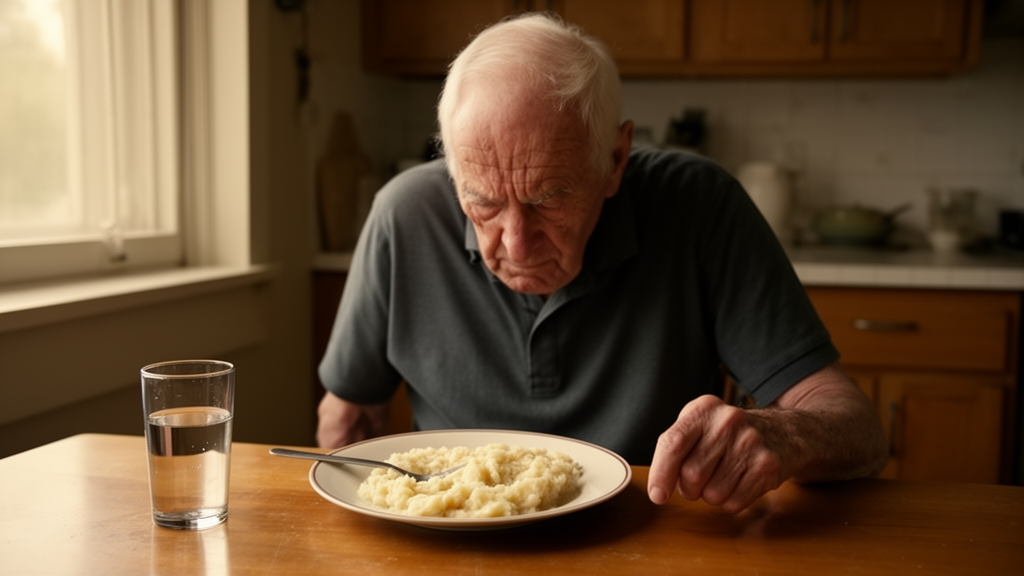
Swallowing feels effortless, yet for millions of older adults it quietly becomes hazardous, turning every meal into a potential route for aspiration pneumonia, malnutrition, and even death. A new cross-sectional study of 468 community-dwelling older adults, published in BMC Geriatrics, now identifies three modifiable factors that independently raise or lower the risk of dysphagia — difficulty swallowing — before it ever becomes clinically obvious: probable sarcopenia, depressive symptoms, and nutritional status.
Researchers from Ankara University, Dokuz Eylul University, and affiliated Turkish hospitals set out to map which parameters gathered during a Comprehensive Geriatric Assessment best predict dysphagia risk in people still living at home. They deliberately excluded participants with severe cognitive impairment, Parkinson’s disease, nursing home residence, and acute medical conditions, narrowing the lens onto a population that often slips through the cracks: older adults who appear reasonably well but may already be on a dangerous trajectory.
Dysphagia risk was screened with the Eating Assessment Tool-10, a validated ten-item questionnaire in which a score of 3 or more signals elevated risk. Probable sarcopenia was defined using the 2019 criteria of the European Working Group on Sarcopenia in Older People, which rely on low muscle strength — typically measured by handgrip dynamometry — or reduced physical performance, such as chair-stand testing, before full body-composition imaging confirms the diagnosis. Depressive symptoms were quantified with the 15-item Geriatric Depression Scale, and nutritional status was scored with the Mini Nutritional Assessment–Short Form.
When the team fed these variables into a multivariate logistic regression model, three signals stood out with striking clarity. Probable sarcopenia more than doubled the odds of dysphagia risk, carrying an odds ratio of 2.654 with a 95 percent confidence interval spanning 1.184 to 5.947 and a p-value of 0.018. Each additional point on the Geriatric Depression Scale raised the odds by roughly 15.5 percent, with an odds ratio of 1.155 (95 percent CI: 1.063 to 1.255, p = 0.001), meaning that mood and swallowing risk rose together in a steady, dose-dependent fashion.
Nutrition worked in the opposite direction. Treated as a continuous variable, each one-point improvement in the Mini Nutritional Assessment–Short Form score cut the odds of dysphagia risk by nearly a third, with an odds ratio of 0.684 (95 percent CI: 0.521 to 0.897, p = 0.006). In practical terms, better-nourished older adults were substantially more likely to swallow safely than their undernourished peers, independent of their muscle status and mood.
The biological logic linking these findings is plausible. Swallowing is a motor act orchestrated by more than thirty pairs of muscles in the mouth, pharynx, and larynx, and the same age-related loss of skeletal muscle mass and strength that defines sarcopenia does not spare the swallowing apparatus. When handgrip weakens and chair stands slow, the pharyngeal muscles that propel a bolus of food past the airway may be weakening in parallel, leaving residue in the throat and opening the door to silent aspiration.
Depression plausibly compounds the problem through several routes. Low mood blunts appetite, slows eating, and reduces the motivation to chew thoroughly or maintain hydration, while certain antidepressant medications can dry the mouth and impair bolus formation. Depression is also intertwined with sarcopenia and malnutrition in a self-reinforcing loop: sadness saps the drive to cook and eat, poor intake erodes muscle, weaker muscles curtail activity and social engagement, and the resulting isolation deepens the mood disorder. The present study cannot untangle causality in this loop, but it demonstrates that depressive symptoms flag swallowing risk even after accounting for other clinical variables.
Nutrition’s protective effect fits the same physiological framework. Adequate protein and energy intake preserve not only limb and respiratory muscle but also the buccal and pharyngeal musculature, keep saliva production healthier, and maintain the connective tissue resilience that protects the airway during swallowing. The Mini Nutritional Assessment–Short Form itself captures appetite, weight loss, mobility, and neuropsychological problems, so a high score reflects an older adult whose overall physiological reserve remains intact.
What makes the study clinically significant is its setting and its preventive framing. Dysphagia in older adults is often detected only after a choking episode or a bout of aspiration pneumonia, by which time the complications have already taken hold. By screening community-dwelling outpatients with a simple questionnaire, the researchers show that risk is identifiable upstream, in a routine geriatric clinic, using tools that require no imaging, endoscopy, or specialist referral. The EAT-10 takes minutes to complete; handgrip strength, the GDS-15, and the MNA-SF are equally quick and cheap.
The authors conclude that optimizing muscle strength, mood, and nutritional status before dysphagia and its complications develop is essential for maintaining swallowing safety in the outpatient setting. For clinicians, the message is to treat a positive sarcopenia screen, an elevated depression score, or a slipping MNA-SF result as prompts to ask about swallowing. For older adults and their families, the takeaway is more visceral: keeping muscles strong, moods lifted, and plates well filled may be among the most effective ways to keep every swallow safe.
Subject of Research: Independent predictors of dysphagia risk, including sarcopenia, depression, and nutritional status, in community-dwelling older adults
Article Title: Probable sarcopenia, depressive symptoms, and nutritional status as independent predictors of dysphagia risk in community-dwelling older adults
Article References: Atmis, V., Dost, F. S., Gumuscubuk, O., Yesin, H., Güngör, A. A., & Isik, A. T. (2026). Probable sarcopenia, depressive symptoms, and nutritional status as independent predictors of dysphagia risk in community-dwelling older adults. BMC Geriatrics. https://doi.org/10.1186/s12877-026-08456-w
Image Credits: AI Generated
DOI: 10.1186/s12877-026-08456-w
Keywords: dysphagia, sarcopenia, depression, nutrition, older adults, geriatrics, EAT-10, swallowing disorders, aspiration pneumonia, comprehensive geriatric assessment, BMC Geriatrics, malnutrition
Cite Scienmag News
Daisy Hatcher. (October 17, 2026). Weak Muscles, Low Mood, Poor Diet: Triple Warning Signs of Swallowing Trouble in Aging. Scienmag. https://scienmag.com/weak-muscles-low-mood-poor-diet-triple-warning-signs-of-swallowing-trouble-in-aging/
Daisy Hatcher. "Weak Muscles, Low Mood, Poor Diet: Triple Warning Signs of Swallowing Trouble in Aging." Scienmag, 17 October 2026, https://scienmag.com/weak-muscles-low-mood-poor-diet-triple-warning-signs-of-swallowing-trouble-in-aging/. Accessed 17 October 2026.
Daisy Hatcher. "Weak Muscles, Low Mood, Poor Diet: Triple Warning Signs of Swallowing Trouble in Aging." Scienmag. October 17, 2026. https://scienmag.com/weak-muscles-low-mood-poor-diet-triple-warning-signs-of-swallowing-trouble-in-aging/


