


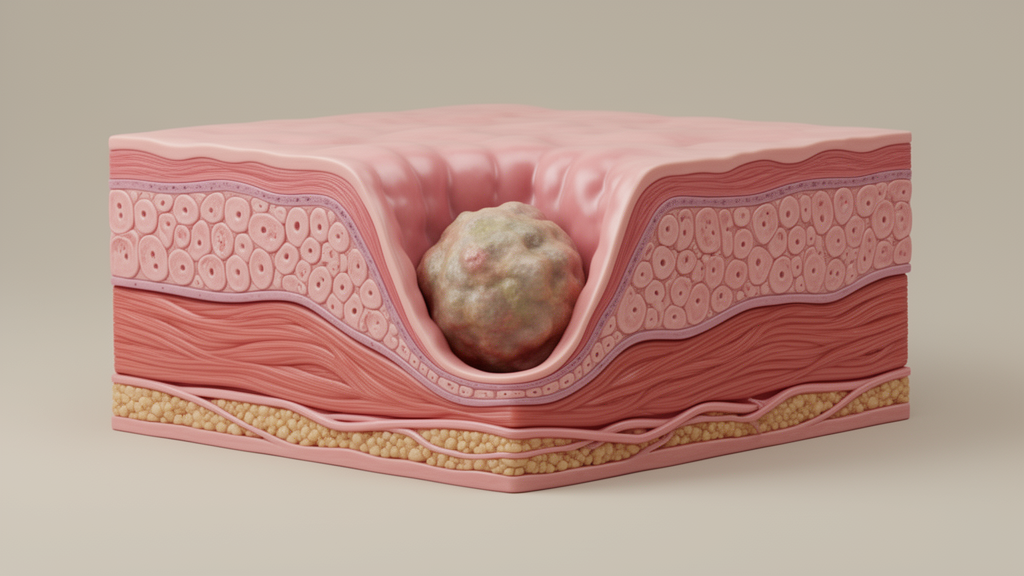
Colorectal cancer remains one of the most common malignancies worldwide and a leading cause of cancer-related death, yet the staging system that guides treatment decisions for most patients still leaves important biological questions unanswered. Nowhere is this more evident than in stage T3 colon cancer, where tumors that have grown through the muscular wall of the bowel are lumped into a single category despite enormous variability in how deeply they invade and how aggressively they behave. A new retrospective study published in Pathology and Oncology Research suggests that a simple microscopic measurement—the distance between the deepest invasive front of a tumor and the visceral peritoneum, the serosal membrane lining the abdominal cavity—may help expose this hidden heterogeneity, even though the measurement itself does not independently predict survival.
The research team, led by pathologists at Kafkas University and Manisa Celal Bayar University in Türkiye, analyzed 329 surgical resection specimens of pT3 colon adenocarcinoma resected between 2010 and 2022. The investigators defined the tumor–visceral peritoneal distance, or T-VPD, as the shortest perpendicular distance from the deepest point of tumor invasion to the true serosal surface, measured in micrometers on digitized slide images at 10 to 20 times magnification. Two pathologists performed the measurements independently, and their agreement was exceptionally strong, with an intraclass correlation coefficient of 0.968. Cases in which the visceral peritoneum could not be reliably assessed—such as tumors whose deepest invasive focus pointed toward a non-peritonealized retroperitoneal surface—were deliberately excluded to avoid systematic measurement bias.
To explore whether proximity to the serosa carried biological meaning, the team tested several distance thresholds, including 0.01, 0.05, 0.1, and 0.5 centimeters. The mean distance across the cohort was 0.30 centimeters, and nearly 90 percent of tumors fell within 0.5 centimeters of the serosal surface. The most consistent and statistically significant associations clustered around two thresholds: 0.5 centimeters and 0.05 centimeters. When the tumor–visceral peritoneal distance was 0.5 centimeters or less, tumors showed a significantly higher frequency of lymphovascular invasion and perineural invasion, two well-established markers of aggressive spread. At the much tighter threshold of 0.05 centimeters, tumors were more likely to be poorly differentiated and to harbor tumor deposits—discrete nests of cancer cells scattered in the fat surrounding the bowel that lack any recognizable lymph node structure.
Multivariable logistic regression sharpened these findings. A distance of 0.5 centimeters or less was independently associated with lymphovascular invasion, with an odds ratio of 0.33 when the outcome was coded as absence of invasion, meaning tumors close to the serosa were roughly three times more likely to show blood vessel or lymphatic channel invasion. Perineural invasion, by contrast, lost its independent association with distance once lymphovascular invasion and lymph node status were accounted for, suggesting that nerve invasion travels in company with other invasive features rather than standing on its own. At the 0.05-centimeter threshold, the association with tumor deposits was striking: tumors within half a millimeter of the serosa had more than six times the odds of harboring tumor deposits compared with those farther away.
The study also revealed a protective role for the immune system. A strong peritumoral lymphocytic response—the accumulation of immune cells around the tumor—was independently associated with a lower likelihood of both tumor deposits and poor differentiation, with odds ratios of 0.29 in each case. This finding aligns with a growing body of evidence that the local immune microenvironment shapes not only how tumors behave but also how patients fare after surgery. In the survival analyses, which drew on 181 patients with available follow-up data, a low peritumoral lymphocytic response was associated with roughly a 2.3-fold increased risk of death compared with a high response, making it one of the strongest independent prognostic factors in the cohort.
Overall survival in the study was driven by familiar culprits. Lymph node positivity, lymphovascular invasion, and perineural invasion each independently increased the risk of death by approximately 2.2 to 2.3 times, while advanced age showed a trend toward significance that did not survive multivariable adjustment. Tumor deposits predicted worse disease-free survival, with a hazard ratio of 4.1 in univariate analysis, and low peritumoral lymphocytic infiltration was again linked to poorer outcomes. Notably, the tumor–visceral peritoneal distance itself did not independently predict either overall survival or disease-free survival at any of the thresholds tested. Kaplan–Meier curves showed no statistically significant separation between patients whose tumors sat close to the serosa and those whose tumors did not.
This apparent paradox—that a measurement tied to aggressive features does not itself forecast survival—makes biological sense when viewed through the lens of tumor behavior. The authors interpret T-VPD not as an independent biological determinant but as a morphological marker that travels alongside the features that truly drive outcomes. A tumor that has pushed its invasive front to within half a millimeter of the serosal surface is, in effect, displaying the outward signature of an aggressive phenotype: it has already learned to invade vessels, shed cell clusters into surrounding fat, and dedifferentiate into a more primitive state. The distance measurement captures the footprint of that behavior without adding prognostic information beyond what lymphovascular invasion, tumor deposits, and nodal status already provide.
The findings carry practical implications for how pathologists might think about T3 colon cancer. Rather than treating all pT3 tumors as a homogeneous group, the study supports the idea that microscopic subclassification—whether by depth of extramural invasion or by proximity to the peritoneum—can identify distinct risk profiles within the same stage. Previous work by Merkel and colleagues proposed subdividing pT3 by invasion depth, and Arencibia-Pérez and colleagues reported that the degree of extramural spread is an independent determinant of recurrence and cancer-related mortality, with a 5-millimeter threshold emerging as potentially critical. The new study adds a complementary dimension by focusing on the distance to the serosal boundary itself rather than the depth of invasion into pericolic fat.
Several caveats temper the conclusions. The study was retrospective and single-center, and survival analyses were restricted to the roughly 55 percent of patients with available follow-up data, raising the possibility of selection bias. Disease-free survival analyses were limited to patients without distant metastasis at diagnosis, and the small number of recurrence events precluded multivariable modeling. The threshold values of 0.5 and 0.05 centimeters were explored without correction for multiple testing and should be regarded as hypothesis-generating rather than validated clinical cut-offs. The authors also note that preanalytical variables such as tissue fixation and processing could not be fully controlled, and that the findings apply only to tumors whose deepest invasion is directed toward a peritonealized surface.
Despite these limitations, the study adds to a growing consensus that the TNM staging system, while indispensable, does not fully capture tumor biology in intermediate-stage colorectal cancer. Tumor deposits in particular have attracted increasing attention, with recent work showing that the number of deposits independently affects survival and that models incorporating deposits alongside nodal counts improve prognostic accuracy compared with classical classification. The authors conclude that there is currently insufficient evidence to support routine use of tumor–visceral peritoneal distance as a standard prognostic marker in pathological reporting, but that the measurement may serve as a complementary component in future multiparametric risk models. Larger prospective studies and external validation cohorts will be needed to determine whether this simple microscopic distance can earn a place in the pathology report of the future.
Subject of Research: The relationship between microscopic tumor–visceral peritoneal distance and histopathological aggressiveness and prognosis in T3 colon adenocarcinoma
Article Title: Association between the histopathologic measurement of tumor–visceral peritoneal distance and prognosis in T3 colon adenocarcinoma
Article References: Hamdemir, Ö., Ayhan, S., Atmış, Ö., & Acar, Ö. (2026). Association between the histopathologic measurement of tumor–visceral peritoneal distance and prognosis in T3 colon adenocarcinoma. Pathology & Oncology Research, 32, Article 1612480. https://doi.org/10.3389/pore.2026.1612480
Image Credits: AI Generated
DOI: 10.3389/pore.2026.1612480
Keywords: colon cancer, colorectal cancer, tumor–visceral peritoneal distance, T3 staging, lymphovascular invasion, tumor deposits, perineural invasion, pathology, prognosis, survival analysis, tumor microenvironment, histopathology
Cite Scienmag News
Nathaniel Bowman. (October 17, 2026). How Far a Tumor Sits From the Serosa May Reveal Hidden Aggressiveness in Colon Cancer. Scienmag. https://scienmag.com/how-far-a-tumor-sits-from-the-serosa-may-reveal-hidden-aggressiveness-in-colon-cancer/
Nathaniel Bowman. "How Far a Tumor Sits From the Serosa May Reveal Hidden Aggressiveness in Colon Cancer." Scienmag, 17 October 2026, https://scienmag.com/how-far-a-tumor-sits-from-the-serosa-may-reveal-hidden-aggressiveness-in-colon-cancer/. Accessed 17 October 2026.
Nathaniel Bowman. "How Far a Tumor Sits From the Serosa May Reveal Hidden Aggressiveness in Colon Cancer." Scienmag. October 17, 2026. https://scienmag.com/how-far-a-tumor-sits-from-the-serosa-may-reveal-hidden-aggressiveness-in-colon-cancer/


