


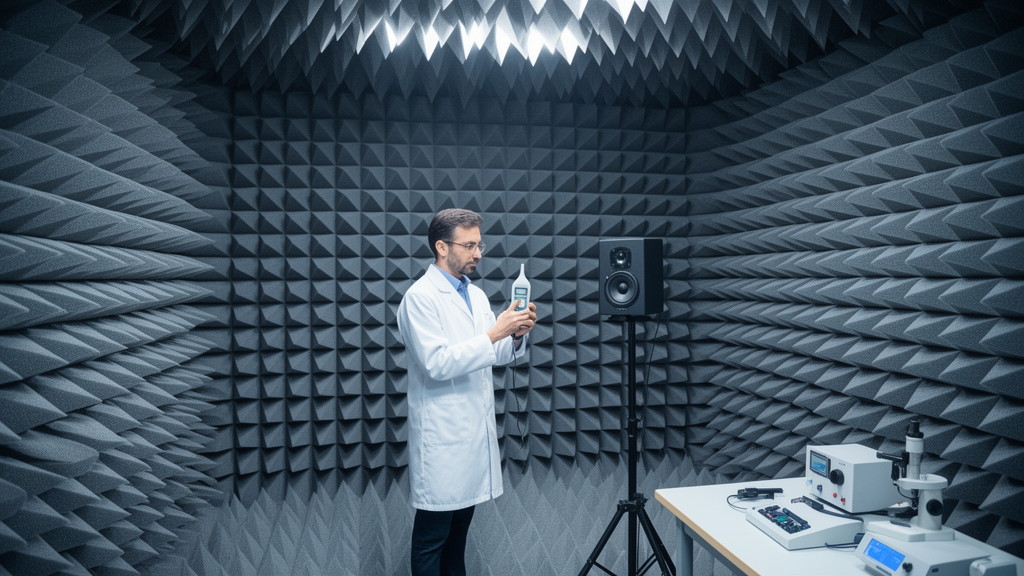
Every hushed concert hall, every quiet electric car cabin, and every soundproofed apartment wall owes its silence to a class of materials that most people never think about: acoustical porous media. Foams, synthetic and natural fibers, and even engineered metamaterials all belong to this family, and their ability to soak up sound depends on a set of physical parameters that must be measured with remarkable precision. A new review published in Frontiers in Acoustics by Luc Jaouen, François-Xavier Bécot, and Fabien Chevillotte of Matelys Research Lab in Vaulx-en-Velin, France, takes stock of how these parameters are characterized, which standardized methods dominate the field, and where the science of measuring sound-absorbing materials is heading next.
The central challenge the authors describe is that a porous sound absorber is not one material but two: a fluid phase, typically the air trapped in the pore network, and a solid phase, known as the skeleton, which may be a polymer foam, a fibrous mat, or a granular assembly. Predicting how such a medium behaves when sound waves strike it requires knowing the parameters of both phases. The seminal work of M. A. Biot in the 1950s provides the theoretical framework for coupling the two, but the practical business of measuring the underlying numbers is where laboratory ingenuity comes in. For an isotropic material, the fluid phase is described by quantities such as open porosity, static air-flow resistivity, tortuosity, viscous and thermal characteristic lengths, and static thermal permeability, while the solid phase requires its mass density, Young’s modulus, loss factor, and Poisson’s ratio.
These parameters are not arbitrary. The widely used Johnson-Champoux-Allard-Lafarge model, or JCAL, needs six fluid-phase parameters to compute the dynamic mass density, which captures visco-inertial dissipation, and the dynamic bulk modulus, which captures thermal dissipation. Combined with the four elastic parameters of the skeleton, this yields the ten-parameter Biot-JCAL model, the workhorse of modern vibro-acoustic prediction. Simpler models exist for materials with particular morphologies: the Delany-Bazley-Miki model needs only flow resistivity and porosity, while the limp model for very soft materials such as cotton-candy-like foams requires nothing more than the skeleton’s mass density. The review emphasizes that choosing the right model is itself a characterization decision, because the number of parameters a laboratory must determine depends on the physics assumed.
Direct measurements form the first category of techniques, and three fluid-phase parameters can be obtained this way. Static air-flow resistivity, standardized in ISO 9053-1, is measured by forcing air through a sample of known thickness and area and recording the pressure drop, an application of Darcy’s law borrowed and adapted from the geosciences, where rocks rather than foams were the original targets. Open porosity, the fraction of a material’s volume accessible to the acoustic wave, can be measured by compressing the air in an enclosure containing a sample and reading the pressure increase, a method related to the gas pycnometer used for geomaterials, or alternatively by weighing a dry sample and then saturating it with a fluid of known density, an application of Archimedes’ principle. The review notes that larger samples yield more accurate porosity results in both approaches.
The high-frequency limit of dynamic tortuosity, which quantifies how the winding pore paths lengthen the effective route of sound through the medium, was historically measured by saturating the sample with an electrically charged liquid and measuring the electrical resistance across it. These methods, now largely abandoned, required the skeleton to be an electrical insulator and prior knowledge of the porosity, and they struggled with the very materials that exhibit the highest tortuosity values, whose pore sizes of a few microns resist complete saturation. The remaining fluid-phase parameters, including the viscous and thermal characteristic lengths and the static thermal permeability, must be estimated indirectly, typically by combining impedance tube measurements with a physical model.
Indirect estimation has become the dominant paradigm, and the impedance tube is its central instrument. In the late 1990s, the technique gained popularity when a third microphone placed inside the rigid backing allowed researchers to measure the pressure behind the sample, simplifying the extraction of the dynamic bulk properties. Building on this, Panneton and Olny showed in 2006 that four JCAL parameters governing viscous dissipation could be recovered analytically from such measurements, and the approach was later extended to retrieve all six JCAL parameters from low- and high-frequency asymptotes. The three-microphone technique is currently in the standardization process via ISO 10534-3, a proposition already submitted, reflecting how laboratory practice matures into international consensus. The review also highlights subtleties that can corrupt results: air leaking around the sample can create double-porosity effects that alter the measured properties, and vibrations of the skeleton itself can contaminate the data, which experimenters mitigate with Teflon tape rather than wax, or by adding nails to shift skeleton resonances out of the measurement range.
Ultrasound methods offer a complementary route. By measuring the speed of sound in a sample of known thickness and porosity, researchers can quickly estimate tortuosity and even map heterogeneity across a material. However, at ultrasound frequencies, multiple scattering can appear in media with pore sizes of hundreds of microns, a phenomenon not accounted for in classical visco-thermal models. Clever workarounds have been developed, including successive measurements in two different fluids to separate and exclude scattering effects from the estimates of the characteristic lengths. Time-domain methods, in which reflected or transmitted impulse waves are analyzed, have also been explored since the early 2000s to estimate porosity, tortuosity, and flow resistivity, though the review describes this approach as still in a sparse state of development with perspectives for complementary robust characterization.
On the elastic side, the review reveals a field riddled with practical difficulties. Interlaboratory tests have shown large deviations between values of Young’s moduli and loss factors obtained by different methods, with the main deviations traced to the frequency range and the initial condition, whether imposed load or imposed strain. Uniaxial compression, the most common technique due to its apparent simplicity, is influenced by at least four factors: the possible anisotropy of the material, the temperature and frequency dependence of visco-elastic behavior, the static strain or stress dependence, and the coupling with the fluid phase as air enters and leaves the sample during compression. For fibrous materials, anisotropy is particularly critical because the elastic parameters along the fibers can differ significantly from those perpendicular to them. Moreover, polymer skeletons exhibit glass transition temperatures typically between minus twenty and twenty degrees Celsius, meaning their stiffness changes dramatically across ordinary laboratory conditions, yet few characterizations are performed at multiple temperatures and frequencies.
The review also confronts the frontier of new materials that defy classical characterization. Activated carbon exhibits a sorption phenomenon that makes direct porosity measurement impossible. Natural fibers typically display multiple scales of porosity, as did early 3D-printed materials, though this tendency is decreasing as printing precision improves. Fractal microstructures and nanomaterials present further challenges, with nanomaterials often difficult to manufacture in prototype samples large enough for impedance tube or ultrasound testing. Characterization in extreme environments, including high temperature for muffler and thermo-acoustic applications, high pressure, water-saturated conditions for building and underwater uses, and in-situ end-of-chain measurements, is actively being developed. Meanwhile, standardization is evolving faster than ever, with newly published standards attempting to be more critical and informative about methods while remaining open to new techniques, as illustrated by the fundamental differences explained between diffuse-field transmission on large samples and impedance-tube transmission on small ones.
The authors close with reminders that apply across the discipline. Uncertainties in measurements are now regularly reported, improving reliability. Anisotropy remains a slowly growing research area despite its importance for fibrous materials, because it multiplies the number of parameters required as scalar quantities become tensors. Statistical approaches, particularly Bayesian methods, and machine learning algorithms are increasingly used to identify and correct errors in measurement data, aided by the commercial availability of material databases. On the acoustic side, the low-frequency parameters remain difficult to characterize even though the low-frequency range is of tremendous importance for sound-absorbing materials. On the elastic side, broadband frequency characterization remains the exception rather than the rule. The review ends with a quote from Tamas Pritz that captures the field’s philosophy: the simpler the method, the better to have reliable results, a reminder that no characterization technique is perfect and that combining complementary methods often provides the most robust and comprehensive picture of the materials that make our world quieter.
Subject of Research: Acoustics
Article Title: Characterizations of acoustical porous media: standardized methods, current trends and challenges
Article References: Jaouen, L., Bécot, F.-X., & Chevillotte, F. (2025). Characterizations of acoustical porous media: standardized methods, current trends and challenges. Frontiers in Acoustics, 3, Article 1543456. https://doi.org/10.3389/facou.2025.1543456
Image Credits: AI Generated
DOI: 10.3389/facou.2025.1543456
Keywords: acoustics, porous materials, sound absorption, impedance tube, standardization, Biot model, characterization, Characterizations, acoustical, porous, media, standardized
Cite Scienmag News
Carl Richardson. (October 17, 2026). The Hidden Numbers Behind Every Quiet Room: How Scientists Measure the Materials That Absorb Sound. Scienmag. https://scienmag.com/the-hidden-numbers-behind-every-quiet-room-how-scientists-measure-the-materials-that-absorb-sound/
Carl Richardson. "The Hidden Numbers Behind Every Quiet Room: How Scientists Measure the Materials That Absorb Sound." Scienmag, 17 October 2026, https://scienmag.com/the-hidden-numbers-behind-every-quiet-room-how-scientists-measure-the-materials-that-absorb-sound/. Accessed 17 October 2026.
Carl Richardson. "The Hidden Numbers Behind Every Quiet Room: How Scientists Measure the Materials That Absorb Sound." Scienmag. October 17, 2026. https://scienmag.com/the-hidden-numbers-behind-every-quiet-room-how-scientists-measure-the-materials-that-absorb-sound/


