


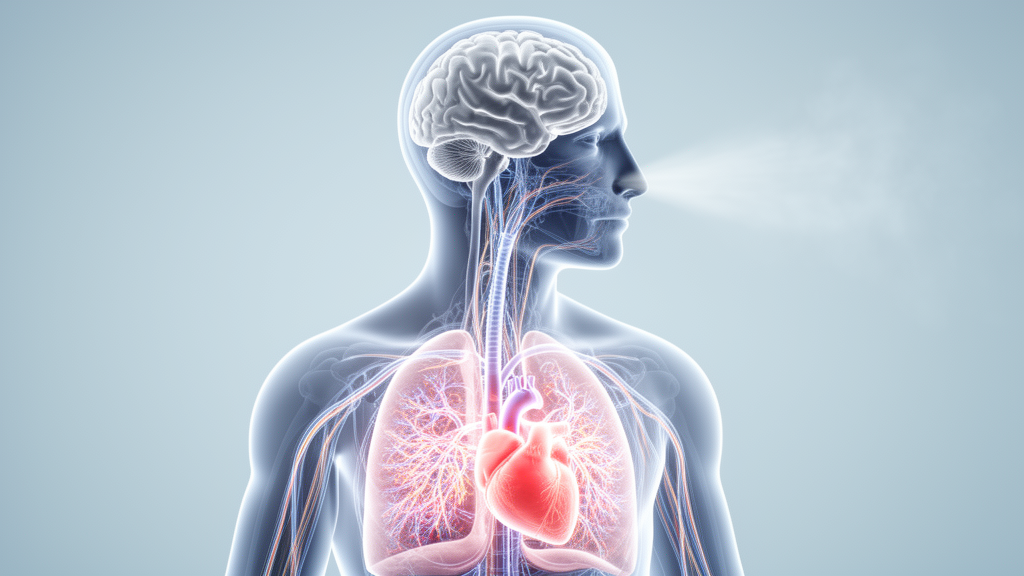
Every breath you take does far more than exchange oxygen for carbon dioxide. According to a new study published in Frontiers in Systems Neuroscience, the phase of the breathing cycle at which you pause—right after inhaling or right after exhaling—pushes the brain and heart into measurably different dynamical states. The research, led by MariNieves Pardo-Rodriguez and Erik Bojorges-Valdez of Universidad Iberoamericana in Mexico City, together with colleagues at the Instituto Nacional de Rehabilitación and Universidad Autónoma Metropolitana, offers some of the most direct evidence yet that respiration acts as a phase-specific tuning mechanism for brain-body dynamics rather than a uniform background rhythm.
The experiment involved 15 healthy young adults, eight male, aged 24 plus or minus 3 years, who performed two controlled breathing protocols while electroencephalogram signals were recorded from 16 scalp electrodes and electrocardiogram signals from chest electrodes. The first protocol followed the pranayama-inspired 4-7-8 pattern: four seconds of inhalation, seven seconds of breath-holding, and eight seconds of exhalation. The second, a 5-8-5 pattern, kept the overall cycle length nearly identical at roughly twenty seconds but shifted the breath-hold to the expiratory side. This design allowed the team to compare a sustained inspiratory state against a sustained expiratory state under otherwise similar slow-breathing conditions, with the slow cycle deliberately placed near a lower harmonic of the well-studied 0.1 Hz resonance frequency associated with enhanced parasympathetic activity.
The central technical innovation was the application of recurrence quantification analysis to cortical signals. Unlike conventional spectral measures, which summarize how much power a signal contains in each frequency band, recurrence analysis examines the temporal structure of a dynamical system: it asks how often a trajectory through state space revisits configurations it has visited before. The researchers computed relative band power time series for the five classical EEG bands—delta, theta, alpha, beta, and gamma—and, for each breath-hold cycle, extracted four-second windows centered on the hold period. Signals from three midline channels were combined into a three-dimensional embedding using the Manhattan distance metric, and multivariate recurrence plots were constructed after standardizing the signals to remove amplitude bias between conditions. The recurrence threshold was set at 1.5 standard deviations and systematically varied between 1.2 and 1.5, with the direction and relative magnitude of condition differences preserved across the entire range, supporting the robustness of the findings.
The results were strikingly phase-dependent. During inhale-holds, participants showed increased gamma band power, higher recurrence rates, and elevated heart rate. During exhale-holds, gamma activity dropped, recurrence fell, and heart rate decreased. The heart rate difference was statistically robust at the group level: mean heart rate was 3.293 beats per minute higher during inhale-holds than exhale-holds, with a 95 percent confidence interval from 1.527 to 5.177 and a large effect size of Cohen’s d equal to 0.873. Nine to fourteen of the fifteen participants showed significant differences in band power between conditions at the individual level, with the gamma and theta bands showing the most pronounced and consistent modulation. In the gamma band, more than half of the participants showed greater power during inhale-holds, while the theta band displayed the opposite tendency, with more participants showing increased power during exhale-holds.
The cardiovascular findings align precisely with the well-established mechanism of respiratory sinus arrhythmia. During inspiration, vagal activity is inhibited, allowing heart rate to rise; during expiration, vagal activity is enhanced, slowing the heart. By holding the breath after inhalation, participants effectively sustained an inspiratory autonomic state, and by holding after exhalation they sustained an expiratory one. Baroreflex mechanisms likely reinforced these effects, as changes in lung volume and intrathoracic pressure modulate blood pressure and baroreceptor activity, shaping vagal outflow through brainstem circuits. The authors also note that breath-holds raise carbon dioxide levels, which may engage chemoreflex responses contributing to the observed differences in heart rate and neural activity in autonomic structures such as the brainstem and insular cortex, although the study did not directly measure respiratory gases.
From a dynamical systems perspective, the elevated recurrence during inhale-holds suggests that cortical activity settled into a more structured and constrained regime, revisiting similar configurations more often and behaving more predictably. The reduced recurrence during exhale-holds points to a comparatively more variable and flexible regime. The authors interpret these shifts as movements within a structured state space, where different regions correspond to different balances of stability and flexibility. This framing connects to influential theoretical work proposing that healthy brain function operates near critical regimes, where an optimal balance between order and variability supports efficient information processing and adaptability. It also resonates with models of the metastable brain, in which neural systems continuously transition between transiently coordinated states rather than remaining fixed in a single configuration.
The prominence of the gamma band is particularly noteworthy. Gamma oscillations, spanning roughly 30 to 100 Hz in this study, have previously been implicated as fast integrative signals within the brain-heart axis. Earlier work by the same group had shown that components of EEG band power align with the breathing rhythm and mediate bidirectional communication between cortical and autonomic systems. The new findings extend that picture by demonstrating that this coupling is not only frequency-specific but also respiratory-phase-dependent, affecting both the magnitude and the dynamical structure of cortical activity. Slower oscillations in the theta, alpha, and beta bands showed no consistent group-level differences between conditions, suggesting that brief phase-specific respiratory perturbations may preferentially engage faster cortical processes.
The study has limitations that the authors acknowledge candidly. The controlled-breathing paradigm involved sustained attention, temporal monitoring, and voluntary regulation of the breathing pattern, all of which have themselves been associated with modulation of cortical gamma activity, so the observed effects likely reflect the combined influence of respiratory phase and cognitive demands. The two breathing tasks were always performed in the same order, with the 4-7-8 protocol preceding the 5-8-5 protocol, so task-specific or order-related influences cannot be fully excluded, although a resting interval averaging 4.29 minutes was intended to minimize carry-over effects. The study also lacked direct measures of carbon dioxide, oxygen, sympathetic activity, or parasympathetic activity beyond heart rate variability, and the relatively small cohort of fifteen participants limits generalizability, though the reported effect sizes and confidence intervals can inform power analyses for larger future studies.
Despite these caveats, the implications are considerable. The findings suggest that respiration may act as a physiological mechanism that rhythmically perturbs and organizes brain-body dynamics, enabling transitions between distinct dynamical regimes across the breathing cycle. Rather than maintaining a fixed operating point, the coupled brain-heart system appears to traverse a continuum of states shaped by ongoing autonomic and respiratory inputs. This phase-dependent organization supports the view that breathing-based interventions, from pranayama techniques to slow-breathing protocols used in stress reduction, may offer a pathway for modulating the balance between stability and flexibility in brain activity. Future research should determine whether the respiratory-phase-dependent dynamical states identified here generalize to spontaneous breathing and to clinical populations, and how these nonlinear signatures relate to cognitive, affective, and autonomic processes.
Subject of Research: Neuroscience
Article Title: Respiratory phase shapes brain-heart dynamics: evidence from recurrence analysis of EEG band power and heart rate
Article References: Pardo-Rodriguez, M., Bojorges-Valdez, E., Arias-Carrion, O., Yanez-Suarez, O., & Gonzalez-Ordiano, J. (2026). Respiratory phase shapes brain-heart dynamics: evidence from recurrence analysis of EEG band power and heart rate. Frontiers in Systems Neuroscience, 20, Article 1905962. https://doi.org/10.3389/fnsys.2026.1905962
Image Credits: AI Generated
DOI: 10.3389/fnsys.2026.1905962
Keywords: brain-heart axis, controlled breathing, EEG, gamma band, recurrence analysis, respiratory sinus arrhythmia, autonomic nervous system, nonlinear dynamics, Respiratory, phase, shapes, brain-heart
Cite Scienmag News
Cassandra Pierce. (October 17, 2026). Breathing In or Out Rewires the Brain-Heart Dialogue, Study Finds. Scienmag. https://scienmag.com/breathing-in-or-out-rewires-the-brain-heart-dialogue-study-finds/
Cassandra Pierce. "Breathing In or Out Rewires the Brain-Heart Dialogue, Study Finds." Scienmag, 17 October 2026, https://scienmag.com/breathing-in-or-out-rewires-the-brain-heart-dialogue-study-finds/. Accessed 17 October 2026.
Cassandra Pierce. "Breathing In or Out Rewires the Brain-Heart Dialogue, Study Finds." Scienmag. October 17, 2026. https://scienmag.com/breathing-in-or-out-rewires-the-brain-heart-dialogue-study-finds/


