


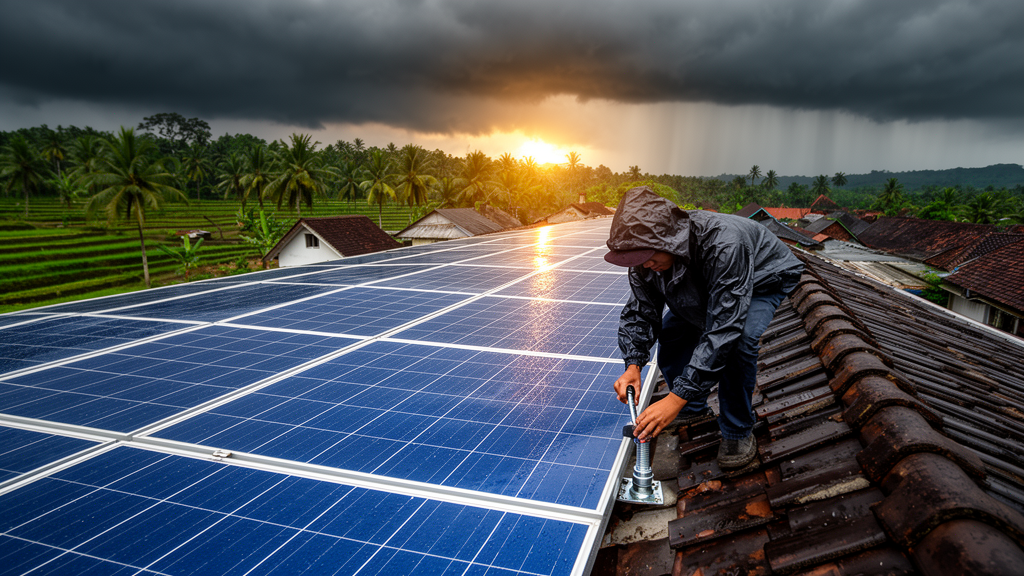
Indonesia’s plan to expand solar power across its vast tropical archipelago has always faced an awkward meteorological truth: the wettest places on the map are often the ones being targeted for new photovoltaic installations. Now, a team of Indonesian and Malaysian researchers has developed a quantitative tool that tells project developers not just where to build solar farms, but precisely when to schedule the physically demanding work of installing them. The Photovoltaic Installation Risk Index, or PVIRI, published in Theoretical and Applied Climatology, is the first climate-based scheduling framework designed specifically for solar PV deployment in high-rainfall tropical regions.
The research team, led by Zakiyyan Zain Alkaf of Universitas Jenderal Soedirman in Central Java, recognised a blind spot in the renewable energy planning literature. While countless studies optimise the policy, finance, and technical performance of solar photovoltaic systems, almost none quantify the operational feasibility of actually constructing them under tropical rainfall. Outdoor construction is acutely sensitive to precipitation: crane operations, concrete curing, electrical wiring, and module handling all become hazardous or impossible during heavy rain events. Yet conventional site screening typically relies on a single variable, such as annual irradiance totals or simply picking the driest month of the year, which the researchers argue can systematically underestimate installation risk.
To build the index, the team integrated three monthly climate variables into a single 0-to-1 risk metric: total rainfall volume, the frequency of rainy days, and global horizontal irradiance, the fundamental measure of solar resource availability. The weighting scheme reflects the operational sensitivity of installation works, with rainfall volume assigned the heaviest weight at 0.50, rainy-day frequency at 0.30, and irradiance at 0.20. This composite approach matters because the researchers found that rainfall-only screening cannot distinguish between months with nearly identical rainfall totals that differ dramatically in how often rain actually falls, a distinction that directly affects the number of workable construction days.
The study analysed three Indonesian sites representing distinct climate regimes: Mimika in Papua, characterised by an equatorial climate with rainfall distributed throughout the year; Padang Pariaman in West Sumatra, where orographic lifting of moist air over mountainous terrain produces intense precipitation; and Luwu Utara in South Sulawesi, which experiences a pronounced monsoonal pattern. The meteorological foundation came from a 30-year NASA POWER reanalysis baseline spanning 1996 to 2025, a record length that meets the World Meteorological Organization standard for climate normals. Critically, the team bias-corrected the reanalysis data throughout using monthly linear scaling against 23 months of daily ground observations from the Indonesian Meteorological, Climatological, and Geophysical Agency, ensuring the satellite-derived climatology reflected local reality rather than model artefacts.
The results reveal strikingly different scheduling landscapes across the three sites. Luwu Utara emerged as the most favourable location, offering five optimal months for installation, with August through October constituting the most reliable window. Padang Pariaman presented a more fragmented picture, with three optimal months scattered across the calendar in May, July, and September, reflecting the irregular interruptions of its orographic rainfall pattern. Mimika proved the most challenging of all, reaching only a single, marginal optimal month, a sobering finding for a site where the equatorial climate delivers persistent rainfall regardless of season.
One of the most technically significant findings concerns the stability of the rankings. The researchers tested the index across six different weighting scenarios and found that month rankings remained consistent, with Spearman correlation coefficients of at least 0.85 across all scenarios. They also verified that the index produces stable results regardless of record length: PVIRI computed on a 10-year baseline agreed with the 30-year version at correlation values between 0.91 and 0.96. This robustness matters because composite climate indices inevitably involve partly subjective component weights, and the team demonstrated that physically reasoned weights produce defensible rankings even when alternative weighting schemes are applied.
The index also demonstrated its ability to expose hidden risks that single-variable screening misses. At Padang Pariaman, the researchers identified three months whose rainfall totals fell within 5 millimetres of one another, yet these months spanned two different PVIRI risk classes. The difference lay not in how much rain fell, but in how frequently it fell and how much irradiance was available, factors that directly influence the probability of weather-related construction delays. The team screened wind speed and heat stress explicitly as potential additional components but excluded both on quantitative grounds, finding that rainfall-related variables dominated the installation risk profile at these sites.
The framework arrives at a pivotal moment for Indonesian energy policy. The country’s National Energy General Plan targets substantial renewable capacity expansion through 2030, and solar photovoltaics feature prominently in the government’s electrification strategy for remote and island communities. Yet the operational benefit of month selection has been argued here from exceedance probabilities rather than quantified in monetary cost terms, a limitation the researchers acknowledge openly. No PV-specific weather-delay function currently exists in the literature, so translating the index’s risk classes into precise schedule savings or budget impacts remains an open question for investment decisions.
A further consideration involves climate change. The team detected a marginal wetting tendency at the equatorial Mimika site, raising the question of how frequently scheduling guidance built on historical climate normals should be revised. As precipitation patterns shift across the Indonesian archipelago, scheduling frameworks calibrated on 30-year baselines may require periodic recalibration to remain reliable, particularly in equatorial zones where even small changes in rainfall frequency can alter the distribution of workable days.
The researchers have made the entire framework fully reproducible from open-access data. The NASA POWER meteorological data are publicly available, the BMKG observational data can be accessed through the agency’s online portal upon registration, and all analysis code and processed datasets are archived on Zenodo under an MIT licence with step-by-step replication instructions. This transparency positions PVIRI not as a proprietary planning tool but as a template that other high-rainfall tropical nations, from Ghana to Malaysia to Brazil, could adapt for their own solar deployment scheduling, potentially transforming how the global south approaches the practical challenge of building renewable energy infrastructure under some of the wettest skies on Earth.
Subject of Research: Photovoltaic installation risk index (PVIRI): a climate-based scheduling framework for solar PV deployment in high-rainfall tropical regions of Indonesia
Article Title: Photovoltaic installation risk index (PVIRI): a climate-based scheduling framework for solar PV deployment in high-rainfall tropical regions of Indonesia
Article References: Alkaf, Z. Z., Lenggana, B. W., Arifin, R. R. N., Sastyawan, M. W. R., Putera, R. D., Hurun’in, Wisudawati, T., Yani, A. R. S. P. A., & Muhammad, K. (2026). Photovoltaic installation risk index (PVIRI): a climate-based scheduling framework for solar PV deployment in high-rainfall tropical regions of Indonesia. Theoretical and Applied Climatology, 157(11), Article 718. https://doi.org/10.1007/s00704-026-06652-7
Image Credits: AI Generated
DOI: 10.1007/s00704-026-06652-7
Keywords: solar energy, photovoltaics, Indonesia, climate risk, renewable energy, tropical climate, construction scheduling, Photovoltaic, installation, risk, index, PVIRI
Cite Scienmag News
Faith Mcneil. (October 17, 2026). New Climate Risk Index Reveals When to Install Solar Panels in Indonesia’s Rainiest Regions. Scienmag. https://scienmag.com/new-climate-risk-index-reveals-when-to-install-solar-panels-in-indonesias-rainiest-regions/
Faith Mcneil. "New Climate Risk Index Reveals When to Install Solar Panels in Indonesia’s Rainiest Regions." Scienmag, 17 October 2026, https://scienmag.com/new-climate-risk-index-reveals-when-to-install-solar-panels-in-indonesias-rainiest-regions/. Accessed 17 October 2026.
Faith Mcneil. "New Climate Risk Index Reveals When to Install Solar Panels in Indonesia’s Rainiest Regions." Scienmag. October 17, 2026. https://scienmag.com/new-climate-risk-index-reveals-when-to-install-solar-panels-in-indonesias-rainiest-regions/


