


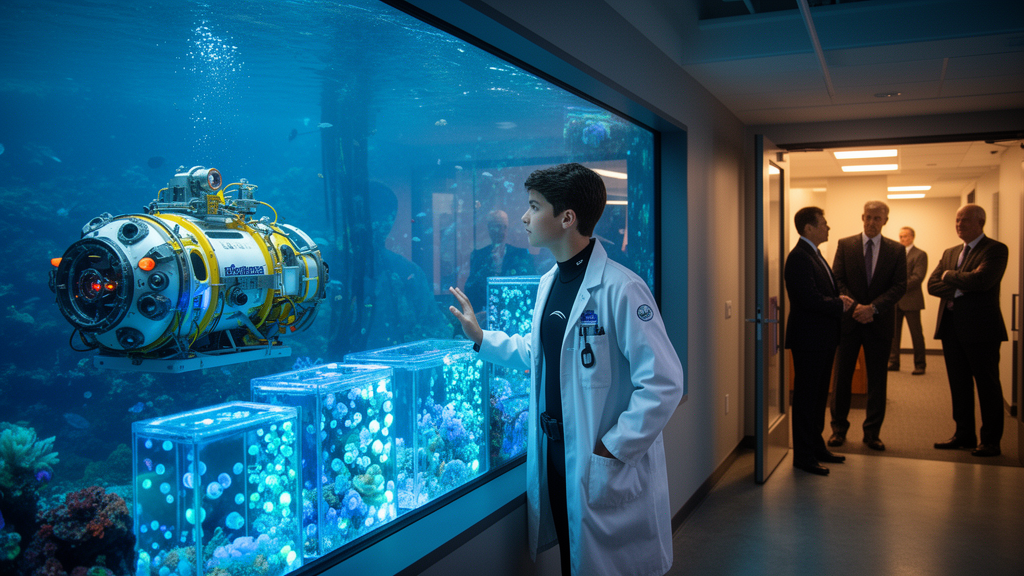
The deep sea is the largest biome on Earth, holding more than 95 percent of the global ocean’s volume, and it is under unprecedented pressure from direct and indirect human activities. Decisions about how to conserve and manage this vast realm are increasingly shaped at the science-to-policy interface, where research evidence meets international negotiations and regulatory frameworks. Yet a new study suggests that the young scientists who will inherit these decisions are struggling to get a seat at the table—and that the obstacles they face depend heavily on where they come from.
The research, published in Frontiers in Ocean Sustainability, surveyed 126 Early Career Ocean Professionals, or ECOPs, drawn from 43 nationalities across six continents. The authors, based at the University of Edinburgh’s Ocean Voices Programme, partnered with the Deep-Ocean Stewardship Initiative, a network of deep-sea experts from more than 100 countries, to run an anonymised online questionnaire in four languages: English, French, Portuguese and Spanish. Their goal was to understand what prevents ECOPs from engaging in deep-sea policy and decision-making, and what support would help them overcome those barriers.
An ECOP is defined as a person who self-identifies as being early in their career, within 10 years or less of professional experience in any field related to the ocean. These professionals are increasingly recognized as key agents of change. They bring interdisciplinary training, fresh perspectives and modern methodologies to problems such as climate change, biodiversity loss and environmental justice. Because they are among the first generations of ocean scientists to routinely work across disciplinary boundaries, they are uniquely positioned to rethink, combine and apply knowledge regimes in the co-production of knowledge with decision-makers.
The survey results show that the appetite is there. Ninety percent of respondents expressed interest in participating in ocean policy and decision-making processes. When asked what role they could play, nearly 40 percent pointed to providing technical support for decision-making, 33 percent saw themselves participating directly in policy processes, and 23 percent highlighted contributing to policy briefs. Despite this enthusiasm, 84 percent of ECOPs reported perceiving challenges and barriers preventing their engagement—and the nature of those barriers split sharply along economic lines.
For ECOPs from developing countries, who made up 51 percent of participants, the most prominent barrier was a lack of financial resources. Not knowing who to approach came second. For ECOPs from developed countries, the picture was different: not knowing who to approach to engage in decision-making was the top-ranked barrier, followed by not knowing how they could contribute to policy processes. Concerns about confidence to communicate in a foreign language ranked lowest for both groups, suggesting that language, often assumed to be a major obstacle, is less decisive than money and access.
These findings matter because deep-sea research capacity is concentrated in developed nations. Exploration facilities, equipment and funding are mainly available in wealthy countries, which means ECOPs from developing countries are more likely to experience parachute science—research conducted in their own Exclusive Economic Zones without their meaningful involvement in planning, execution or publication. The survey suggests that without adequate funding, ECOPs risk being excluded from transdisciplinary research that addresses local needs, perpetuating inequalities that already shape the field.
When asked what opportunities could enhance their participation, 83 percent of participants identified funding to cover costs of attendance at policy and decision-making processes as a key opportunity. Seventy-two percent wanted more information on how to engage in policy processes, 71 percent called for general information and training around such processes, and 67 percent highlighted the importance of connections with relevant national or international delegates. Answers between participants from developed and developing countries were generally similar, but funds and connections with delegates were more important among participants from developing states, while information and training were slightly more relevant for those from developed countries.
The study also examined the role of international networks, adopting the Deep-Ocean Stewardship Initiative as a case study. Nearly 37 percent of participants reported already being members of a deep-sea network, including COBRA, Challenger 150, the Deep Ocean Observing Strategy and the UN Ocean Decade nodes. Forty participants provided reflections on how network engagement had affected their careers, with answers mostly positive: networking and collaboration, training and career development, access to science-to-policy information through webinars, and dissemination of educational resources and career opportunities. Some reported co-authorships, joining projects, writing reports and policy briefs, and applying for research awards as direct results of network membership.
Regarding how ECOPs would like to be supported by a deep-sea science-to-policy network, most participants indicated training programs would be crucial. They also pointed to access to information about funding and job opportunities, financial support to attend policy processes, opportunities to exchange knowledge with senior professionals, interaction with other ECOPs, and access to mentoring and professional advice. The authors argue that establishing nurturing spaces where learning and exchange take place is an important step for furthering ECOP engagement in deep-sea decision-making and for achieving future-proofing solutions for the ocean.
The findings arrive at a moment when global ocean commitments, including the UN Decade of Ocean Science for Sustainable Development, are investing in efforts to include historically marginalized voices. The UN Ocean Decade established the ECOP Programme to empower young professionals through networking and capacity-sharing opportunities with each other and with global institutions. Yet the study notes that only a handful of initiatives consistently provide funding to sustain ECOP attendance at policy processes, and these are not generally targeted at deep-sea researchers. The authors recommend targeted training on international agreements and negotiations related to the deep sea, such as the Biodiversity Beyond National Jurisdiction Agreement and the International Seabed Authority regulatory framework, alongside foundational courses in science advice and diplomacy. Mentorship, they argue, is fundamental: it provides mentees with access to valuable networks and a deep understanding of policy design, negotiation and implementation from experienced professionals. Without such support, the study warns, the next generation of ocean stewards may remain enthusiastic but locked out of the rooms where the future of the deep sea is decided.
Subject of Research: Ocean Sustainability
Article Title: Deep-sea early career ocean professionals (ECOPs) at the science-to-policy interface: needs, challenges, and opportunities against country economic status
Article References: Guilhon, M., Caldeira, M., & Lopes, V. (2026). Deep-sea early career ocean professionals (ECOPs) at the science-to-policy interface: needs, challenges, and opportunities against country economic status. Frontiers in Ocean Sustainability, 4, Article 1651081. https://doi.org/10.3389/focsu.2026.1651081
Image Credits: AI Generated
DOI: 10.3389/focsu.2026.1651081
Keywords: deep sea, early career ocean professionals, ocean governance, science policy interface, marine conservation, UN Ocean Decade, Deep-sea, early, career, ocean, professionals, ECOPs
Cite Scienmag News
Violet Maxwell. (October 17, 2026). Young Ocean Scientists Are Locked Out of Deep-Sea Policy—and Money Is Not the Only Reason. Scienmag. https://scienmag.com/young-ocean-scientists-are-locked-out-of-deep-sea-policy-and-money-is-not-the-only-reason/
Violet Maxwell. "Young Ocean Scientists Are Locked Out of Deep-Sea Policy—and Money Is Not the Only Reason." Scienmag, 17 October 2026, https://scienmag.com/young-ocean-scientists-are-locked-out-of-deep-sea-policy-and-money-is-not-the-only-reason/. Accessed 17 October 2026.
Violet Maxwell. "Young Ocean Scientists Are Locked Out of Deep-Sea Policy—and Money Is Not the Only Reason." Scienmag. October 17, 2026. https://scienmag.com/young-ocean-scientists-are-locked-out-of-deep-sea-policy-and-money-is-not-the-only-reason/


