


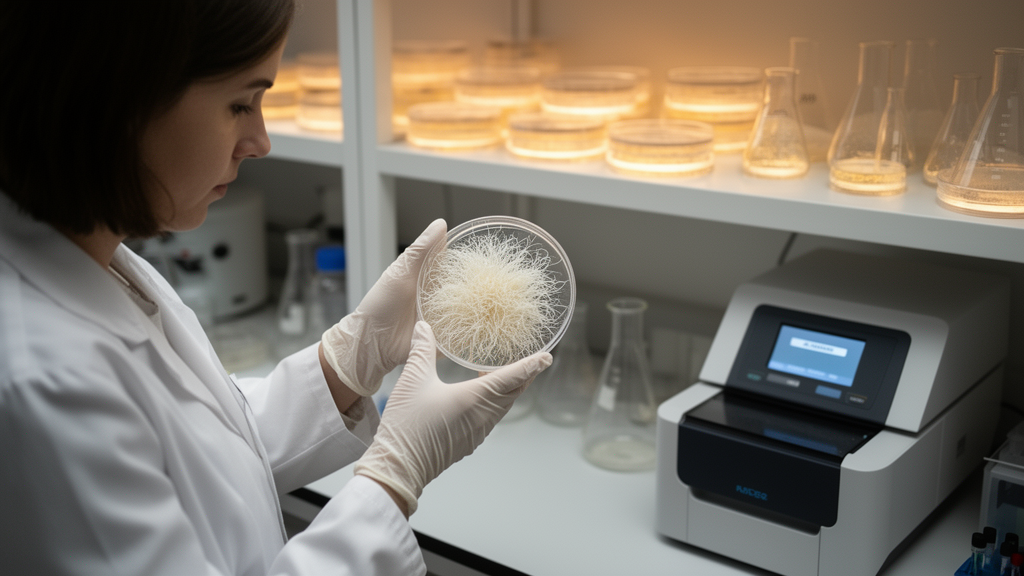
The lion’s mane mushroom, Hericium erinaceus, has long been prized across Asia for its delicate flavor and its dense load of proteins, polysaccharides, polyphenols, and other bioactive compounds. Yet the shaggy fruiting bodies that end up on dinner plates are only the final product of a long, invisible process that happens underground or inside substrate bags. Everything depends on the mycelium, the thread-like vegetative network that absorbs water, inorganic salts, and organic nutrients, and that later commits to forming primordia and mature mushrooms. A new study published in Frontiers in Fungal Biology has now mapped, in fine molecular detail, what happens inside that network as it grows, offering one of the most comprehensive transcriptomic portraits of mycelial proliferation in this species to date.
Researchers at Inner Mongolia Agricultural University, working with colleagues from the Agricultural and Animal Husbandry Technology Extension Center of Inner Mongolia Autonomous Region, set out to answer a deceptively simple question: why do some strains of H. erinaceus grow faster and more vigorously than others? The answer matters commercially, because extensive prior work has shown that the eventual yield of mature fruiting bodies is tightly linked to the state of the mycelium that precedes them. Faster mycelial growth reflects better environmental adaptability, more efficient absorption and conversion of nutrients from the culture medium, stronger metabolic activity, and greater overall vitality. In practical cultivation, H. erinaceus is notoriously demanding, with stringent environmental requirements that make fruiting induction difficult and yields relatively low, while its mycelia are comparatively easy to propagate. Understanding the genes behind mycelial vigor therefore opens a direct route to better cultivation and breeding.
The team selected two commercially relevant strains, named Jing3 and 911, which differ visibly in colony characteristics and growth vigor. Both were grown on potato dextrose agar at 25 degrees Celsius in the dark, and sampling began once mycelial growth initiated after three days of incubation. Mycelial samples were harvested at seven and fourteen days post-germination, snap-frozen in liquid nitrogen, and stored at minus 80 degrees Celsius until analysis. Each strain at each stage included three biological replicates, producing twelve sequenced samples in total. Before any sequencing, the researchers carefully quantified the physiological differences: they measured germination time, time to full plate colonization, mycelial growth rate using the cross method with a vernier caliper, biomass yield, mycelial density, and colony morphology. They also assayed core biochemical indicators, including protein content, soluble sugars, proline, and cellulase activity, using commercial assay kits.
The physiological data told a clear story. Both strains germinated after the same three days, but Jing3 displayed consistently greater growth vigor and denser mycelia than 911. Across both time points, both strains showed significant increases in growth rate, biomass, protein, soluble sugar, proline, and cellulase activity, and at every measured parameter Jing3 significantly outperformed 911. These measurements established that the two strains genuinely represent fast- and slower-growing phenotypes, providing the biological contrast needed for the transcriptomic comparison that followed.
For the molecular analysis, total RNA was extracted from all twelve samples and sequenced on the Illumina platform. The workflow was technically rigorous: messenger RNA was enriched using oligo(dT)-conjugated magnetic beads, fragmented, converted into first- and second-strand cDNA, purified with AMPure XP beads, then subjected to end repair, A-tailing, adapter ligation, size selection, and PCR amplification before high-throughput sequencing. The sequencing generated 78.53 gigabases of raw reads, of which 77.09 gigabases of high-quality clean reads were retained after filtering. Quality metrics were excellent, with Q20 scores around 98.78 percent, Q30 around 96.53 percent, and GC content near 56.87 percent. Clean reads were aligned to the latest H. erinaceus reference genome using HISAT2, transcript assembly was performed with StringTie, and expression levels were quantified with the RSEM package using FPKM as the metric.
Quality control confirmed the dataset’s reliability. Pearson correlation coefficients among biological replicates ranged from 0.89 to 1.00, indicating high reproducibility, and principal component analysis showed that the three replicates of each condition clustered tightly together while the two genotypes formed distinct clusters at each growth stage. Differential expression analysis using DESeq2, with thresholds of a p-value below 0.05, an absolute fold change of at least 2, and a false discovery rate below 0.05, identified a total of 3,257 differentially expressed genes across the comparisons. Strikingly, upregulated genes significantly outnumbered downregulated ones, indicating that mycelial growth is accompanied by a predominantly activated transcriptional program rather than a shutdown of existing processes.
The comparison structure revealed an intriguing asymmetry between the strains. In the within-strain comparisons from day 7 to day 14, the 911 strain underwent 1,505 differentially expressed genes, with 808 upregulated and 697 downregulated, while Jing3 showed 1,203, with 729 upregulated and 474 downregulated. This suggests that the slower-growing 911 strain actually experiences more pronounced transcriptional changes as it grows. Between strains, only 67 genes differed at day 7, but 482 differed at day 14, indicating that the regulatory divergence between genotypes widens and becomes more complex as mycelial development proceeds. Overall, 574 genes were expressed specifically in 911 and 350 in Jing3, while 676 genes were co-expressed in both, implying substantial transcriptional overlap in the machinery regulating growth rate. Only six genes were co-expressed across both time points, and 142 genes were exclusive to the fourteen-day phase, underscoring that late-stage mycelial maturation involves a far more intricate regulatory network than early growth.
Functional annotation pointed to the biochemical engines driving this growth. Gene Ontology enrichment analysis showed that the differentially expressed genes were primarily associated with oxidoreductase activity, the enzymatic function that mediates redox reactions in energy metabolism and secondary metabolite biosynthesis. In strain 911, 26.01 percent of differentially expressed genes fell into small molecule metabolic process, 15.88 percent into oxidoreductase activity, and 15.20 percent into small molecule biosynthetic process. In Jing3, the top terms were oxidoreductase activity at 17.51 percent, ribosome biogenesis at 16.59 percent, and nucleolus at 15.67 percent. The ribosome enrichment makes biological sense: ribosomes are the molecular machinery of protein synthesis, and their upregulation aligns with the rapid growth and nutrient accumulation characteristic of mycelium maturation, a pattern previously observed in Flammulina velutipes and Auricularia. Ribosomes also participate in DNA repair, organismal development, and cell division, all processes that intensify during active hyphal extension.
Kyoto Encyclopedia of Genes and Genomes pathway analysis sharpened the picture further, concentrating the differentially expressed genes in amino acid metabolism pathways, including arginine and proline metabolism, phenylalanine metabolism, and tryptophan metabolism. These pathways are pivotal for supplying essential nitrogen sources, regulating cellular osmotic balance, and synthesizing bioactive molecules that support proliferation. The individual gene patterns were revealing. Of the 22 differentially expressed genes in arginine and proline metabolism, most were significantly upregulated in both strains, with more upregulated genes in 911 than in Jing3. The six genes in phenylalanine metabolism split evenly, three upregulated and three downregulated in each strain. Among the 11 genes in tryptophan metabolism, two genes, august03889 and august09942, were upregulated and highly expressed specifically in Jing3. The functional logic is compelling: proline reduces reactive oxygen species in edible fungi and inhibits programmed cell death, arginine regulates growth and development through its metabolites and associated enzymes, phenylalanine-derived phenolic compounds such as gallic acid scavenge excess intracellular reactive oxygen, and tryptophan exhibits antioxidant activity through its hydroxyl and amino functional groups. Together, these findings suggest that the mycelium actively manages the oxidative stress generated during its own growth, converting amino acid metabolism into a protective and proliferative advantage.
To validate the sequencing results, the team performed quantitative real-time PCR on ten randomly selected differentially expressed genes, using the 18S rRNA gene as an internal reference and the standard 2-delta-delta-Ct method for relative quantification. The RT-qPCR data showed high consistency with the RNA-seq measurements, confirming the credibility of the transcriptomic dataset for candidate gene screening. The authors are candid about the study’s limitations: only two genotypes and two growth stages were examined, which cannot fully resolve the complete transcriptional dynamics of mycelial maturation, and functional inferences rest mainly on transcriptomic data and homologous annotation rather than direct experimental evidence. Future work, they note, will expand the number of strains and developmental stages, apply co-expression network analysis, and integrate multi-omics with molecular functional verification. Even so, the dataset, publicly deposited under NCBI accession PRJNA1321699, provides a robust theoretical foundation for optimizing stable large-scale cultivation of H. erinaceus and for molecular-assisted breeding aimed at improving agronomic traits. For a mushroom whose market value rests on both nutrition and medicine, knowing which genes switch on as the mycelium spreads may prove to be the first step toward growing it faster, more reliably, and at scale.
Subject of Research: Transcriptomic mechanisms regulating mycelial growth in Hericium erinaceus
Article Title: Transcriptomic analysis of Hericium erinaceus mycelia at distinct growth stages: insights into molecular mechanisms underlying mycelial proliferation
Article References: Zong, H., Duan, Y., Li, X., & Bao, H. (2026). Transcriptomic analysis of Hericium erinaceus mycelia at distinct growth stages: insights into molecular mechanisms underlying mycelial proliferation. Frontiers in Fungal Biology, 7, Article 1778644. https://doi.org/10.3389/ffunb.2026.1778644
Image Credits: AI Generated
DOI: 10.3389/ffunb.2026.1778644
Keywords: Hericium erinaceus, lion's mane mushroom, mycelial growth, transcriptomics, RNA sequencing, differentially expressed genes, amino acid metabolism, oxidoreductase activity, edible fungi, molecular breeding, fungal physiology, cultivation optimization
Cite Scienmag News
Juliet Wilcox. (October 16, 2026). Scientists Decode the Genes That Make Lion’s Mane Mushroom Mycelia Grow Fast. Scienmag. https://scienmag.com/scientists-decode-the-genes-that-make-lions-mane-mushroom-mycelia-grow-fast/
Juliet Wilcox. "Scientists Decode the Genes That Make Lion’s Mane Mushroom Mycelia Grow Fast." Scienmag, 16 October 2026, https://scienmag.com/scientists-decode-the-genes-that-make-lions-mane-mushroom-mycelia-grow-fast/. Accessed 16 October 2026.
Juliet Wilcox. "Scientists Decode the Genes That Make Lion’s Mane Mushroom Mycelia Grow Fast." Scienmag. October 16, 2026. https://scienmag.com/scientists-decode-the-genes-that-make-lions-mane-mushroom-mycelia-grow-fast/


