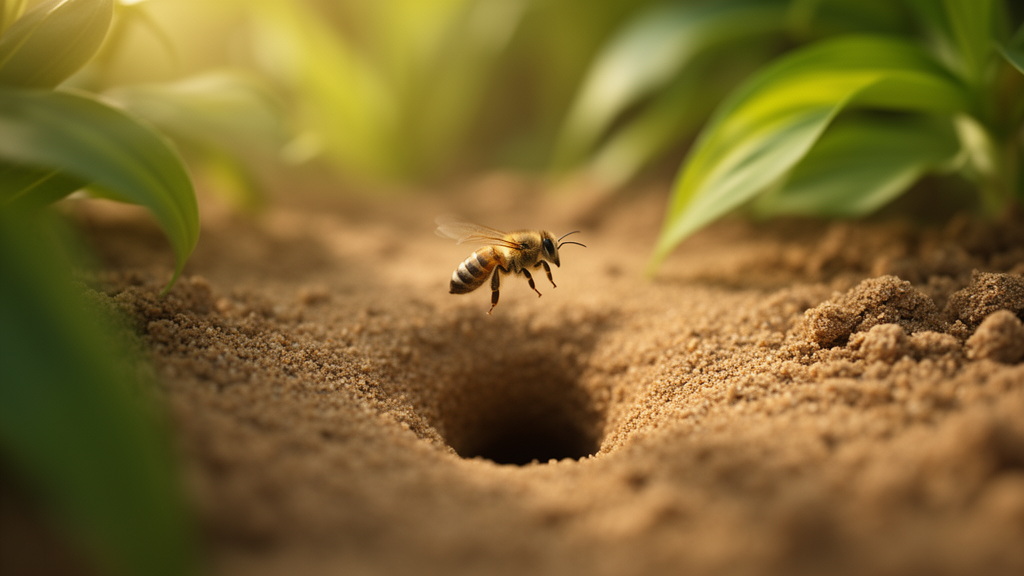
Deep in the soil beneath your feet, thousands of bee species are raising their young in complete secrecy. Solitary bees, which build and provision their nests entirely alone, without queens, workers, or any contact between mothers and offspring, account for roughly 77 percent of all bee diversity on Earth, approximately 15,500 species. Yet according to a new analysis published in Frontiers in Bee Science, scientists have managed to study the nests of only a tiny fraction of these insects in the Neotropics, the vast biogeographical region spanning Mexico to southern South America. The knowledge gap is so severe that for some of the most common bee genera in the Americas, not a single nest has ever been located.
The analysis, conducted by Isabel Alves-dos-Santos of the University of São Paulo and Maria Cristina Gaglianone of the State University of Norte Fluminense Darcy Ribeiro, focused on two prominent groups of Neotropical bees: the tribe Eucerini, known as long-horned bees, and the subfamily Diphaglossinae, large hairy bees restricted to the Americas. The authors combed through a century of literature indexed in the Web of Science database, looking for every published study on the nesting biology of these bees. What they found was sobering. Of roughly 780 known Eucerini species worldwide, only about 4 percent, 32 species, have ever had their nests described. Among the Diphaglossinae, with approximately 130 species, only about 10 percent have been studied.
Solitary bees live lives fundamentally different from the familiar honeybee. There is no cooperation and no intergenerational contact. A female constructs her nest alone, provisions each cell with pollen and nectar, lays a single egg, and departs. After hatching, the larva passes through four or five stages, consuming the food its mother supplied before pupating. The adult then emerges to restart the cycle. These phases may last a few weeks or stretch across many months, but offspring and mothers never meet. Every detail of how this cycle unfolds, from nest architecture to larval development, must be pieced together through painstaking fieldwork.
Part of the problem is logistical. About three-quarters of all solitary bee species nest in the ground, excavating their own burrows rather than using pre-existing cavities. Finding a ground nest is often a matter of spotting a small hole in the soil, a task that becomes feasible only when species form aggregations, clusters of nests in close proximity that produce visible activity when the bees are active. Even after a nest is found, excavating it to reach the brood cells presents a second challenge. Many nests are shallow with few branches, but several species dig deep tunnels into hard or sandy soil that require time-consuming and careful excavation.
By contrast, the minority of species that nest in pre-existing cavities, such as beetle holes in rotting wood or hollow branches, can be studied far more easily using artificial trap nests like bamboo segments or perforated wood blocks. This technique has enabled detailed biological research and even commercial deployment of species such as Osmia cornuta and Megachile rotundata for crop pollination. But for the ground-nesting majority, no such shortcut exists, and the data gap reflects that asymmetry.
The Eucerini illustrate the problem vividly. With 31 genera, 16 subgenera, and 247 species in the Western Hemisphere, ranging from Quebec, Canada, to Chubut, Argentina, these bees are easily recognized by the males’ extremely long antennae, sometimes twice the length of the females’. All Eucerini species nest in the ground, and the studies that do exist reveal a consistent biological pattern: oval-shaped cells oriented vertically with a thin lining, eggs placed on top of the provision, pollen packed into the base of the cell, and a liquid layer covering the pollen mass. The mature larva positions its feces against the cell cap before spinning a thin cocoon of coarse and fine silk layers. Some species are polylectic, gathering pollen from many plant families, while others are strict oligoleges, such as the squash-specialist genera Peponapis and Xenoglossa, whose brood cells have been found to contain 100 percent Cucurbita pollen.
Yet even within the 32 studied Eucerini species, only 14 occur in the Neotropics, and the gaps are glaring. There are no nest studies at all for the genus Florilegus, which contains 11 species, or for Gaesischia, with 31 species. Only one study exists for Alloscirtetica, which has 44 species, and just two for Melissoptila, with 54 species. Brazilian Eucerini are well resolved taxonomically thanks to the systematic work of Danúncia Urban, and several species are known to be oligolectic, with Florilegus specializing on Pontederia and Gaesischia on Vernonia. But their nests remain undetected, likely requiring more intensive and careful field efforts to locate.
The Diphaglossinae present an even more elusive target. These large, colorful, abundantly hairy bees of the family Colletidae are restricted to the New World and divided into three tribes, 12 genera, and approximately 130 species. Most species are crepuscular, active only during a brief window at twilight, which makes locating their nests especially difficult because the nest entrance remains closed all day. The 14 studies conducted to date, 11 on Neotropical species and 3 in Arizona, reveal a distinctive architecture: a deep vertical tunnel with lateral branches radiating in various directions, each ending in a single large, elongated cell that is vertically oriented and curved at the top, sometimes reaching angles of 90 degrees or more. The cells are lined with a cellophane-like layer and contain semiliquid provisions. Recurrent parasites include the cleptoparasitic bee genera Triepeolus and Odyneropsis, and some species form huge, permanent nesting aggregations.
A recent study of Ptiloglossa latecalcarata in the Brazilian cerrado uncovered a curious ecological detail: monofloral pollen of Caryocar brasiliense, the pequi tree, in the brood cells. Pequi is a chiropterophilous plant, pollinated by bats, whose flowers open in the evening and provide resources until dawn, supplying substantial pollen for nocturnal bees. But P. latecalcarata is not a specialist on Caryocar; it is an opportunist exploiting a plant with nocturnal anthesis and mass flowering near the nest. A similar pattern was observed with Campomanesia phaea, a myrtaceous tree. The females have only a short window to forage, so the nearest available plant becomes the primary pollen source for their offspring, a finding that illustrates how tightly crepuscular bee biology is bound to the timing of local flora.
The authors argue that these gaps stem partly from a cultural shift in science: descriptive natural history papers have fallen out of fashion and are not regarded as high-impact results by journals or modern researchers. They push back against this trend, noting that basic biological data fuel the advanced studies that address evolutionary questions, phylogenetic relationships, population genetics, and species interaction networks. Two examples make the case. Decades of meticulous nest excavation and larval anatomy descriptions of cleptoparasitic bees, primarily from Neotropical regions, contributed substantially to understanding the evolution and phylogenetic relationships within Nomadinae, the oldest clade of parasitic bees. And a study of the European mining bee Andrena marginata in Sweden used detailed nesting and foraging data to estimate the critical pollen resources needed for a nest and an entire population, effectively predicting the carrying capacity of bee habitats and providing a conservation planning tool based on easily measured variables such as available plants.
The conservation stakes are considerable. In Europe, approximately 60 percent of bee species are listed with insufficient data, preventing conclusive assessment of their conservation status. For the Neotropical region, the authors note, that percentage is certainly much higher. Bees cannot be protected if scientists do not know where they live or what they depend on, and the fact that solitary bees are less studied already poses a risk. The authors close with a call for young scientists to leave the comfort of air conditioning and venture into fieldwork, where the biology of these insects actually unfolds. Observing a female building her nest, they note, is both pedagogically valuable and deeply enjoyable, and with a good protocol and some instruments, a wealth of data can be achieved, data that may prove essential for the survival of the 96 percent of Eucerini species whose nests have never been found.
Subject of Research: Nesting biology knowledge gaps in Neotropical solitary bees
Article Title: Knowledge gaps on Neotropical solitary bees
Article References: Alves-dos-Santos, I., & Gaglianone, M. C. (2025). Knowledge gaps on Neotropical solitary bees. Frontiers in Bee Science, 3, Article 1670631. https://doi.org/10.3389/frbee.2025.1670631
Image Credits: AI Generated
DOI: 10.3389/frbee.2025.1670631
Keywords: solitary bees, Neotropics, Eucerini, Diphaglossinae, ground-nesting bees, nesting biology, pollination, bee conservation, natural history, oligolectic bees, crepuscular bees, Frontiers in Bee Science
Cite Scienmag News
Margaret Porter. (October 16, 2026). Most Solitary Bees in the Neotropics Have Never Had Their Nests Found, New Review Reveals. Scienmag. https://scienmag.com/most-solitary-bees-in-the-neotropics-have-never-had-their-nests-found-new-review-reveals/
Margaret Porter. "Most Solitary Bees in the Neotropics Have Never Had Their Nests Found, New Review Reveals." Scienmag, 16 October 2026, https://scienmag.com/most-solitary-bees-in-the-neotropics-have-never-had-their-nests-found-new-review-reveals/. Accessed 17 October 2026.
Margaret Porter. "Most Solitary Bees in the Neotropics Have Never Had Their Nests Found, New Review Reveals." Scienmag. October 16, 2026. https://scienmag.com/most-solitary-bees-in-the-neotropics-have-never-had-their-nests-found-new-review-reveals/