


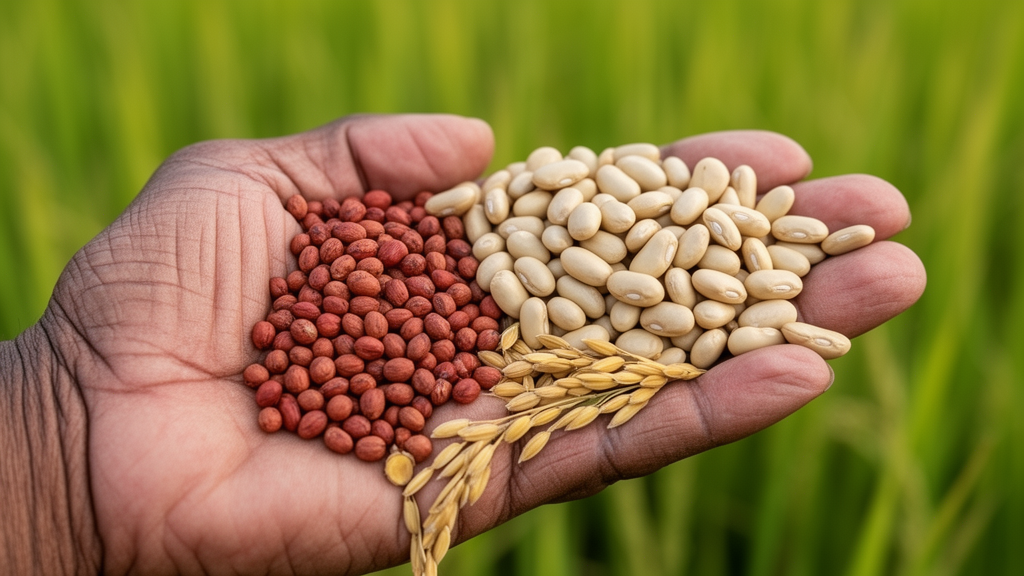
Groundnut is one of the world’s most important oilseed crops, and the size of its kernels plays a decisive role in productivity, market value and end-use quality. Yet the molecular machinery that determines whether a groundnut seed grows large or stays small has remained largely uncharacterized. A new study published in Molecular Biology Reports takes an unusual route into this problem: rather than searching for seed-size genes from scratch in the peanut genome, researchers borrowed the well-mapped genetic knowledge of rice, a grass separated from groundnut by tens of millions of years of evolution, and tested whether the same genes behave similarly in contrasting groundnut varieties.
The research team, led by scientists at Sri Venkateswara Agricultural College and the Regional Agricultural Research Station in Tirupati, India, evaluated thirty genetically diverse groundnut genotypes during the Kharif 2022 cropping season at the Dryland Farm in Tirupati. Statistical analysis of variance revealed significant variation across the panel for four key traits: hundred pod weight, hundred kernel weight, kernel length and kernel breadth. From this phenotypic spectrum, two genotypes stood out as ideal molecular contrasts. Bheema, also known as TG 47, carries bold, plump kernels, while TPT 4, designated TCGS 30, produces markedly smaller seeds.
With these two contrasting genotypes in hand, the researchers turned to the developing kernels themselves. They collected developing groundnut kernels at two developmental stages, 60 and 85 days after sowing, capturing both the active seed-filling phase and a later maturation point. RNA was extracted from these tissues and subjected to semi-quantitative PCR analysis using primer pairs designed against eight well-characterized rice seed-size genes: GW5, GW7, GS3, GS2, GS5, OsSPL16, OsSNB and OsPGL1. The logic was straightforward: if these genes have conserved orthologs in groundnut, their expression patterns should differ between bold-seeded and small-seeded varieties at specific developmental stages.
All eight rice-derived primer pairs successfully amplified products from groundnut kernel RNA, confirming that the underlying gene sequences are sufficiently conserved across these distantly related species to allow cross-genera marker transfer. This cross-species amplification itself is a notable technical achievement, demonstrating that functional genomic knowledge from rice can be directly leveraged in a legume crop where genomic resources have historically lagged behind those of cereals.
More importantly, the expression analysis revealed clear differential dynamics between the two genotypes. Four genes in particular, GW5, GW7, GS3 and GS2, showed comparatively higher expression in the bold-seeded genotype Bheema at the 60-day-after-sowing stage. This timing is biologically meaningful: 60 days after sowing corresponds to the period of rapid kernel expansion, when cell division and cell elongation in the developing seed are at their peak. The elevated expression of these four genes in the large-seeded variety during this critical window provides preliminary evidence that they participate in driving seed-size variation in groundnut, just as they do in rice.
Each of these four genes has a well-documented role in rice grain development. GW5, first isolated as a major quantitative trait locus for grain width and weight, acts by modulating the ubiquitin-proteasome pathway to influence cell division in the outer seed layers. GW7, part of the OsSPL16 regulatory module, determines grain shape by controlling cell elongation and simultaneously improves both yield and grain quality. GS3, encoding a putative transmembrane protein, functions as a major QTL for grain length and weight, with different protein domains linking to natural variation in grain size. GS2, when carrying a rare favorable allele, enhances both grain size and overall grain yield by promoting cell proliferation. That all four show heightened expression precisely when the bold-seeded groundnut genotype is actively filling its kernels suggests a conserved developmental logic spanning monocots and dicots.
Beyond the expression work, the team conducted in silico searches to map the full landscape of seed-size gene homologs in the groundnut genome. Using PeanutBase, the community genomic database for peanut, they identified 31 putative homologous sequences corresponding to rice seed-size-related genes. Parallel searches of NCBI transcriptome resources uncovered 32 putative homologous groundnut transcripts. These numbers indicate that groundnut harbors a substantial repertoire of genes related to the rice seed-size network, providing a rich target list for future functional validation and marker development.
The findings carry practical implications for groundnut improvement. Bold-seeded groundnut varieties command premium prices and are preferred for confectionery uses, while smaller-seeded types are often favored for oil extraction. Molecular markers linked to seed-size genes would allow breeders to select for kernel dimensions early in the breeding cycle, long before plants reach maturity, dramatically accelerating the development of varieties tailored to specific market demands. The four candidate genes identified here, GW5, GW7, GS3 and GS2, represent the first step toward building such a marker-assisted selection toolkit for groundnut seed size.
The researchers emphasize that their results are preliminary and that further validation is required before these genes can be deployed in routine breeding. The proposed next steps include sequence characterization of the groundnut homologs, development of peanut-specific primers to replace the cross-genera rice primers, quantitative real-time PCR to confirm the semi-quantitative expression patterns with higher precision, and genetic association studies linking sequence variation in these genes to seed-size phenotypes across broader groundnut populations. Such studies would establish whether the expression differences observed here translate into functional genetic variation that breeders can exploit.
What makes this study scientifically compelling is its demonstration that comparative genomics across vastly divergent species can accelerate candidate gene discovery in crops with fewer genomic resources. Rice and groundnut last shared a common ancestor roughly 100 million years ago, yet the fundamental developmental programs governing seed growth appear to retain enough conservation that genes discovered in one species can illuminate biology in another. As pangenome analyses and high-density genetic maps continue to expand the genomic toolkit for peanut, the rice-to-groundnut gene transfer strategy exemplified here offers a template for how researchers can fast-track molecular discovery in orphan and under-resourced crops, ultimately helping to improve yield and quality traits that matter to farmers and consumers alike.
Subject of Research: Genetics
Article Title: Cross-genera marker transferability, expression dynamics and in silico identification of rice seed size gene orthologs in contrasting groundnut genotypes
Article References: Gundrathi, S. V., Killada, G. K., Akkareddy, S., Penumalli, S., Sankarareddy, V., Paul, P. J., & Vasu, U. (2026). Cross-genera marker transferability, expression dynamics and in silico identification of rice seed size gene orthologs in contrasting groundnut genotypes. Molecular Biology Reports, 53(1), Article 1737. https://doi.org/10.1007/s11033-026-12924-2
Image Credits: AI Generated
DOI: 10.1007/s11033-026-12924-2
Keywords: Cross-genera, marker, transferability, expression, dynamics, silico, identification, rice, seed, size, gene, orthologs
Cite Scienmag News
Alan Morgan. (October 16, 2026). Rice Seed-Size Genes Point the Way to Bigger Groundnut Kernels. Scienmag. https://scienmag.com/rice-seed-size-genes-point-the-way-to-bigger-groundnut-kernels/
Alan Morgan. "Rice Seed-Size Genes Point the Way to Bigger Groundnut Kernels." Scienmag, 16 October 2026, https://scienmag.com/rice-seed-size-genes-point-the-way-to-bigger-groundnut-kernels/. Accessed 16 October 2026.
Alan Morgan. "Rice Seed-Size Genes Point the Way to Bigger Groundnut Kernels." Scienmag. October 16, 2026. https://scienmag.com/rice-seed-size-genes-point-the-way-to-bigger-groundnut-kernels/


