


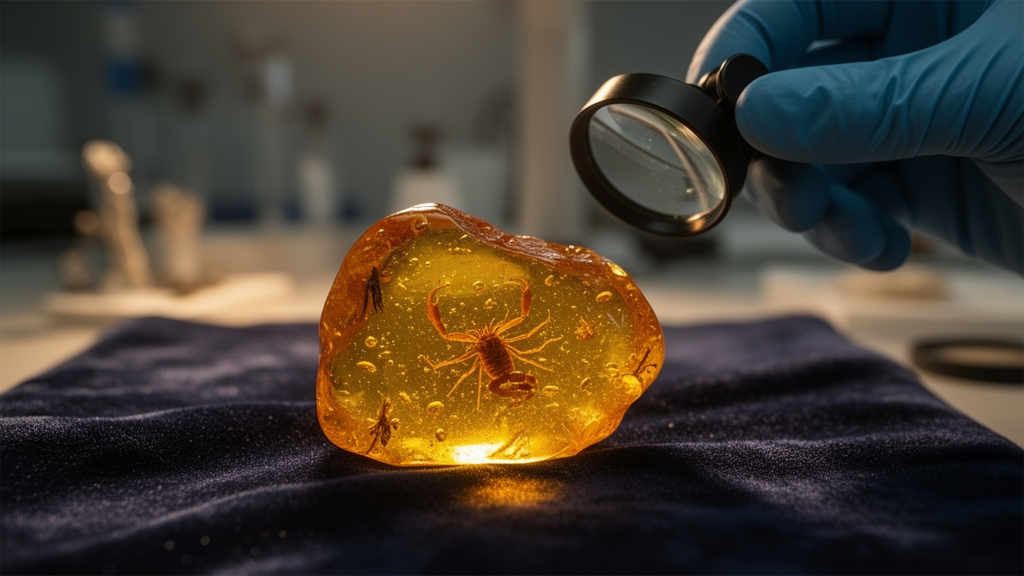
Deep inside a piece of golden amber from northern Myanmar, a tiny arachnid has been waiting for roughly 99 million years to rewrite the history of its family. Researchers examining mid-Cretaceous Burmese amber have described the first fossil representative of Chernetidae, one of the most species-rich families of pseudoscorpions alive today. The new genus and species, named Burmachernes cenomanium, pushes the confirmed fossil record of the family back by at least 20 million years and offers a rare, exquisitely detailed window into the evolutionary history of a lineage that had previously been almost invisible in the Mesozoic rock and amber record.
Pseudoscorpions are small terrestrial arachnids, typically measuring between 2 and 8 millimeters in body length, characterized by enlarged pincer-like pedipalps and the complete absence of the metasomal tail and sting that define true scorpions. Despite their scorpion-like appearance, they occupy a wide spectrum of terrestrial habitats, where they function primarily as predators of small arthropods. Many species exhibit phoretic dispersal, attaching themselves to larger insects or vertebrates to hitchhike to new environments. As one of the oldest terrestrial arachnid lineages, pseudoscorpions have a fossil history extending all the way back to the Middle Devonian, with the earliest known species, Dracochela deprehendor, discovered near Gilboa, New York, and dating to approximately 392 million years ago.
Yet the fossil record of the order remains strikingly sparse. Aside from that Devonian pioneer and a single compression fossil from Triassic deposits of Ukraine dating to roughly 227 million years ago, the documented fossil pseudoscorpions are limited to the Cretaceous and the Cenozoic. Most described fossil species originate from European Eocene ambers, including Baltic, Bitterfeld, and Rovno amber, which together account for more than 49 species, as well as from Miocene deposits with at least eight described species. In total, only 64 fossil species representing 23 genera and a single fossil family have been documented, a stark contrast to the extant diversity of 26 families and more than 4,350 species. This disparity highlights a strong preservational bias against Mesozoic representatives and underscores substantial gaps in our understanding of early pseudoscorpion evolution.
Mid-Cretaceous Burmese amber from Kachin State in northern Myanmar, dated to approximately 99 million years ago, has emerged in recent decades as one of the most important sources for fossil pseudoscorpions. Produced by the resin of ancient coniferous trees, this deposit preserves organisms in exceptional three-dimensional detail, including delicate cuticular structures and sensory organs that would normally be lost in conventional compression fossils. Although Burmese amber has yielded a comparatively diverse assemblage of pseudoscorpion inclusions, only a small fraction has been formally described. Currently, 14 species in 12 genera have been recorded from this deposit, demonstrating that many diagnostic features of modern pseudoscorpions, including specialized pedipalps and sensory structures, were already established at the family and sometimes genus level by the Cretaceous.
Chernetidae Menge, 1855 is among the most speciose families within Pseudoscorpiones, comprising 746 described species in 122 genera. Assigned to the suborder Iocheirata, the family is defined by the presence of a venom apparatus in the movable finger of the chela, a proximal raised slit sensillum on the leg tarsi, and typically at least one accessory tooth on the chelal finger. While some chernetids possess lateral eyes, most lack eyes or eyespots entirely. The family exhibits substantial ecological and behavioral diversity, including frequent phoresy, bark- and nest-dwelling habits, and complex reproductive strategies with marked sexual dimorphism in some taxa. Despite this diversity and broad geographic distribution, the taxonomy of Chernetidae remains preliminary, with three subfamilies currently recognized and no complete molecular phylogenies available for the family.
The fossil record of Chernetidae was, until now, extremely limited. The oldest known occurrence was an undescribed deutonymph from Campanian Canadian amber at Grassy Lake in southern Alberta, dating to between 79 and 78.2 million years ago. Although confidently assignable to Chernetidae, its juvenile status precluded detailed comparison using adult diagnostic characters. Adult representatives were otherwise known only from the Eocene genus Oligochernes and additional undescribed material from Bitterfeld and Rovno ambers, as well as from Miocene Chiapas and Dominican ambers. Notably, no formally described member of Chernetidae had been reported from Burmese amber, despite indications of an undescribed representative. This absence was unexpected given the family’s modern diversity, leading researchers to hypothesize that Chernetidae had already diversified by the mid-Cretaceous and that their principal diagnostic character, the venom apparatus on the movable chelal finger, was established well before the Campanian.
The new fossil, an adult female preserved in Burmese amber from the Hukawng Valley, was acquired in 2016 by private collector Patrick Müller and has now been permanently deposited at the Museum of Nature Hamburg in Germany. The specimen was examined using a combination of high-resolution photography with a Canon EOS 7D Mark II camera and specialized macroscopic and microscopic lenses, with images layered into high-resolution composites using Zerene Stacker software. Measurements were taken with a LEICA M205 A microscope, and the amber specimen was additionally examined using micro-computed tomography at the imaging beamline P05 of PETRA III at the Deutsches Elektronen-Synchrotron in Hamburg. Although suboptimal scan quality prevented detailed segmentation within the resulting three-dimensional model, the combined imaging approaches allowed comprehensive morphological documentation of the fossil’s diagnostic features.
Burmachernes cenomanium exhibits the principal synapomorphy of Chernetidae, namely venom glands in the movable chelal finger, but is distinguished from all 121 extant genera as well as the Eocene fossil genus Oligochernes by a unique combination of characters. These include a distinctive trichobothrial arrangement on the chelal fingers, with eight trichobothria on the fixed finger and two on the movable finger, a specific pattern of chelal teeth with at least three accessory teeth on the fixed finger, six setae on the dorsum of the cheliceral palm, a rallum with two blades, and a carapace nearly as wide as long with two deep transverse furrows. The body measures 4.11 millimeters including the chelicerae, with long and slender pedipalps and legs. All tergites and sternites are divided, tergal setae are slightly clavate and arranged in a single row, and the last tergite bears longer tactile setae. External female genitalia are visible and covered with at least 17 fine setae, confirming the specimen’s adult status and sex.
The syninclusions preserved alongside the new chernetid comprise a much smaller pseudoscorpion belonging to the family Chthoniidae, previously described as Lechytia finniae, as well as insect larvae and a member of Zygentoma, the silverfish order. This assemblage implies a litter-related environment, suggesting that the resin trapped a community of organisms living in or near forest floor debris. The co-occurrence of multiple pseudoscorpion families within a single amber piece provides rare direct evidence of ancient pseudoscorpion community structure and ecological partitioning in a mid-Cretaceous forest ecosystem, reinforcing the value of Burmese amber as a window into Mesozoic terrestrial arthropod communities.
Comparisons with other fossil chernetids highlight the morphological distinctiveness of Burmachernes. Compared to the Eocene Oligochernes species from Baltic amber, the new genus exhibits a proportionally longer prosoma, different positions of transverse carapacial furrows, and a different arrangement of chelal trichobothria, with trichobothrium ist positioned nearer to isb than to it, whereas in Oligochernes ist lies closer to it. Burmachernes also possesses tactile setae on the tarsi, a feature absent in Oligochernes. Comparisons with Dominican and Mexican Chiapas amber chernetids from approximately 16 million years ago reveal differences in cheliceral setation, carapace shape, rallum blade number, and the relative position of the tactile seta on tarsus IV. Taken together, these comparisons indicate that Burmachernes exhibits a combination of characters not seen in any previously described fossil chernetid, representing a distinct lineage that expands the morphological diversity of the family into the mid-Cretaceous.
The remarkably modern appearance of Burmachernes provides critical evidence that the characteristic chernetid phenotype, including the venom tooth on the movable chelal finger, was already fully in place by the Cenomanian. Interestingly, the fossil exhibits no novel morphological characters exclusive to chernetids; instead, its designation as a new genus reflects a distinctive combination of traits rather than any entirely new structures. This morphological stasis mirrors patterns observed in other pseudoscorpion lineages preserved in Burmese amber, including Chthonioidea, Neobisioidea, Cheiridioidea, and Feaelloidea, suggesting that early-established body plans were maintained over tens of millions of years. The fossil’s age provides direct support for molecular phylogenetic estimates by Benavides and colleagues, who inferred the emergence of Chernetidae between the Late Jurassic and Late Cretaceous, with the highest likelihood in the Early Cretaceous, suggesting that the characteristic chernetid morphology was likely established even earlier, possibly during the Jurassic.
The discovery also strengthens the fossil record of the superfamily Cheliferoidea, which encompasses the most derived pseudoscorpions, including Atemnidae, Cheliferidae, Withiidae, and Chernetidae. To date, Cheliferidae was the only Cheliferoidea family formally documented from Burmese amber, represented by Echinochelifer curvatus. The presence of both Cheliferidae and Chernetidae in the mid-Cretaceous demonstrates that Cheliferoidea had already diversified into extant family-level lineages by the Upper Cretaceous, indicating that even the most derived pseudoscorpion clade had established recognizable family-level diversity more than 99 million years ago. Burmachernes cenomanium not only extends the minimum age of Chernetidae by approximately 20 million years but also provides direct evidence that the apparent paucity of mid-Cretaceous chernetid fossils reflects preservational and taxonomic limitations rather than a delayed evolutionary emergence, underscoring the deep evolutionary roots and morphological stability of modern pseudoscorpion lineages.
Subject of Research: First fossil of the pseudoscorpion family Chernetidae Menge, 1855 ( Arachnida , Pseudoscorpiones ) from mid-Cretaceous Burmese amber
Article Title: First fossil of the pseudoscorpion family Chernetidae Menge, 1855 ( Arachnida , Pseudoscorpiones ) from mid-Cretaceous Burmese amber
Article References: Willmott, L. A., Kotthoff, U., & Harms, D. (2026). First fossil of the pseudoscorpion family Chernetidae Menge, 1855 (Arachnida, Pseudoscorpiones) from mid-Cretaceous Burmese amber. Evolutionary Systematics, 10(1), 101-111. https://doi.org/10.3897/evolsyst.10.190572
Image Credits: AI Generated
DOI: 10.3897/evolsyst.10.190572
Keywords: First, fossil, pseudoscorpion, family, Chernetidae, Menge, Arachnida, Pseudoscorpiones, mid-Cretaceous, Burmese, amber, scientific research
Cite Scienmag News
Drew Townsend. (October 16, 2026). Cretaceous Amber Yields First Fossil of a Diverse Pseudoscorpion Family. Scienmag. https://scienmag.com/cretaceous-amber-yields-first-fossil-of-a-diverse-pseudoscorpion-family/
Drew Townsend. "Cretaceous Amber Yields First Fossil of a Diverse Pseudoscorpion Family." Scienmag, 16 October 2026, https://scienmag.com/cretaceous-amber-yields-first-fossil-of-a-diverse-pseudoscorpion-family/. Accessed 16 October 2026.
Drew Townsend. "Cretaceous Amber Yields First Fossil of a Diverse Pseudoscorpion Family." Scienmag. October 16, 2026. https://scienmag.com/cretaceous-amber-yields-first-fossil-of-a-diverse-pseudoscorpion-family/


