


In a crowded public clinic in Dandora, one of Nairobi’s most densely populated neighborhoods, a small pilot trial has quietly produced one of the most striking retention figures in adolescent mental health research: every single teenager assigned to a new community-delivered therapy program stayed through the final session. The study, published in Frontiers in Child and Adolescent Psychiatry, tested the Ushirikiano treatment model, a task-shifted, stepped-care approach that trains community health promoters to deliver a compressed, four-session group version of Interpersonal Psychotherapy for Adolescents (IPT-G-A), with fluoxetine reserved for the most severe cases. All 16 adolescents in the intervention arm completed treatment, compared with just 69 percent of the 16 who received enhanced treatment as usual, a difference that matters enormously in a field where dropout routinely undermines care.
The trial enrolled 32 adolescents aged 12 to 18 who met DSM-5-TR criteria for depression, anxiety, or somatic symptom disorder, drawn from 155 screened at a single public primary care facility in Nairobi. The clinical picture was sobering: major depressive disorder dominated the sample, and the largest subgroup presented with severe depression accompanied by suicidal ideation. Participants, whose average age was about 15.6 years and who were evenly split by gender, were randomized one-to-one between the Ushirikiano model and an enhanced version of standard care that included a single group session on peer pressure, substance use, and school challenges. The researchers were explicit that the study was a pilot, powered for feasibility rather than definitive efficacy, and that no formal effect sizes or confidence intervals were computed.
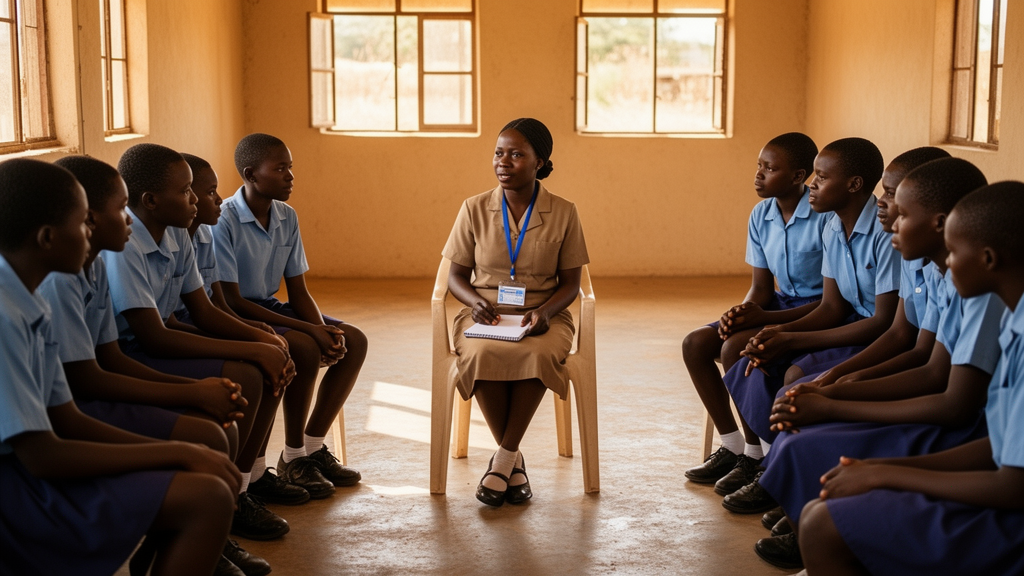
The intervention itself is a study in pragmatic compression. Standard Interpersonal Psychotherapy for Adolescents, developed by Laura Mufson in the 1990s, typically involves 12 weekly individual sessions with a specialist. The Ushirikiano model condenses this into one individual pre-group session followed by four weekly 90-minute group meetings, guided by the World Health Organization’s group IPT manual, which outlines how an eight-session format can be adapted to a brief four-session structure. The first session combines assessment, formulation, and initial intervention; the middle two sessions actively address problem areas; and the final session consolidates gains and closes. The group format, the researchers argue, adds peer support, reduces stigma, and improves engagement, while the brevity boosts feasibility and retention among adolescents.
Delivery rested entirely on non-specialists. Seven community health promoters, along with a social worker, two psychologists, and two IPT supervisors, carried the intervention, receiving blended virtual and in-person training with ongoing supervision. Fidelity was monitored with the WHO Group IPT Task Checklist, and the results showed a clear supervision-driven learning curve: 88 percent of competencies were rated satisfactory or superior, and previously trained facilitators consistently outperformed newly trained ones, particularly in pre-group sessions. Skills requiring deeper clinical judgment, such as emotional exploration and case formulation, initially lagged but improved steadily as supervisors observed sessions and debriefed facilitators afterward.
The researchers framed their evaluation of acceptability and feasibility through the COM-B model, which analyzes behavior as the interaction of capability, opportunity, and motivation. On the capability front, the transformation was visible on both sides of the group room. Adolescents who initially struggled to name their feelings or connect mood to relationships progressively learned to link emotional states to interpersonal events, express emotions, and practice communication strategies through role-plays and problem-solving exercises. One participant described the relief of the group format directly: initially anxious about sharing in a group, they realized after the first session that many peers were struggling similarly, which gave them courage to participate. Facilitators, meanwhile, moved from confusion about basic tools, with one admitting she initially thought the PHQ-9 depression questionnaire was a medical procedure, to confident ownership of the sessions.
Opportunity proved equally decisive. Sessions were embedded in an existing primary care facility without disrupting clinic operations, scheduled on quieter weekday afternoons and Saturday mornings during school holidays to maximize attendance. The familiar setting helped both adolescents and facilitators, who could coordinate referrals and flag concerns to colleagues without special arrangements. The social dimension of the group itself emerged as a therapeutic engine: by the second session, participants who had been reluctant to speak began opening up as they recognized their struggles in others. One participant said it was relieving to hear that other adolescents their age suffered similarly, and that learning from other participants really helped.
Motivation, the third COM-B pillar, was sustained by the intervention’s perceived relevance and by visible symptom improvement. Participants reported applying skills to real-world stressors, and the qualitative accounts are striking in their specificity. One adolescent described confronting his father about his drinking, after which their relationship improved and the drinking stopped. Another, who had experienced suicidal thoughts, reported never feeling suicidal again after the sessions and now hoping to become a doctor. A mother whose daughter had presented with severe depression and a recent suicide attempt, and who was one of only two participants prescribed fluoxetine alongside the therapy, said the intervention had opened her eyes and that she did not think her daughter would still be alive without it. Such accounts are illustrative of lived experience rather than proof of effectiveness, but they chart the human stakes behind the statistics.
The preliminary quantitative trends, though descriptive, point in a promising direction. Depressive symptoms appeared to decline faster in the intervention group, and at the two-month follow-up, all but one IPT-G-A participant had reached symptomatic remission, compared with only one in the control arm. Functional outcomes on the WHO Disability Assessment Schedule 2.0 favored the intervention across several domains, with gains maintained or still improving at follow-up rather than fading. Only two participants, both with severe depression, active suicidal ideation, and prior suicide attempts, received fluoxetine 20 milligrams daily, decided after consultation among a psychiatrist, psychologists, and IPT supervisors. Both used the medication for two months and reported feeling able to manage with the skills they had learned. The authors caution that with only two medicated participants, the apparent additive benefit of fluoxetine cannot be disentangled from the therapy and must be treated as hypothesis-generating.
The study situates itself within a growing body of evidence for task-shifted psychological care in East Africa and beyond. Group IPT delivered by lay providers substantially reduced depression in a landmark 2003 cluster-randomized trial in rural Uganda, and the WHO formally endorsed group IPT delivered by non-mental-health workers in 2019. In Kenya, the SMART-DAPPER trial in Kisumu tested non-specialist-delivered IPT and nurse-prescribed fluoxetine for adults with depression and PTSD, and earlier work showed group IPT was acceptable for depressed adolescent mothers living with HIV. Comparable approaches, including the Shamiri intervention in Kenyan schools, lay-counsellor problem-solving therapy in India, teacher-delivered group cognitive behavioral therapy in Nigeria, and the Youth Friendship Bench in Zimbabwe, collectively suggest that brief, non-specialist-delivered psychological care is feasible across low-resource settings, with group IPT-A one promising option among several.
The limitations are candidly acknowledged: a small sample, a single site, a short follow-up, no blinding, and no assessment of outcomes specific to anxiety or somatic symptom disorder, which will be addressed in the planned fully powered trial. Mixed-gender groups required deliberate facilitation, with younger, female, and anxious participants needing active encouragement early on, and placing siblings or relatives in the same group restricted disclosure for at least one participant, prompting a protocol for separating family members in future trials. The emotional toll on facilitators also surfaced, with one describing how the negativity from eight different people accumulated unnoticed, leading supervisors to build debriefing and self-care into the supervision structure. Still, the core finding stands: a four-session, community-delivered group therapy embedded in routine primary care kept every adolescent in treatment, and most emerged from severe depression into remission within two months. For a region where specialist mental health care remains scarce and suicide ranks among the leading causes of death for young people, a model that adolescents finish, and that community health workers can run, may be the most consequential result of all.
Subject of Research: Task-shifted group interpersonal psychotherapy for adolescent depression in Kenyan primary care
Article Title: Acceptability and feasibility of the Ushirikiano treatment model for Kenyan adolescents: a pilot randomized controlled trial
Article References: Ali, N. A., Mwavua, S. M., Yator, O., Kathono, J., Huizink, A. C., & Kumar, M. (2026). Acceptability and feasibility of the Ushirikiano treatment model for Kenyan adolescents: a pilot randomized controlled trial. Frontiers in Child and Adolescent Psychiatry, 5, Article 1890788. https://doi.org/10.3389/frcha.2026.1890788
Image Credits: AI Generated
DOI: 10.3389/frcha.2026.1890788
Keywords: adolescent mental health, depression, interpersonal psychotherapy, Kenya, community health workers, task-shifting, primary care, pilot randomized controlled trial, fluoxetine, WHO mhGAP, low- and middle-income countries, stepped care
Cite Scienmag News
Phoebe Ingram. (October 16, 2026). Community Health Workers Deliver Brief Group Therapy That Keeps Depressed Kenyan Teens in Care. Scienmag. https://scienmag.com/community-health-workers-deliver-brief-group-therapy-that-keeps-depressed-kenyan-teens-in-care/
Phoebe Ingram. "Community Health Workers Deliver Brief Group Therapy That Keeps Depressed Kenyan Teens in Care." Scienmag, 16 October 2026, https://scienmag.com/community-health-workers-deliver-brief-group-therapy-that-keeps-depressed-kenyan-teens-in-care/. Accessed 16 October 2026.
Phoebe Ingram. "Community Health Workers Deliver Brief Group Therapy That Keeps Depressed Kenyan Teens in Care." Scienmag. October 16, 2026. https://scienmag.com/community-health-workers-deliver-brief-group-therapy-that-keeps-depressed-kenyan-teens-in-care/


